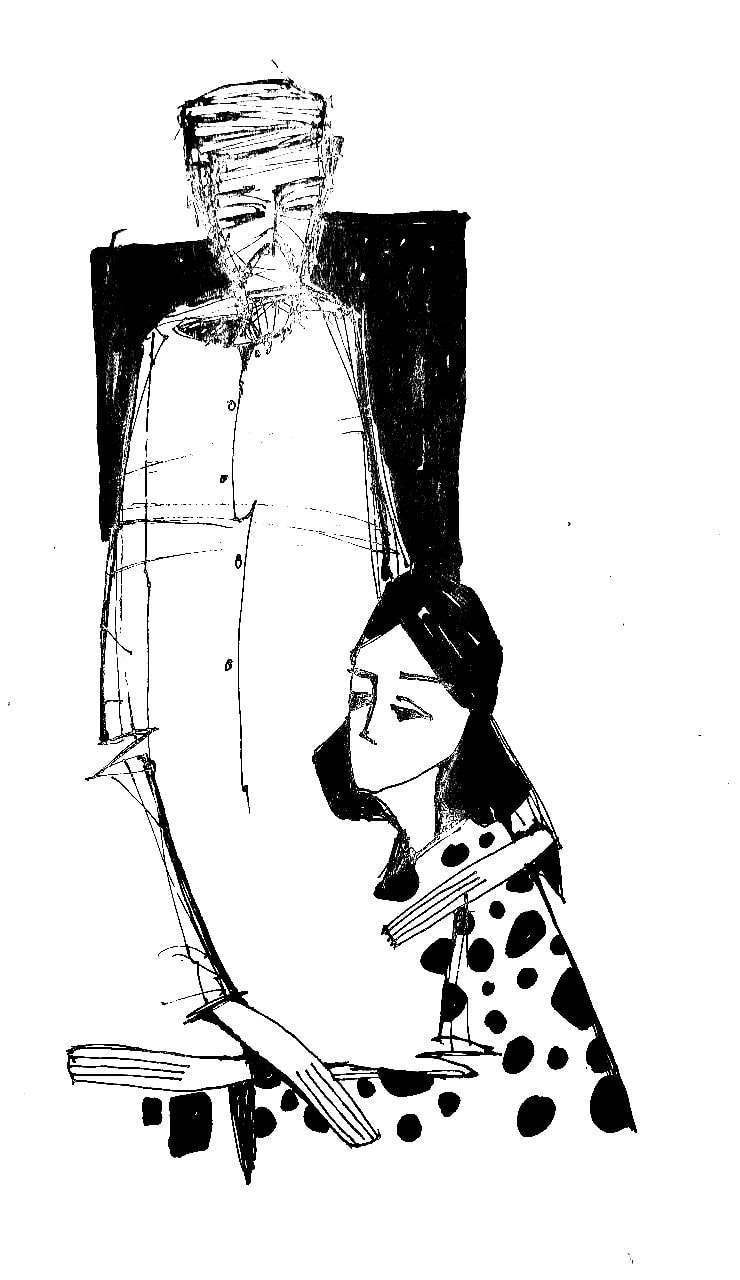
My father desperately wanted a son. Actually, he did have a son, my older brother, but unfortunately, he was disabled. So my father kept pressuring my mother to have another son. On the fifth attempt, my mother went to get an IUD inserted. She said angrily, "At 40, who can keep having children forever?" And so, his longing could never be fulfilled. In my father's eyes, we were just a bunch of useless ducks. He needed a son to carry on the family line. He needed a son so that when he went drinking, people wouldn't mock him, saying, "Have another child to get a son, so that when you die, there will be someone to offer incense." After every drinking session, he would come home and call each of us up to stand and listen to his insults, if my mother wasn't home. If my mother was, he would always bring up things from "eight or nine lifetimes ago" (as she often said) to pick a fight, and, as soon as my mother retorted, he would jump up and grab whatever he could find to hit her. "So if you want to argue, you should stand outside in the yard and yell at them. Why would you stand in front of them? They'll throw you to your death," my mother said.
I was afraid of my father. I was afraid of the beatings he gave us when we sneaked over to the neighbor's house (across a vast mangrove forest) to watch TV and came home late, or when we were too engrossed in playing and didn't sweep the house, or when we made a racket while he was sleeping. Later, I started to hate him. As I grew older, I both hated and resented him. This time, it wasn't because he beat me, but because I felt sorry for my mother. This happened decades ago, yet every time I think about it, it's still vividly clear. It was one night, when I was in second grade, my father came home drunk, argued with my mother, and she ran into the garden. He chased after her, grabbed a stick, and was determined to beat her. My older sister, terrified, carried my older brother and us to hide in the garden. The garden was pitch black, and mosquitoes bit our legs, making them itch. My younger sister had to comfort the youngest child to stop her from screaming and crying, threatening her: "If you cry, Dad will come and kill all of us!" And so she fell silent. We can still hear our father cursing inside the house, threatening, "If I find you all, I'll kill you all. Where are you hiding? Are you going to come out?"
I was scared. I don't know why I was scared this time, even though it wasn't the first time we'd had to sneak out to the garden. In my young mind, I sensed the seriousness of the situation, even though I didn't understand what was happening. My older sister said, "You guys sit here while I go find Mom." Hearing her name, we felt a little more at ease. Mom was our salvation. A little while later, Mom arrived, crying and muttering curses. Of course, she was cursing Dad. We all cried along with her, and my eldest brother groaned, his mouth wide open in frustration. Later, every time I saw him cry, I couldn't help but feel sorry for him; even he couldn't cry out loud.
Unfortunately, it started to drizzle again. We were both sleepy and in pain from mosquito bites, and we desperately wanted to go inside, but Mom said Dad would kill us all if we went in. I didn't understand why Dad was so angry this time; I only knew Mom had told us not to go inside. So where were we supposed to go? It was very late, and it was raining. Mom carried my older brother and urged us on:
- Let's go, let's sleep at Uncle Thanh's house.
Uncle Thanh was my father's cousin; his house was below the waterfall, about three kilometers from my house. In the darkness of the night, my mother and I trudged along. My mother carried my eldest son ahead to scout the way, my second sister carried my youngest child, and my third sister, me, and my fifth child followed in turn. We continued like that, and every now and then I would hear my mother's soft sob.
When we arrived at Uncle Thanh's house, we were all soaking wet. Uncle Thanh looked at us and understood what had happened without even asking. His wife rummaged through some clothes and urged us to change. I was exhausted and fell asleep. We stayed at Uncle Thanh's house the whole next day. We had the whole day off from school. That was great. We got to play with our two cousins and run around the garden picking cherries.
I don't remember how we got home afterward, or if my parents argued again. In my childhood memories, the scene just fast-forwards to that point and then cuts off. I only remember that, a few months later, my father borrowed a small amount of money from relatives and left home. My mother cried uncontrollably. I was too young to understand what was happening. My aunts and uncles gathered at the house, comforting my mother and telling her to rest assured, they would find my father and "drag him back." I didn't understand why my mother needed my aunts and uncles to find my father; wouldn't it be better if he wasn't there? No one to beat or scold him.
One evening, my mother whispered, weeping:
- I have to find a father for you because without one, people will laugh at you. I can endure hardship myself, but you must have both parents. You are daughters; when you get married later, who would want to marry someone without a father?
My older sister was furious:
- Mom, just let him go. I'll drop out of school and work as a factory worker to help you support my younger siblings.
At this point, my older sister was in 9th grade. She was two years behind in school. And, a new timber company had just opened in town, and people her age could get jobs there; many of her friends had dropped out of school to work. My mother cried even louder:
- My children, I beg you. My life has been so hard because I was illiterate. You must learn to read and write so you can work in an office and have a better life. It's so hard, my children.
My mother sobbed uncontrollably. She recounted the old story, how, because of extreme hunger, my parents had to leave their hometown and move south with the whole family. Because they had no son, my father became an alcoholic and beat my mother. She said women's lives are hard, and that we should study hard so we can have a better life later. My older sister cried. We all cried, including my eldest brother…
From then on, none of us wanted to drop out of school anymore. Every time I got bad grades and felt discouraged and wanted to quit, I remembered my mother's words: try hard to study well so that later I can get a job and earn money to support my mother and my brother. My mother instilled in our minds the desire to study to change our lives, helping us persevere in our studies and not quit to become factory workers like others.
My uncles brought my father back home. He drank alcohol again, got drunk, and cursed and beat his wife and children. My mother silently endured it, arguing with him less often. Sometimes she told us not to hate him, that it was because she couldn't give him a son that he went looking for another woman. She said if my older brother were healthy, he wouldn't be so depressed, drinking and beating his wife and children like this. My mother would hug my older brother and cry. He would open his mouth wide, his face contorted, wanting to cry out loud but unable to, just groaning and whimpering.
We grew up on potatoes and corn grown by our mother, wild greens from the garden, crabs and snails that my sisters and I foraged in the rice fields, and clams and mussels that we gathered in the streams. Our mother diligently worked as a hired laborer, then rented land to grow cassava and corn. We spent half the day at school and the other half helping our mother with her work. During the summer, my two older sisters helped her weed fields for hire, earning a little money for school fees. Whenever the corn was harvested or the cassava plants were dug up, my sisters and I would go with our mother to glean. We'd go to school in the morning, glean cassava in the afternoon, and in the evenings, we'd help our mother peel and chop cassava by the oil lamp to dry the next morning… And so we grew up, each of us taking university entrance exams, moving to the city, and leaving home.
I remember when I was taking my university entrance exams, my mother said she'd borrow some money from my uncles and aunts for me to study. I told her not to, that I'd study on my own, and whatever I got on the exam would be fine. I didn't have high hopes for university. My two older sisters had failed the exams for two consecutive years and had to go to college instead. My mother said it didn't matter what I studied, as long as I could get a job later and avoid hardship. She could borrow money, she could manage, as long as I studied hard. But I couldn't bear to see her borrowing money back and forth, I didn't want to see her being insulted with comments like, "She'll get married eventually, why make her study so much? She should quit and work as a factory worker," or "We're poor, why send her to such a high school?" I taught myself, driven by a burning desire to leave this house, to go to the city, and to have a brighter future.
That year I got into university. I got accepted into my first-choice school. The day I left home for the city, I felt neither regret nor fear; instead, I felt happy. Finally, I was free from that house, free from my father…
I felt like a young bird, thrilled to spread its wings and fly into the vast sky for the first time. I studied diligently, my shyness preventing me from actively seeking part-time jobs like my classmates. I just focused on studying and carefully managed the meager amount of money my mother sent me each month, subsisting on instant noodles when I needed to buy books and supplies. Some months, I ate instant noodles for the entire month because I had to buy textbooks. But I still felt happy, happy because I no longer had to listen to my father's insults. Happy because I didn't have to witness my parents arguing and fighting. Little did I know how hard my mother had to work, how much she had to borrow and run around borrowing money to send me those few hundred thousand dong each month. "Raising five children studying in the city, do you think that's a joke?" she would often say later.
From then on, the distance between me and my father grew wider. I went to school and then worked in the city, refusing to return home. Even though my mother told me to come home to work closer to home, and that my father was doing better these days, alas, no bird that flies away from its nest wants to return to its old nest, Mom. They only want to build a new nest for themselves, a nest called freedom. I stubbornly stayed in the city, then got married and followed my husband back to his hometown. In my mind, I never wanted to live near my parents. Even though their hair had turned white. Even though my parents said that since all their children had married far away, the two of them would be lonely. Even though my mother said that if life with my husband's family was so hard, she would give us land to build our own house… I still stubbornly refused everything. I didn't want to go home, I didn't want to be near my father. In my mind, there was a vast sky between my father and me. My husband told me not to hate Dad so much, that he felt sorry for him because he was neglected and shunned by his wife and children, and that he must be very lonely. I listened to him but dismissed his words, thinking that the outcome was my father's fault, not ours. So, for over a decade of marriage, I didn't speak to my father, even though I did go home for Tet (Lunar New Year), but only to greet him.
Sometimes, I wonder what would happen if my father were sick now? How would I react? I can't find the answer. My heart is filled with resentment. Then I push that question away; my father is still very healthy. At seventy, he can still push a wheelbarrow to help my mother fertilize the rambutan trees. My mother says he's never taken a single pill in his life, unlike her who is constantly ill.
Dad is still very healthy, Mom says.
I think Dad is still very healthy.
Everyone thought my father was still very healthy, as he would ride his bicycle around the village every day…
Suddenly, my older sister called to tell me Dad had cancer. Lung cancer, and he was hospitalized for treatment. That oncology hospital was nothing new; they only admitted him when the disease was very serious. I was stunned. I took a bus to the city in the middle of the night.
My father lay in bed, frail and weak. Tears streamed down my face as I choked out, asking him if he was alright. He turned to look at me, called my name, and told me to rest, that he was fine. In front of us, he always said he was fine. When the pain was too much, I heard him groan softly. My older sister told me to massage him every few hours; he was in pain but didn't dare ask for help for fear of bothering his children. All the old resentments suddenly vanished. I regretted not caring for him more over the years. My aunt from the North also flew in to visit my brother; now it was just the two of us. My father was overjoyed to see her, sitting up and talking animatedly as if he were only pretending to be sick. One day, I secretly listened to what my father and aunt were talking about. I heard him sobbing softly, worried that no one would take care of my older brother after he died, since they were all girls. I clearly heard him say, "My life has been full of failures, sister," and then he cried like a child. My aunt cried. I cried too. A vague sense of fear enveloped us. Last night, the man in the bed next to my father was discharged from the hospital; I heard he died halfway there…
My father was only hospitalized for a week before he passed away. He had terminal cancer that had metastasized to his brain. That's clearly stated in his medical records.
I still can't believe it's true. It happened faster than a dream. Only now do I realize the suffering my father silently endured. "Your life is nothing but failure." My father's words keep haunting me. Yet for so many years I couldn't understand his pain, only resentment.
Only now do I understand that in life, not everything is rigidly right or wrong, black or white. The most important thing is love.
Only now do I understand that happiness is like sunshine; it seems so far away, yet it's so close—you can see it, but you can't hold it in your hand.
But what difference does it make if I understand? My father is gone…
Source: https://baobinhthuan.com.vn/nang-trong-long-tay-128579.html


![[Image] Ho Chi Minh City: Ma Lang area, Chicken-Rice Market about to change its appearance](https://vphoto.vietnam.vn/thumb/1200x675/vietnam/resource/IMAGE/2026/06/25/1782377698627_ndo_br_m1-jpg.webp)
![[Image] Schools organize meetings and introduce teaching models to students admitted to grade 10.](https://vphoto.vietnam.vn/thumb/1200x675/vietnam/resource/IMAGE/2026/06/25/1782368077271_ndo_br_z7970052192242-1ec8daeb77a6eed1a4e9f58c564ddd3e-jpg.webp)

![[Photo] General Secretary and President To Lam receives Palestinian Ambassador Saadi Salama](https://vphoto.vietnam.vn/thumb/1200x675/vietnam/resource/IMAGE/2026/06/25/1782365384740_a1-bnd-9423-8322-jpg.webp)






![[Video] Weather forecast for tonight and tomorrow, June 26, 2026: Northern Vietnam to end heatwave from tomorrow, Central Vietnam to continue experiencing a heatwave.](https://vphoto.vietnam.vn/thumb/402x226/vietnam/resource/IMAGE/2026/06/25/1782392692278_thumb-dem-png.webp)