

 |
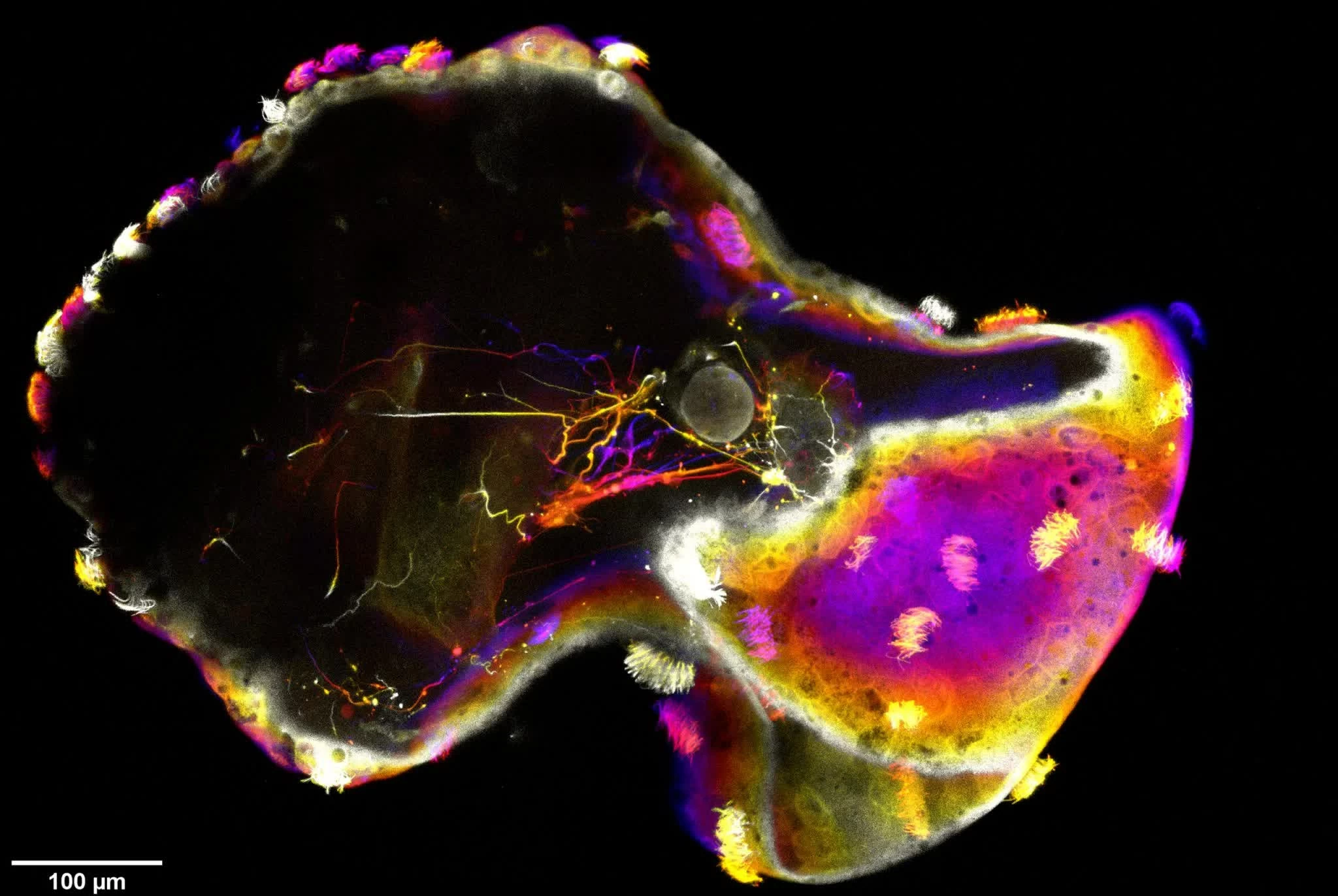
| The stained neurobot model shows ciliated cells around the perimeter and nerve fibers in the center. (Source: Advanced Science) |
New research published in the German journal Advanced Science shows that scientists are taking another step in understanding how biology creates functional living structures. The focus of the research is neurobots, microscopic bio-robots made from frog cells and incorporating neurons. These are developed from xenobots, a previous version of bio-robots that lacked neural components.
Accordingly, in 2020, researchers at Tufts University (USA) created xenobots using frog cells. These are microscopic living structures that can move in water, self-repair, and even assemble individual cells to form new xenobots. Building on that foundation, the research team at Tufts University and the Wyss Institute (USA) continued to experiment with introducing neurons into these structures to see what would happen. The new version is called a neurobot.
The research team said this is part of a larger effort to understand how groups of cells can self-organize into complex structures under unfavorable conditions. The insights gained could be useful in synthetic biology and regenerative medicine.
To create the xenobots, scientists used cells taken from the early embryos of the African clawed frog Xenopus laevis. When the skin precursor cells were separated and placed in a culture dish, they spontaneously assembled into small, round, hairy structures that could swim in water. These structures are entirely bio-derived, requiring no scaffold or genetic modification, can self-heal, and can survive for about 9 to 10 days thanks to the nutrients stored in the original embryonic cells.
With neurobots, the research team implanted clusters of neural progenitor cells into the center of the biobots as they were forming. These cells then matured, developing axons and dendrites. Microscopic observation revealed that the neurobots had formed key features of a natural nervous system. The researchers also confirmed that these cells could function within simple neural networks.
Compared to biobots without neurons, neurobots are typically larger and more elongated, exhibiting more complex movement patterns. When exposed to a drug that affects brain activity, neurobots also change their movements differently from typical biobots. This suggests that the newly formed neural network not only exists structurally but also directly participates in shaping behavior.
Another noteworthy finding was the unexpected gene activity within the neurobot, including genes related to visual processing and light-sensitive cells. From this, scientists are raising the possibility that neurobots could later react to light. Although still in its early stages, this research is gradually exploring how living cells can organize themselves into functional structures, opening up new avenues in biotechnology.
Source: https://baoquocte.vn/neurobot-va-buoc-tien-moi-cua-sinh-hoc-tu-to-chuc-385273.html



![[Photo] General Secretary and President To Lam presides over a meeting on preparations for the review of one year of operation of the three-tiered government system.](https://vphoto.vietnam.vn/thumb/1200x675/vietnam/resource/IMAGE/2026/06/02/1780391821195_a1-bnd-4595-9717-jpg.webp)





























































































Comment (0)