

 |
Hunt for cheap capital from trading flows.
Following the direction of the State Bank of Vietnam, credit institutions continue to improve the quality of payment services to attract idle capital at low costs, striving to contribute to lowering market interest rates to support people and businesses.
Techcombank continues to expand its "Automatic Profit Generation" model across its payment account system. Under this mechanism, idle funds in customers' accounts are automatically optimized for yield while ensuring continuous spending, transfers, and payments 24/7. A notable aspect of this initiative is the bank's focus on maintaining a continuous flow of funds within the digital ecosystem, rather than clearly separating payment accounts from savings accounts as before. According to Techcombank's announcement, over 5 million customers are currently using this solution. As of the end of Q1 2026, the bank's current account balance (CASA) reached approximately VND 246,900 billion.
Similarly, MB is also strongly developing a large-scale digital transaction ecosystem to maintain a consistent cash flow for both individual and corporate customers. In addition to retail digital banking applications, MB is expanding its platforms to include payroll, QR payments, collection and disbursement services, corporate financial management, and supply chain financing. According to statistics, MB currently serves approximately 34 million customers, with a CASA ratio of around 36-37%, among the highest in the system. This demonstrates that the bank's advantage lies not only in its customer base but also in its ability to maintain transaction frequency and a consistent cash flow.
Among large-scale banks, VietinBank has recently been promoting its transactional banking model for businesses through the eFAST platform. This system integrates accounting, cash flow management, internal approvals, supplier payments, tax payments, and foreign exchange transactions on a single platform. As of Q1/2026, more than 148,000 businesses were using VietinBank eFAST, an increase of approximately 24.4%; the rate of business transactions via digital channels reached approximately 95.3%. The bank's CASA reached approximately VND 395,000 billion, an increase of 24.7% compared to the same period.
Meanwhile, Vietcombank is expanding its non-term deposit mobilization by improving service quality within its co-branded experiential ecosystems. Through its partnership program with "Haha's Cafe," transactions on VCB Digibank, balance maintenance, and savings deposits are linked to real-world cultural and entertainment activities. This is considered a form of "soft mobilization," where the bank increases customer presence within the digital ecosystem through experiences rather than just financial products.
Multi-channel, multi-utility
According to SSI Research, customer funds are currently shifting constantly between banks, securities, open-ended funds, e-wallets, and digital investment platforms. Aggregate data from 27 listed banks shows that the average CASA ratio has decreased from approximately 15.18% at the end of 2025 to approximately 13.77% at the end of Q1/2026, with most banks recording a decline in CASA.
According to experts at SSI Research, while CASA (Current Account Savings Account) previously came primarily from basic payment accounts and money transfer services, many banks have now shifted to corporate cash flow management platforms, interest-bearing payment accounts, and digital payment ecosystems to maintain a more stable source of low-cost funding. The group of banks maintaining high CASA levels are mainly those with well-developed transaction and payment ecosystems.
Dr. Phan The Nhat, Director of PTT Financial Investment Joint Stock Company (Ho Chi Minh City), believes that transactional banking is no longer just a simple payment service but is gradually becoming the capital foundation for many banks. According to him, maintaining a regular payment cash flow not only helps improve CASA (Current Account Savings Account) but also creates conditions for banks to expand value-added services such as international payments, foreign exchange, asset management, insurance, and investment.
"While cash flow management platforms previously primarily served large enterprises or FDI companies, from 2025 onwards, many banks have expanded their services to include small and medium-sized enterprises, household businesses, retail units, and e-commerce businesses," Mr. Nhat noted.
 |
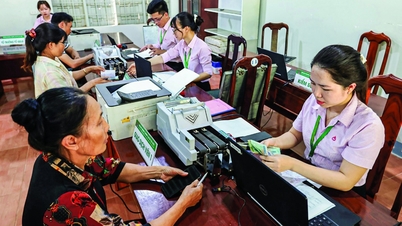
| Large commercial banks offer many services that give them an advantage in attracting demand deposits. |
With the development of open banking, API banking connectivity, and integrated financial ecosystems, many banks have gradually shifted from the traditional "receiving deposits - lending" model to developing operations on digital financial platforms, where payments, savings, investments, and transaction data are connected within a single ecosystem.
From the beginning of 2026 until now, the State Bank of Vietnam has continued to maintain the policy interest rates to facilitate credit institutions' access to capital at low costs, thereby providing a basis for supporting the economy. In particular, the State Bank of Vietnam has aggressively implemented measures to stabilize market interest rates to support businesses and individuals.
To facilitate market support, in mid-May 2026, Circular 08/2026/TT-NHNN allowed 20% of the State Treasury's time deposits to be included in the deposits of domestic and foreign organizations when calculating certain safety ratios. In the past, the State Treasury's funds were mainly deposited through state-owned commercial banks. These banks, with their large deposit and loan ratios within the system, better ensured the provision of low-cost financial support for the economy's production and business activities.
Source: https://thoibaonganhang.vn/ngan-hang-phat-trien-he-sinh-thai-thu-hut-tien-gui-182574.html
![[Photo] The heat at the fireworks display site on the opening night of the Da Nang International Fireworks Festival 2026](https://vphoto.vietnam.vn/thumb/1200x675/vietnam/resource/IMAGE/2026/05/27/1779889741485_ndo_br_z7872039145157-fecaba5112f39e8352544099d7ef4738-5140-jpg.webp)


![[Photo] The courage of new recruits of Brigade 144 on the training ground.](https://vphoto.vietnam.vn/thumb/1200x675/vietnam/resource/IMAGE/2026/05/27/1779881651341_anh-man-hinh-2026-05-27-luc-18-32-52.png)


















































![[Photo] The courage of new recruits of Brigade 144 on the training ground.](https://vphoto.vietnam.vn/thumb/402x226/vietnam/resource/IMAGE/2026/05/27/1779881651341_anh-man-hinh-2026-05-27-luc-18-32-52.png)
























Comment (0)