Although export and business results in the first half of 2026 showed many positive signs, the textile and garment industry faces many challenges in the remainder of the year. Pressure from weakening consumer demand, global inflation, and escalating container shipping costs are forcing businesses to proactively manage risks rigorously to secure orders and aim for an annual export target of $48-49 billion.
Textile and garment exports in the first five months of 2026 reached US$18.8 billion, an increase of 5.6% – an impressive result amidst a gloomy global market. However, behind these optimistic figures lies a real concern for businesses: orders in the fourth quarter are almost non-existent, transportation costs have skyrocketed by 30-40%, and competition is becoming increasingly fierce.
According to Mr. Cao Huu Hieu, General Director of Vietnam Textile and Garment Group (Vinatex), this result was achieved thanks to businesses proactively and effectively taking advantage of the "window of opportunity" when the US court rejected President Donald Trump's retaliatory tariffs, replacing them with a temporary 10% tariff applied until July 24, 2026. The companies accelerated production, boosted deliveries, and optimized order schedules to maximize the favorable tariff period.
However, this growth rate is showing signs of slowing down in the second quarter, especially in May and June, under pressure from new technical barriers and rising production costs. Commenting on the current market situation, economic experts point out that inflation in key textile and garment consuming markets such as the US, EU, China, Japan, and South Korea are all trending upwards compared to the same period last year.
Analyzing the industry's cyclical fluctuations in depth, Dr. Le Tien Truong, Chairman of the Board of Directors of Vietnam Textile and Garment Group (Vinatex), issued a highly predictive warning, noting that the second half of 2026 shares many similarities with the scenario of 2022. At that time, the textile and garment industry experienced relatively favorable growth in the first six months, but the market declined extremely rapidly in the last two quarters due to weak import demand and geopolitical conflicts.
Mr. Truong emphasized that, due to the inherent uncertainty of this period, even current orders that have been finalized by partners until the end of the third quarter cannot be considered as certain as in previous years.



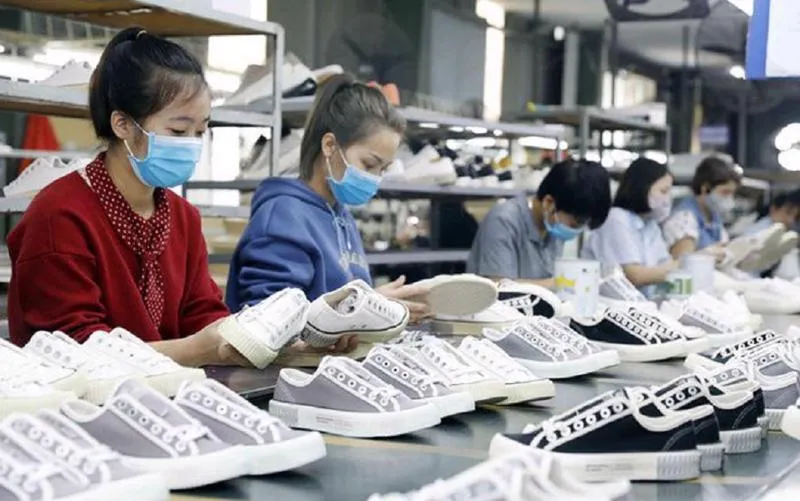
The biggest pressure on the textile and garment industry today remains the decline in global consumer demand - Photo: Government Newspaper
Sharing the same view on the difficulties in the final stages, Mr. Cao Huu Hieu further analyzed that the biggest pressure on the textile and garment industry today is still the decline in global consumer demand, requiring member units to prepare response scenarios early and in advance.
Mr. Hieu noted that businesses need to pay special attention to financial management and cash flow in the context of tightening liquidity in the banking system. Proactively reviewing and minimizing non-essential operating costs and optimizing inventory levels will be key solutions to maintaining stable cash flow for continuous production.
Faced with these systemic challenges, the Vietnam Textile and Garment Association (VITAS) has identified the core solution for businesses at this time as establishing the capacity to manage sudden market changes. Instead of competing purely on price, businesses need to focus on increasing non-price competitiveness by strongly shifting to higher-intellectual-content production methods such as FOB and ODM.
In terms of long-term strategy, Vinatex has determined that it will not pursue mere scale growth but will focus on improving efficiency in depth. The Group is accelerating the development of a green, smart, and circular production ecosystem, implementing carbon footprint measurement, investing in rooftop solar power, and applying automation in production. Member units such as Hoa Tho, Hue Textile and Garment, and Phong Phu are gradually building smart factory models, meeting the ESG standards of global brands – considered a foundation for sustainable growth in the 2026-2030 period.
Leading companies such as May 10 Corporation and Viet Tien Garment Corporation are also accelerating the application of smart factory solutions, integrating artificial intelligence (AI) into supply chain management to optimize operating costs and flexibly switch production lines to meet small-scale orders requiring ultra-short lead times from European and American partners.



On the other hand, to address the crucial challenges of cash flow and input costs, textile and garment businesses are implementing comprehensive and rigorous financial risk management solutions. According to industry experts, garment businesses need to accurately determine their maximum tolerance threshold and optimal operating limits in adverse scenarios. Business management must clearly define critical decision points: when to continue production despite declining efficiency to retain the workforce, and when to proactively scale back or temporarily suspend operations to preserve capital.
Simultaneously, export units are actively developing financial balancing plans, maintaining a suitable and stable source of foreign currency to proactively respond to exchange rate pressures and promptly meet the capital needs for purchasing raw materials and components for production from now until the end of the year.
Source: https://vtv.vn/nganh-det-may-vuot-thach-thuc-nua-cuoi-nam-100260621140531762.htm


![[Photo] Prime Minister Le Minh Hung presides over the thematic session on promoting science and technology development and innovation.](https://vphoto.vietnam.vn/thumb/1200x675/vietnam/resource/IMAGE/2026/06/23/1782207872934_ndo_br_dsc-1724-jpg.webp)