

Upon arriving at the entrance to Dao Thuc village, the clicking sounds of chisels and the clanging of wood against each other emanated from the small houses, like a welcoming greeting to visitors from afar. In a corner of the courtyard, filled with the scent of fresh wood, artisan Nguyen Van Phi, who has spent decades crafting traditional water puppets, was meticulously finishing the face of a new puppet. For Mr. Phi, water puppets are not just "wooden figures that dance under the lights of a water pavilion," but an integral part of the village's cultural soul, of the Vietnamese people, and of 300 years of folk art.
The art of water puppetry in Dao Thuc dates back to the 17th century, passed down by its founder, Dao Dang Khiem. After many ups and downs, there was a time when the puppetry troupe seemed on the verge of disappearing. Then, in the 1970s and 1980s, the villagers came together to revive it, preserving a part of their homeland's heritage.
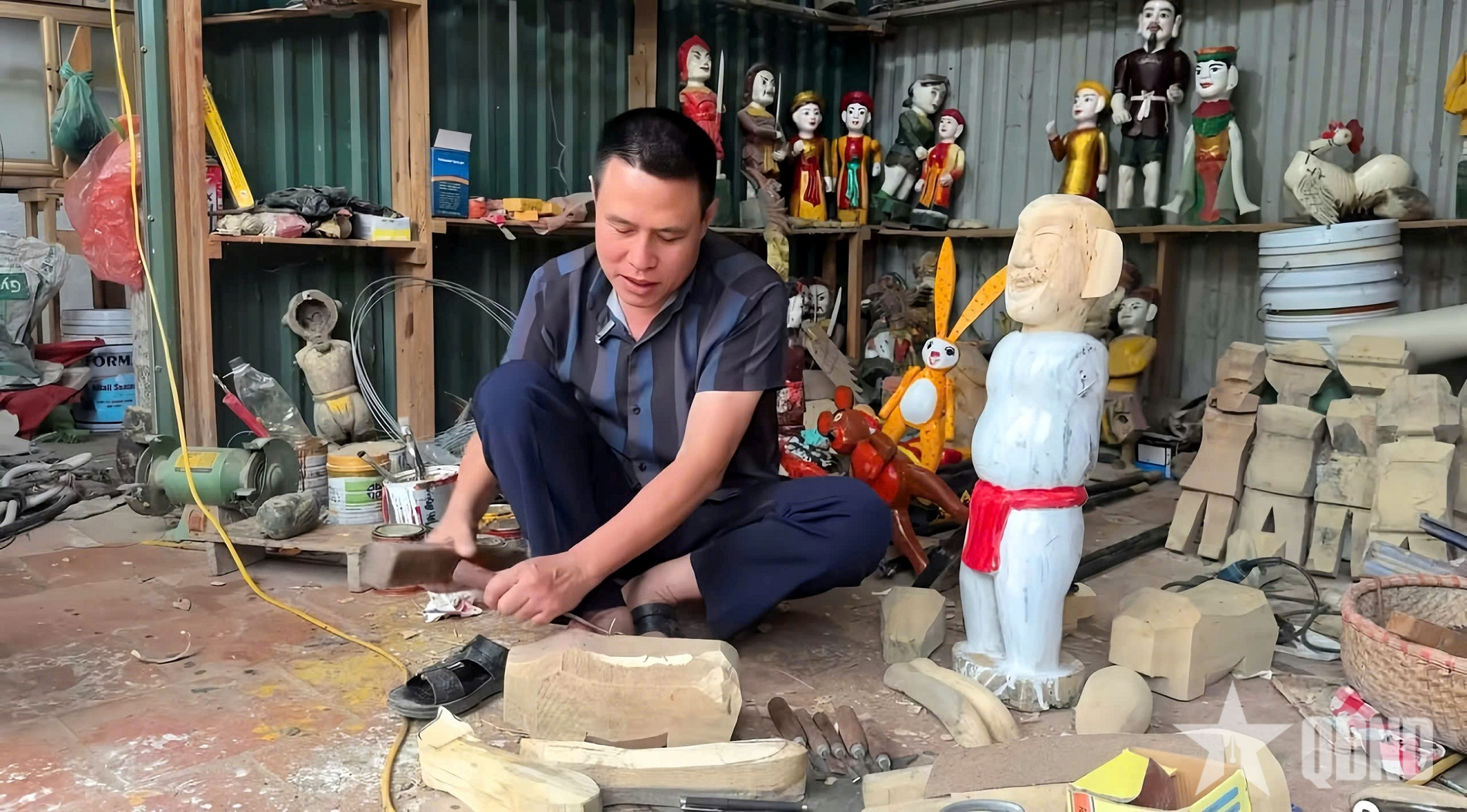 |
Artisans from Dao Thuc village create water puppets. |
In his woodworking workshop, Mr. Phi recounted the most difficult stage: "Making puppets involves many steps, but the hardest part is creating a soul for the character. The puppet must embody the folk traditions of the past, but still move rhythmically so that the artist can perform with agility and grace."
The craftsman must be both a carpenter and an artist. A complete puppet goes through dozens of steps: selecting smooth wood, hollowing out the inside to reduce weight, carving the shape, drying, applying multiple layers of paint, then attaching the strings and installing the control mechanism on the back.
The technique of creating a puppet focuses not only on the shaping but also, and especially, on the type of wood used to make the characters in the water puppet show. Analyzing the materials used in handcrafted puppet making at Dao Thuc, Mr. Phi said: The low water absorption rate of fig wood makes the puppets lighter and easier to manipulate, which is why artisans have used fig wood since ancient times. Besides meeting quality requirements, fig wood also symbolizes prosperity and belief in a comfortable and fulfilling life in the craft.
For artisan Dao Thuc, crafting wooden puppets is not just about carving the shape of a character. More importantly, it's about infusing artistic soul into every facial expression, posture, and gesture of the puppet. To achieve this, the craftsman must not only be skilled but also deeply understand the roots of folk culture, the story, and the spirit of each play. Every carving, every layer of paint must reflect the simplicity, sincerity, and intelligence of the past. Only when the puppet embodies the spirit of folk art can it truly "come alive" on the water, convey emotions to the audience, and preserve the full value of a heritage passed down through generations.
The puppet-making craft of Dao Thuc village has continued the cultural flow for over three hundred years. In each workshop, the sounds of chiseling and carving still resonate regularly, like the rhythm of the village's life. From the skillful hands of the artisans, lifeless blocks of fig wood are brought to life, becoming characters that can laugh, dance, and tell stories. And it is this perseverance that has kept Dao Thuc as one of the important cradles of folk water puppetry. So today, whenever the drums of the water pavilion sound, people see that in Dao Thuc, the craft still exists, the spirit of the craft still lives on, and the love for water puppetry still burns brightly in every home and in the hearts of the people in this ancient village.
Source: https://www.qdnd.vn/van-hoa/doi-song/nghe-nhan-thoi-hon-vao-tung-khuc-go-vo-tri-1017871


![[Photo] Prime Minister Pham Minh Chinh attends the Conference on the Implementation of Tasks for 2026 of the Industry and Trade Sector](/_next/image?url=https%3A%2F%2Fvphoto.vietnam.vn%2Fthumb%2F1200x675%2Fvietnam%2Fresource%2FIMAGE%2F2025%2F12%2F19%2F1766159500458_ndo_br_shared31-jpg.webp&w=3840&q=75)



























































Comment (0)