

1.
Eighty years after the August Revolution of 1945, our country is talking a lot about a new era, an era of national resurgence. For me personally, throughout the long history of the Ho Chi Minh era, we have only had one era: Independence - Freedom - Happiness.
Beginning 80 years ago, immediately after gaining independence, the Vietnamese people embarked on the task of building the Democratic Republic of Vietnam, ending thousands of years of feudal rule and hundreds of years of colonial domination, thus opening a historical turning point and leading Vietnam and the Vietnamese people into a new chapter in their history.
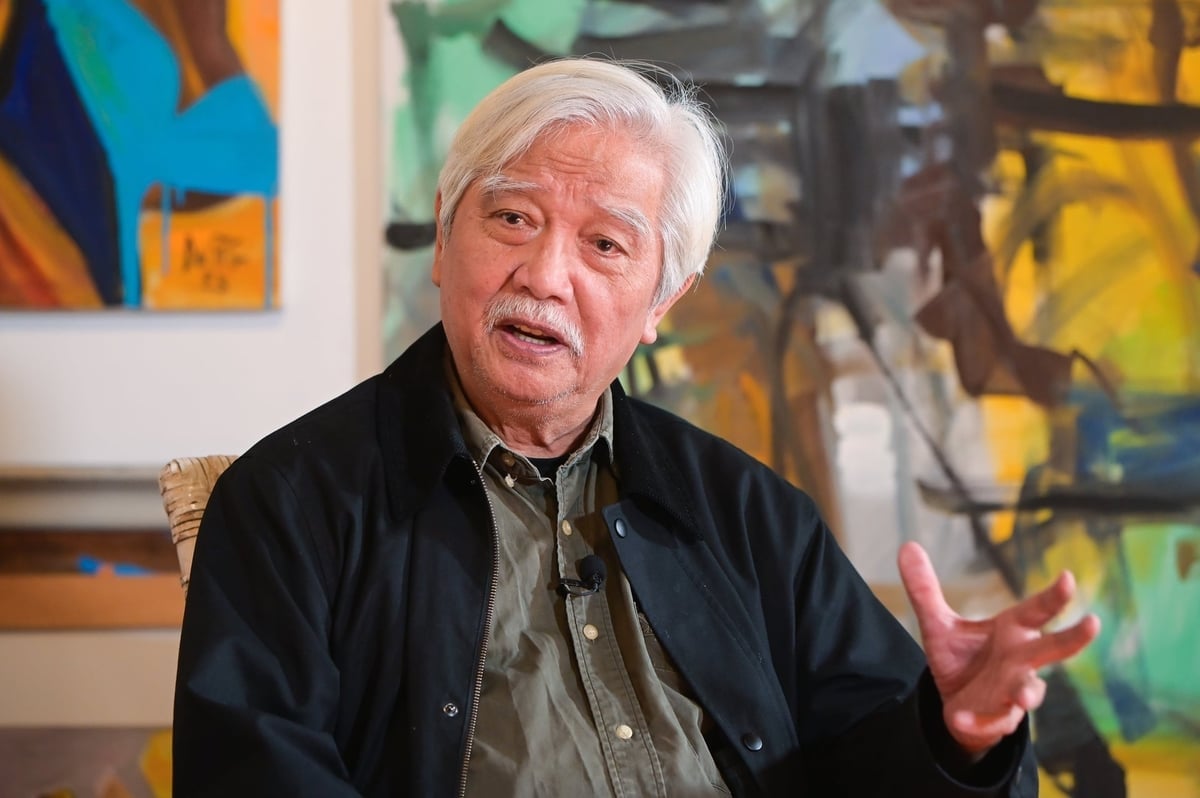
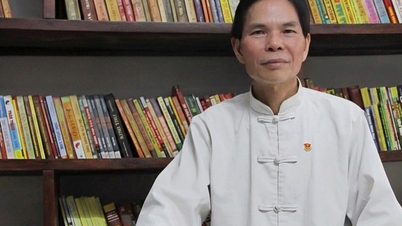
Historian Duong Trung Quoc. Photo: Tung Dinh.
So, faced with that historical turning point, how did the Central Committee of the Party and President Ho Chi Minh consider and address the issue of Vietnam's national development?
Perhaps we need to look back at the context of our country at that time. After gaining independence, the young Democratic Republic of Vietnam simultaneously faced famine, illiteracy, and foreign invasion. The situation, with internal enemies and external threats, was extremely dire, demanding historic decisions. And President Ho Chi Minh demonstrated his exceptional stature and intellect by choosing to eliminate famine first, with the belief that "the foundation of humankind is food first."
To prioritize food, one must first establish agriculture as the foundation. At the beginning of the new era, President Ho Chi Minh's thought was consistent and unwavering: all policies of the Provisional Government of Vietnam focused on prioritizing agriculture , putting the interests of farmers first. Even though agriculture was still backward and farmers were still poor, President Ho Chi Minh believed that for sustainable development, both in the short and long term, "if our farmers are prosperous, our country will be prosperous; if our agriculture thrives, our country will thrive."
Stemming from that ideology, the Ministry of Agriculture was established very early, just over two months after the nation's founding. On November 14, 1945, the Ministry of Agriculture was founded with two main tasks. Firstly, to implement a program of rapid agricultural production increase in Northern Vietnam and North Central Vietnam to partially alleviate the famine threatening the people. Secondly, to prepare a foundation for agricultural revitalization to pave the way for the development of a national agricultural economy in the future.
Almost immediately followed the launch of the newspaper "Tấc Đất" (December 4, 1945) - a newspaper named and introduced by President Ho Chi Minh. Engineer Hoang Van Duc, Director General of the Department of Agriculture under the Ministry of Agriculture, was appointed as the newspaper's first editor-in-chief. Before discussing other significant ideological issues, I would like to analyze the meaning of the two words "Tấc Đất" - a truly subtle and meaningful phrase.
The word "tấc" (a small, insignificant piece of land) easily evokes associations with small and fleeting things, but "tấc đất" (a piece of land) is compared to "tấc vàng" (a piece of gold), signifying growth and prosperity, or, in modern terms, the potential for high added value. More profoundly, a piece of land is the source of human life. For a nation like Vietnam, whose economy is based on agriculture, a piece of land is the fundamental means of survival and development.
Every inch of land is inextricably linked to the farmers, the largest and most influential force in the revolution and the country's development. Placing farmers at the center, caring for them and connecting them to every inch of land, is a brilliant achievement not only of President Ho Chi Minh but also a profound lesson for the Provisional Government.
The two words "An Inch of Land," which President Ho Chi Minh gave to the newspaper of the Ministry of Agriculture, not only had significance at that time but also carried lasting and enduring meaning, closely linked to the destiny of "agriculture as the foundation" of the Vietnamese nation and people.
Secondly, if we reread the articles by President Ho Chi Minh and many other articles in the first issue of the newspaper "Tac Dat" (published on December 7, 1945), we will see the significance of many lessons that remain relevant to this day.
Specifically, in his article "A Message to Vietnamese Farmers," President Ho Chi Minh expressed: "The proverb: 'An inch of land is worth an inch of gold' has two meanings today:
1 - The "Tấc Đất" newspaper will guide farmers on how to rapidly advance agriculture. The guidance from the "Tấc Đất" newspaper is as precious as gold.
2 - All humankind prioritizes food above all else. In our country, agriculture is the foundation. If people want to eat well, they must cultivate abundantly. If the nation wants to be rich and strong, it must develop agriculture. Therefore, we should not leave a single inch of land uncultivated. We must cherish every inch of land as if it were gold…”
In that same article, President Ho Chi Minh appealed to farmers: "Currently, we have two most important tasks: relieving famine in the North and fighting the resistance in the South," calling on farmers to: "Increase production! Increase production immediately! Increase production even more! That is our slogan today. That is our practical way to safeguard our freedom and independence."
Every time I reread this article by President Ho Chi Minh, I personally always think and wonder: in today's era, are our use of concepts and viewpoints such as "agriculture is a national advantage" merely a continuation of the viewpoint "agriculture is the foundation" or "if our agriculture prospers, our country prospers"? Similarly, is the idea "if our farmers are wealthy, our country will be wealthy," along with the letter to the business community, the core value of private and collective economic development...?
But one thing is certain: President Ho Chi Minh's ideology of "Every inch of land is worth its weight in gold" is fundamental and pervasive, igniting the revolutionary flame and helping our nation steadfastly overcome nine long and arduous years of resistance and 30 years of struggle for national independence and reunification.
That idea holds great significance in today's era, as we clearly see the value of agriculture, farmers, and rural areas in the country's development process. We see agriculture as an export sector that brings in the highest material wealth with a surplus value. We see that today's farmers seem to have bridged the gap with entrepreneurs, intellectuals, and scientists, integrating all of them, so that we can proudly say, "I am a Vietnamese farmer." We see that rural areas are not only a shelter for the nation against all circumstances but also the cradle of Vietnamese culture.
I believe that all those values have been inherited and developed from the original ideas in the newspaper "Tấc Đất" (A Piece of Land) 80 years ago. Looking back, we see that the two words "Tấc Đất," though small, carry the meaning of the origins and roots of the country, embodying the culture and strength of the Vietnamese people.
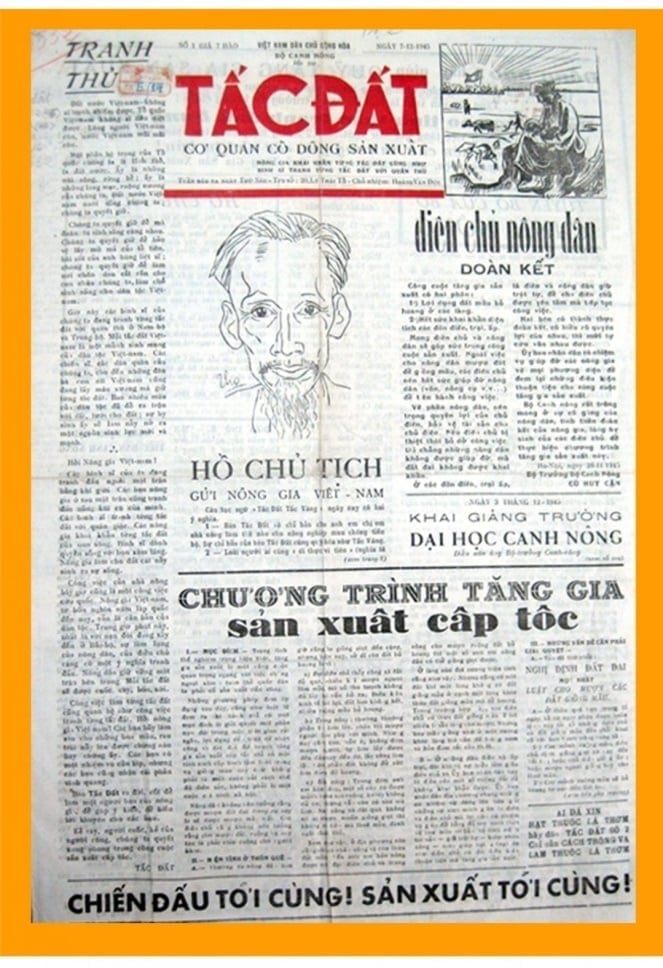
The newspaper Tấc Đất published its first issue on December 7, 1945. Photo: Archival material.
2.
Thinking about the 80th anniversary of the newspaper "Tấc Đất" - now the "Agriculture and Environment" newspaper - I am reminded of a generation of revolutionary intellectuals who also came from peasant backgrounds, were deeply connected to agriculture, and made enormous contributions to the national revolutionary cause. These included Minister of Agriculture Cù Huy Cận, Engineer Hoàng Văn Đức, Minister Nghiêm Xuân Yêm, Professor Bùi Huy Đáp, Engineer Nguyễn Xiển…
Remembering them means remembering the early days of nation-building, a precarious situation, like "an egg hanging on a stick," "a thread hanging by a bell," filled with countless hardships. These very people emerged; some contributed from the time the revolution was still in Tan Trao, others were directly entrusted with important responsibilities by President Ho Chi Minh, but all of them worked together to shoulder the burden and, to varying degrees, became iconic figures of the Ministry of Agriculture and the Tac Dat Newspaper.
I'm also wondering why Engineer Hoang Van Duc is mentioned less often compared to his contributions? But indeed, he made a great contribution to the country, to the Ministry of Agriculture and the Tac Dat Newspaper. Originally a member of the Hanoi intellectual delegation, in August 1945, Engineer Hoang Van Duc went to the Viet Bac War Zone to attend the Tan Trao Congress along with poet Cu Huy Can, lawyer Vu Dinh Hoe, doctor Nguyen Duong Hong… Afterwards, he returned to Hanoi and was appointed Director General of the Agricultural Administration of the Ministry of Agriculture. Before being elected to the National Assembly, Engineer Hoang Van Duc was the first editor-in-chief of the Tac Dat Newspaper.
Or other prominent figures in the field of agriculture, such as Minister Cu Huy Can, who requested President Ho Chi Minh to establish the newspaper "Tac Dat" (A Piece of Land). Professor Bui Huy Dap, an agricultural researcher and Secretary-General of the Ministry of Agriculture. In its early issues, "Tac Dat" called on the people to participate in the first general election in the country to elect a legitimate National Assembly. Voting was directed towards candidates such as: Hoang Van Duc, an agricultural engineer, running in Hanoi; Cu Huy Can, an agricultural engineer and Minister of Agriculture, running in Ha Dong; and Bui Huy Dap, an agricultural engineer, running in Nam Dinh. The slogan used by "Tac Dat" when voting for these three candidates was: "Choose those who protect the rights of farmers and serve agriculture."
Remembering the newspaper "Tac Dat" brings to mind Mr. Nghiem Xuan Yem and his articles encouraging production published in the Agricultural Journal; remembering Engineer Nguyen Xien and his achievements in building dikes to prevent floods and receiving the first commendation from the Democratic Republic of Vietnam. And many other intellectuals, people who were not only "children of the farmers," intellectuals born from the countryside who contributed to the work of the Ministry of Agriculture and the newspaper "Tac Dat," but also laid the foundation for creating values that are preserved and passed on to this day.
Eighty years of the newspaper "Tấc Đất" also marks eighty years of the country's new political system. I think that, once again, we need to pay special tribute to the generations of revolutionary intellectuals who have made immense contributions to the cause of agriculture.
Honoring the essence of concepts like "Agriculture is the foundation" or "Every inch of land is worth its weight in gold" in the spirit of today's era is also a way for us to thoroughly prepare ourselves to lead Vietnam and the Vietnamese people into a new stage of development.
The newspaper Tấc Đất was established by the Government on December 4, 1945, and was one of the first newspapers founded immediately after the country gained independence.
On December 7, 1945, the newspaper Tac Dat published its first issue and had the honor of having President Ho Chi Minh write an introductory article and assign its mission.
On March 1, 2025, the Agriculture and Environment Newspaper was established through the merger of the Vietnam Agriculture Newspaper and the Resources and Environment Newspaper. The founding date of the Tac Dat Newspaper (December 4, 1945) was chosen as the Traditional Day of the Agriculture and Environment Newspaper.
The ceremony honoring and expressing gratitude on the occasion of the 80th anniversary of the Agriculture and Environment Newspaper will take place at 5:30 PM on December 4, 2025 at the Hanoi Museum (Pham Hung Street, Hanoi).
Source: https://nongnghiepmoitruong.vn/nghi-ve-hai-chu-tac-dat-d785570.html
![[Photo] Hanoi is ready for the "National Festival"](https://vphoto.vietnam.vn/thumb/1200x675/vietnam/resource/IMAGE/2026/03/12/1773305846167_ndo_br_z7612336508628-14627dc7d18cc27532ffea5d4089713b-4105-jpg.webp)
![[Photo] Trial run of the election process at polling stations in Dong Da ward (Hanoi)](https://vphoto.vietnam.vn/thumb/1200x675/vietnam/resource/IMAGE/2026/03/12/1773306146728_ndo_br_van-hanh-thu-to-bau-cu-4070-755-jpg.webp)














































Comment (0)