
Going back in history, after King Le Thanh Tong's southern campaign in 1471, the village's founder chose the alluvial land at a bend in the river as a resting place, naming it Hoi Ky.

Since then, the village has always faced the water source as its lifeline, using the bamboo hedge as a fortress, and opening up herd-like pathways towards the fields behind as a solid rear base.

From the beginning, the twelve clans (12 families) of the village, such as Nguyen, Nguyen Van, Duong Quang, Duong Van, Tran, Ngo, Nguyen Duc, etc., worked together to clear land and choose agriculture as their livelihood.

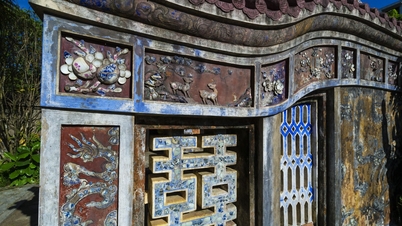
For over 500 years, Hoi Ky village has had a full range of cultural and religious institutions, including communal houses, temples, and ancestral churches, all facing the riverbank.

The village communal house is where villagers hold annual spring and autumn festivals, and where traditional culture is passed down through village customs and rituals.

In addition, ancestral temples are places where genealogical records, royal decrees, and ceremonial documents are preserved, and where the traditions and customs of the lineage are established.

In particular, within the village's landscape, the plot of land behind the residential area still contains the tomb of Lady Duong Thi Ngot - a talented and beautiful daughter of the village, a ninth-rank concubine - a consort of King Thanh Thai - the 10th king of the Nguyen dynasty.

Hoi Ky village is small and narrow, but hidden within that space is a picturesque landscape with a vast system of cultural heritage nurtured over many generations .
Heritage Magazine


![[Photo] Standing Committee member of the Party Central Committee Tran Cam Tu working with the Central Inspection Committee](https://vphoto.vietnam.vn/thumb/1200x675/vietnam/resource/IMAGE/2026/05/28/1779969579668_ndo_br_bnd-2495-jpg.webp)





































































Comment (0)