

Hanoi – A 40-year-old woman who works as a butcher and sells pork suddenly experienced subcutaneous bleeding in patches, and tests came back positive for Streptococcus suis bacteria.
On May 22nd, representatives from Military Hospital 103 reported that the patient had a history of severe joint pain in her hands and feet, as well as back pain, and had been taking traditional medicine and weight-loss drugs for about a month. Two days prior, she experienced fatigue, poor appetite, and persistent dull pain in her right flank, sometimes with sharp, cramping pain, which subsequently worsened.
Upon admission, she was in a state of shock, agitated, and restless, with jaundice of the skin and mucous membranes, subcutaneous hemorrhage in patches, rapid and shallow breathing, rapid pulse, irregular heartbeat, acute liver and kidney failure, and elevated signs of infection. The doctor assessed the patient as having septic shock and multiple organ failure, possibly due to drug poisoning (previous use of traditional medicine) or infection (epidemiological factors related to her work in slaughtering and selling pork), with a very high risk of death.
The patient received respiratory and circulatory resuscitation, continuous hemodialysis, and fluid and electrolyte replacement. During treatment, the doctor observed signs of bacterial infection with petechiae (small red spots) on the hands and feet, jaundice, and ordered a blood culture which tested positive for Streptococcus suis.
The patient underwent 7 consecutive dialysis sessions, received strong antibiotics, and received organ support. Gradually, the patient's condition improved, organ function returned to normal, and they were discharged after 28 days of treatment.
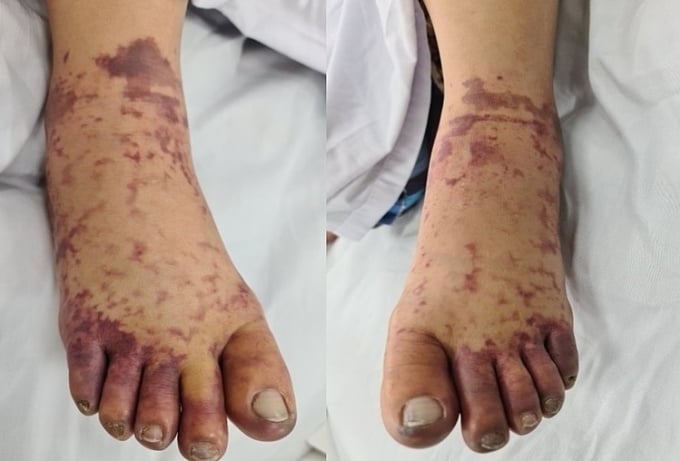
The patient's foot on the second day of hospitalization. Photo: Provided by the hospital .
According to the Department of Preventive Medicine ( Ministry of Health ), Streptococcus suis is a zoonotic disease, with no evidence of human-to-human transmission. Most patients are linked to slaughtering pigs, consuming raw blood dishes, or undercooked foods such as fermented pork sausage (nem chạo, nem chua). Some cases, even without consuming raw blood or slaughtering pigs, can result from eating contaminated meat or contact with skin lesions or abrasions during processing.
This disease progresses extremely rapidly, causing septic shock, coma, and multiple organ failure. Patients commonly experience three forms: sepsis, purulent meningitis, or a combination of both. The severity of the disease varies depending on the form, with some cases showing severe infection from the outset.
The incubation period can range from a few hours to 4-5 days, depending on the individual. Symptoms include fever (hot or cold), nausea, vomiting, and diarrhea (though not frequent), which can be easily mistaken for common digestive disorders or food poisoning. Patients may also experience headaches, tinnitus, deafness, stiff neck, impaired consciousness, and necrotic skin lesions due to septicemia or purulent meningitis caused by Streptococcus suis. Severe cases can lead to septic shock, circulatory collapse, hypothermia, hypotension, acute sepsis, severe coagulation disorders, respiratory failure, multiple organ failure, coma, and death.
Treatment involves antibiotics, combined with hemodialysis, and respiratory and circulatory support. The mortality rate from Streptococcus suis infection is approximately 7%. While patients survive, the rate of sequelae is also very high, around 40% (often irreversible deafness).
The bacteria that cause streptococcal infection in pigs are completely destroyed when food is thoroughly cooked. Therefore, to prevent the disease, sick or dead pigs should not be slaughtered, raw pork should not be handled with bare hands, especially if there are wounds on the hands, gloves should be worn when handling raw or undercooked pork; and hands should be washed thoroughly after processing meat.
Thuy Quynh
Source link
![[Photo] The courage of new recruits of Brigade 144 on the training ground.](https://vphoto.vietnam.vn/thumb/1200x675/vietnam/resource/IMAGE/2026/05/27/1779881651341_anh-man-hinh-2026-05-27-luc-18-32-52.png)
![[Photo] The heat at the fireworks display site on the opening night of the Da Nang International Fireworks Festival 2026](https://vphoto.vietnam.vn/thumb/1200x675/vietnam/resource/IMAGE/2026/05/27/1779889741485_ndo_br_z7872039145157-fecaba5112f39e8352544099d7ef4738-5140-jpg.webp)






















































![[Photo] The courage of new recruits of Brigade 144 on the training ground.](https://vphoto.vietnam.vn/thumb/402x226/vietnam/resource/IMAGE/2026/05/27/1779881651341_anh-man-hinh-2026-05-27-luc-18-32-52.png)

























Comment (0)