Billions of dong swept away in the night.
Along both banks of the Vu Gia River in Ha Nha commune ( Da Nang city), the traces of the historic floods at the end of October are still evident on every patch of land and tree trunk, clearly showing the devastating power that the natural disaster had just unleashed on this area. The once lush green rice fields now lie motionless under a thick layer of white sand.
Hundreds of hectares of farmland were eroded away by the floodwaters, leaving behind steep landslides along the riverbanks. On the banks, the muddy, silt-laden water swirled, and the bewildered eyes of the villagers gazed down at the fields they had been cultivating for so many years, now buried beneath the mud. Their gazes held a mixture of shock, worry, and sorrow at the immense loss.

The once fertile and lush fields along the Vu Gia River have been devastated after the historic flood. Photo: Lan Anh.
In the middle of a 5-acre pineapple field covered in thick sand, Mrs. Nguyen Thi Mien in Hoa Huu Tay village, Ha Nha commune, stood bewildered, her hands trembling as she brushed away the sand, searching for any remaining hope. In just over two months, the pineapple harvest – the most important crop of the year and the main source of income for her family during Tet (Lunar New Year) – would have been underway. However, the flood came too quickly; the rising, powerful current from upstream carried sand and gravel, burying the entire pineapple crop, which was in its prime.
“My family spent tens of millions of dong buying fertilizers and pesticides, and for almost a year we visited the plantation every day, tending to each fragrant plant. And now it’s all buried under this layer of sand,” Mrs. Mien said, her voice choked with emotion. Her reddened eyes seemed to darken against the cold white sand. What worried her most right now wasn’t just the money lost, but where she would find the manpower and resources to level the land, remove the sand, and rebuild for a new season.

Mrs. Nguyen Thi Mien's 5 sao (approximately 0.5 hectares) of fragrant pineapples were completely destroyed. Photo: Lan Anh.
Not far away, the damage was even more devastating. In just one night, more than 5 hectares of fruit orchards belonging to Ms. Vo Thi Hong's family, including 500 pomelo trees, 300 guava trees, 200 mango trees, and 30,000 pineapple plants, were swept away by floodwaters into the Vu Gia River. The trees, carefully nurtured since they were young and supposed to be bearing fruit this year, are now just bare remnants precariously perched on the edge of the riverbank. The estimated value of the damage is over 1 billion VND, not including all the hard work, sweat, and years of savings of the entire family.
“My family’s investment of over 1 billion dong is now completely lost. Our farmland is gone too. We spent years saving up to build all that, and now I just stand here, not knowing how I’ll feed my children…,” Mrs. Hong said with a heavy sigh. Her eyes followed each piece of land disappearing into the river, as if a part of her family’s life had been swept away by the flood.

You may also like

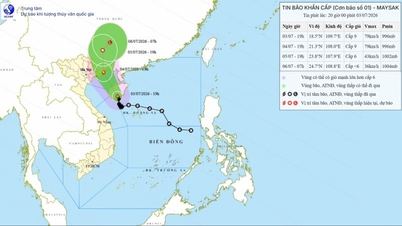
Responding to Typhoon No. 1: Inspecting infrastructure and residential areas before heavy rains.On the afternoon of July 3rd, the Tuyen Quang Provincial Meteorological and Hydrological Station reported that, due to the influence of the northwestern edge of the circulation of typhoon No. 1, followed by a weakened low-pressure area from the typhoon, from the afternoon of July 4th to July 6th, the province is likely to experience moderate to heavy rain, with some areas experiencing very heavy rain accompanied by thunderstorms, tornadoes, lightning, and strong gusts of wind. 
Assessment and Recognition of the Provincial Political School as Level 1- On the afternoon of July 3rd, the Deputy Secretary of the Provincial Party Committee and Chairman of the Provincial People's Council, Nguyen Duc Tuy, and the Deputy Director of the Ho Chi Minh National Political Academy, Hoang Phuc Lam, chaired a working session with the Quang Ngai Provincial Political School to survey and assess its performance as a basis for recognizing the Quang Ngai Provincial Political School as meeting Level 1 standards. The vegetable garden area belonging to Mr. Truong Cong Lac's family has been covered with sand. Photo: Lan Anh.
Along Hoa Huu Tay and Hoa Huu Dong villages, an entire area of fertile land that once sustained generations has slid down the Vu Gia River, leaving behind cold, desolate, and hopeless voids. Preliminary statistics show that over 10 hectares of crops in the village have been completely destroyed, 12 hectares of agricultural land have been completely eroded, and nearly 15 hectares remain buried under sand 50 cm to 1.5 m deep – a level of sedimentation sufficient to make immediate recovery difficult for any area.
Mr. Ngo Dinh Hoa, head of Hoa Huu Dong village, said that the 2026 winter-spring crop is approaching, but the damage this time is too severe. Farmers have lost land, production materials, and livelihoods as many cultivated areas have been eroded or deeply silted up. “If this is not addressed soon, the 2026 winter-spring crop will be ruined. People have lost their land and their seeds. We earnestly hope that the authorities will implement urgent policies to restore the land for the people,” Mr. Hoa said.
Urgent need for support with plant and animal breeds, and essential supplies.
According to the Da Nang Department of Agriculture and Environment, the heavy rains and floods from October 25th to November 3rd, combined with the impact of Typhoon Kalmaegi (Typhoon No. 13), caused the most severe damage to the city's agricultural sector in many years.
Across the area, 358 hectares of rice paddies, over 1,172 hectares of other crops, 745 hectares of perennial plants, 213 hectares of fruit trees, and tens of thousands of potted flowers and ornamental plants were damaged. Livestock also suffered significant losses, with over 2,500 head of cattle and nearly 286,000 poultry swept away or killed due to prolonged flooding. The floods also destroyed 119 hectares of fish ponds and 26 hectares of shrimp ponds, completely washing them away.

The farming area of farmers in Ha Nha commune has suffered serious landslides. Photo: Lan Anh.
Immediately after the floodwaters receded, the city's agricultural sector urgently implemented numerous measures: environmental remediation, disinfection of livestock facilities, disease control, restoration of cultivated land, and clearing of irrigation canals. In addition, nearly 40 technical training courses were continuously organized to help farmers understand solutions for restoring production after the floods. The Department of Agriculture and Environment also sent a document requesting localities to compile detailed statistics on the damage to serve as a basis for submitting to the City People's Committee for allocation of support funds.
According to Ms. Ngo Thi Thu Van, Deputy Director of the Da Nang Agricultural Extension Center, in a short period of time, nearly 40 training courses have been organized, helping farmers access solutions to restore production in three areas: crop cultivation, livestock farming, and aquaculture. Information dissemination on weather warnings and disease prevention after the floods has been intensified to help people be more proactive when returning to production.

Experts from the Institute of Vegetable and Fruit Research ( Ministry of Agriculture and Environment ) guide residents of Huong Tra ward on how to care for crops damaged by waterlogging after prolonged rain. Photo: Lan Anh.
“The biggest challenge right now is how to resume production while ensuring disease safety. The land has been heavily silted up, making environmental remediation more complicated. In livestock farming, the previously reported African swine fever outbreak remains a potential threat, hindering restocking efforts. Farmers want clearer guidance on how to handle the disease before restocking, so they can confidently restore production,” Ms. Van shared.

Strengthening the friendship between Vietnam and the United States.On July 3rd, as part of the Pacific Partnership - Friends of the Pacific 2026 program, the U.S. Army Pacific delegation, led by Lieutenant General Joel Vowell, Deputy Commander of the U.S. Army Pacific, paid a courtesy visit to the Quang Tri Provincial Military Command. Currently, the local budget is limited, while the extent of the damage is immense, making the need to support farmers in restoring production extremely urgent. The city has requested the central government to promptly review and supplement post-disaster support policies, tailored to the specific conditions of Da Nang – a locality frequently affected by flash floods, deep flooding, and landslides due to its diverse topography.

Residents in Da Nang are hoping for clearer guidance on how to prepare the soil and care for plants, so they can confidently restore production after the floods. Photo: Lan Anh.
At the same time, the city hopes for additional support from the central government in terms of plant and animal breeds, essential supplies, and funding for recovery, especially for areas severely damaged by the disaster. The city also proposes improving agricultural extension policies to support climate change adaptation, encourage ecological, organic, and circular agricultural models; and strengthen the application of technology for forecasting and warning of drought, salinity, and disease outbreaks to serve production.
Another important requirement is that the National Agricultural Extension Center continue to provide more in-depth professional support to localities, especially in land reclamation after siltation, pond environmental treatment, livestock restocking, and restoration of affected production areas. The "four-party" linkage model between the State - scientists - businesses - farmers also needs to be promoted to form a sustainable value chain, helping people access seeds, supplies, and markets more easily.
On November 19th, the National Agricultural Extension Center, in coordination with the Da Nang Agricultural Extension Center, organized field training at several crop and livestock farming models damaged by the recent storms and floods. Farmers directly practiced steps for soil remediation, pond restoration, livestock sanitation, and environmental treatment. This helped farmers grasp the procedures and apply them immediately in practice, shortening the time needed for production recovery. On this occasion, the National Agricultural Extension Center provided 3 tons of fertilizer and 1,500 liters of microbial products and disinfectants to help flood-affected people quickly restore production.
Source: https://nongnghiepmoitruong.vn/nguoi-dan-vung-lu-mien-trung-can-tro-luc-d786007.html