

Despite the continuous development of social life and science and technology, and the outstanding achievements it has made, over time, the role and position of teachers and the enduring values of the teaching profession remain irreplaceable.
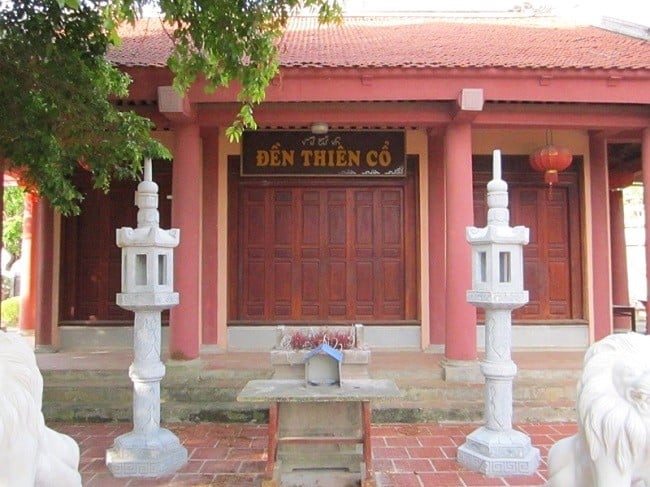 |
| The position of the teacher and the enduring values of the teaching profession remain irreplaceable. Photo: Thien Co Temple relic - One of the first places of worship dedicated to learning in Vietnam. (Source: dangcongsan.vn) |
The Teacher - A Crucial Role
From ancient times, our ancestors have summarized the importance of teachers in proverbs, idioms, and folk songs: "Without a teacher, you can't achieve anything" or "If you want to prosper, build a bridge; if you want your children to be well-educated, you must respect your teachers"; "One word makes a teacher; half a word makes a teacher." Teachers have always been highly regarded and are symbols and role models of morality, talent, and their role in shaping moral values, character, and knowledge for generations of students. Throughout the years and the ups and downs of history and social development, teachers and learning have always been respected and honored by the people, who trust them most to educate their children and help them become good people. Every family and every village, no matter how difficult, encourages and guides their children to pursue education so that they may become good people, achieve fame, and become talented.
The value of teachers originated during the Hung Kings era. This was reflected in the concern for education , primarily for the princesses and princes, and later for the common people. Evidence of this is King Hung Due Vuong's welcoming of teachers Vu The Lang and Nguyen Thi Thuc to teach him. Through their education, the princesses and princes became virtuous and talented individuals, making significant contributions to the country. From then on, the position and contributions of teachers spread throughout society; teachers became shining symbols of morality and knowledge, living in the hearts of the people, respected and praised by them. In Phu Tho province, the ancestral land, there is still an ancient relic: Thien Co Temple – the first temple dedicated to learning in Vietnam, a sacred and enduring symbol of the Vietnamese tradition of valuing education.
In the Ho Chi Minh era, the position of the teacher was constantly elevated to higher levels of morality and knowledge to meet the needs of national development. President Ho Chi Minh once affirmed: “The teacher's task is very glorious, because without teachers there would be no education… Without education, what can we say about the economy and culture?” (Ho Chi Minh Complete Works, National Political Publishing House, Hanoi 2011, Volume 10, p. 345). At the same time, he emphasized: “The heavy and glorious responsibility of the teacher is to care for the children of the people to become good citizens, good workers, good soldiers, and good cadres of the country” (Excerpt from President Ho Chi Minh's letter to the National Education Conference in March 1955). He honored good teachers as “unsung heroes”; Uncle Ho always emphasized the importance of nurturing human resources in society: "For the benefit of ten years, plant trees; for the benefit of a hundred years, cultivate people."
In practice, teachers always bear a great responsibility as the country faces both fierce wars and the task of rebuilding and developing. The need for education and moral training for generations of Vietnamese students, as President Ho Chi Minh once wished, is to cultivate individuals who are both morally upright and professionally competent, capable of both bravery in combat and enthusiasm and creativity in labor and production. To achieve this, the guidance and teaching of teachers, the "silent ferrymen," are essential, sowing the seeds of knowledge so that each generation of students, in each different stage, receives adequate training, education, and sufficient knowledge to enter life.
In the era of industrialization, modernization of the country, international integration, and continuous development, the need for training high-quality human resources is always a pressing issue in education. Only then can we grasp and embrace the advanced achievements of the world today. More than ever, learning and the role of teachers are elevated to a new level. Teachers must constantly learn, innovate, and change their thinking so that they not only serve as transmitters of lectures containing the knowledge of the new era but also inspire students with a passion for creativity, igniting in them a desire to conquer the pinnacle of human knowledge.
Distinguished educator Cao Van Tu, former Director of the Department of Education and Training of Lao Cai province, shared: “The role of teachers is essential at any stage. Learning and excellent teachers are always crucial foundations for training human resources and nurturing talent for the country. The position of teachers is always elevated as society develops. Therefore, factors related to teachers such as qualifications, methods, setting a good example, and the tradition of respecting teachers change over time.”
The teacher from the perspective of the past and present.
As society develops, the role, position, and perceptions of teachers have changed significantly compared to the past. Teaching is a profession that goes beyond simply imparting knowledge; it is also about character development, teaching how to be a good person, and creating a unique product for society: individuals who are both virtuous and talented. Teachers and students are the heart and soul of the teaching and learning process. Teachers always instill in their students enduring values of character, aspiration, and the awareness of being good citizens. Teachers have a lasting influence in the process of teaching both knowledge and character.
Teacher Le Van Cuong, head of the professional department at Cam An High School, Yen Binh district (Yen Bai province), shared: “The position of teachers in society at all times is extremely important because the teaching profession has the unique characteristic of training people with knowledge and skills that suit the needs of each historical period of society. Therefore, the teaching methods of teachers may change over time, but the importance of teachers does not diminish but is even enhanced.”
Teacher Le Van Cuong emphasized that the product he creates for his students is not just academic knowledge and skills; for the student's product to be complete, it must also contain the boundless, unconditional love and affection that the teacher has for his students. This transcends ordinary social values that the products of other professions and fields do not need or cannot possess.
In today's society, despite the continuous development of science and technology and the changing perceptions and viewpoints, the importance of teachers has not only not diminished but has also been elevated to a new level with distinct differences. While in the past, teachers were the most highly qualified individuals in a particular locality, today they are no longer the only ones; they are simply individuals who have received formal pedagogical training and possess the necessary skills and expertise to teach. Previously, teachers were the sole providers of knowledge; today, due to advancements in science and technology, teachers offer countless other sources of knowledge to support students in their learning process.
Therefore, the teaching and learning methods of both teachers and students have also changed. In the past, the teacher acted as a guide, transmitting knowledge and providing information, while the student was the recipient and absorber. Now, the teacher acts as a directional guide, inspiring, accompaniment, organizer, and discoverer of students' abilities. In other words, while teaching was previously a process of "giving and receiving," it is now about guidance. This places a challenge on teachers today: they need effective methods and a deep understanding of their students to help them discover knowledge and grasp what they need during the learning process.
The teacher-student relationship has also changed today, especially the traditional Vietnamese value of "respecting teachers and valuing education." In the past, respecting teachers and valuing education was associated with reverence and obedience to the teacher, while today, this beautiful principle means empathy, understanding, and gratitude from students towards their teachers. The role model of teachers has also changed. Previously, setting an example was often associated with the image of a serious, exemplary, and dignified teacher. Today, setting an example is linked to the teacher's actions and deeds – a model of morality, self-learning, creativity, methodology, and conduct – to positively influence the character of their students. The life and work of a teacher must reflect educational values.
Challenges for teachers
Societal development presents opportunities for every educator to assert themselves, but it also poses challenges that educators today are facing. These include issues such as access to modern scientific and technological achievements, the need for continuous self-learning and innovation to improve oneself, and the ability to adapt teaching methods to meet the demands of new curricula. Furthermore, educators' concerns about recruitment mechanisms, salary policies, rotations, living and working conditions in mountainous, island, and particularly disadvantaged areas, along with the pressures of social media and the negative aspects of the market economy, still require the understanding and support of society as a whole.
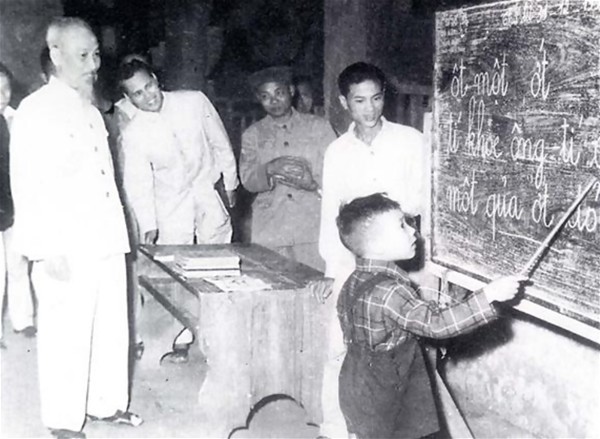 |
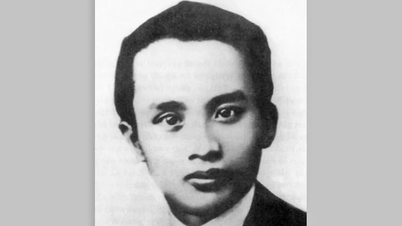
| During his lifetime, President Ho Chi Minh paid special attention to the cause of education, teachers, and students' learning. (Archival photo). |
Dr. Pham Kieu Anh, Lecturer in the Department of Literature, Hanoi Pedagogical University 2, shared: “As society develops, the role of teachers will be affected. However, this is also another way to affirm the importance of teachers in life. At the same time, in modern society, teachers also face significant challenges in constantly improving their professional ethics, skills, and expertise to meet the increasingly high demands of education and training from society.”
I believe that no matter how developed society becomes, even with the advent of advanced and modern science and technology, the position and role of teachers in education cannot be replaced. This is because the teaching profession has been and continues to fulfill the noble mission entrusted to them by the Party, the State, and the People: the task of "nurturing people," educating the character, morality, and knowledge of the nation's young generation.
We believe that every teacher at all levels will always remember President Ho Chi Minh's teaching in his "Letter to cadres, teachers, staff, students on the occasion of the beginning of the new school year" in 1968: "No matter how difficult the circumstances, we must continue to compete in teaching well and learning well." Society always needs teachers, the "engineers of the soul," to sow the seeds of knowledge. The task of teachers is very noble and glorious, but also deeply arduous. Because behind the worries and hardships of the teaching profession are the eyes of children, the future of the younger generation.
Source


![[Photo] General Secretary and President To Lam meets with National Assembly delegates from ethnic minorities.](https://vphoto.vietnam.vn/thumb/1200x675/vietnam/resource/IMAGE/2026/04/20/1776696701056_a1-bnd-8331-3342-jpg.webp)


![[Image] National Assembly discusses the implementation of the socio-economic development plan.](https://vphoto.vietnam.vn/thumb/1200x675/vietnam/resource/IMAGE/2026/04/20/1776696707422_ndo_br_img-20260420-185419-jpg.webp)












































































Comment (0)