

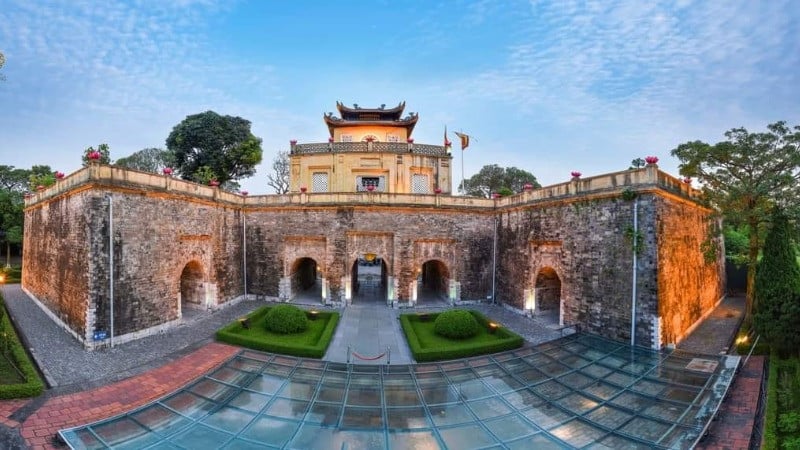
Thang Long Imperial Citadel, a top-priority heritage site that Hanoi dedicates resources to protecting and promoting its value. (Photo: nhandan.vn)
Ministries, departments, and local governments have implemented numerous solutions to preserve and promote heritage values. The most important solution is relying on the people, through awareness-raising activities, to directly involve the community and ensure that people benefit from the heritage.
Affirming the role of the subject
Mr. Nguyen Van Loi (Ngoc Ha Ward, Hanoi) still vividly remembers the sacred feeling of offering prayers to the ancestral emperors who contributed to the country during the farewell ceremony for the old year and the welcoming of the new year, the Year of the Snake 2025. “I have served as the chief priest for many years at Tong Temple (Van Phuc Temple, Ngoc Ha Ward). At the beginning of this year, I was invited to perform rituals for the emperors at Thang Long Imperial Citadel. Previously, my work had nothing to do with the cultural field. Only when I got older did I participate in local cultural and spiritual activities. Being able to perform the rituals at the Imperial Citadel, wearing the ancient official robes, made me feel very proud. I and others have learned more about court culture to be able to perform the rituals well.”
Fifteen years after being recognized as a World Cultural Heritage site, the Thang Long-Hanoi Heritage Conservation Center has restored a series of royal court rituals at the Thang Long Imperial Citadel, including: the Spring Buffalo Offering Ceremony, the Calendar Offering Ceremony, the Upper Lantern Ceremony, the Fan Giving Ceremony (part of the Dragon Boat Festival rituals), the Changing of the Guard Ceremony, etc.
These rituals are considered the "soul" of Thang Long Imperial Citadel. Remarkably, all reconstruction activities were socialized. The "officials" and "soldiers" involved came from diverse social backgrounds: retired officials, construction workers, youth union officials, designers, and more.
Heritage originally belonged to the community, but due to its "royal" nature and the historical upheavals it experienced, Thang Long Imperial Citadel was once unfamiliar to many. When the community participated in conservation and restoration activities, the Thang Long Imperial Citadel became more accessible. For students in Hanoi, the Thang Long Imperial Citadel is also a familiar venue for extracurricular activities. Every year, tens of thousands of students visit for learning.
Raising community awareness means that the community itself becomes the early and distant protector of heritage. Similarly, in Thanh Hoa , the Ho Dynasty Citadel (Tay Do commune), a World Cultural Heritage site, has now become a space for extracurricular learning sessions for students.
Dr. Nguyen Ba Linh, Director of the Ho Citadel Heritage Conservation Center, said: “Recognizing the role of the community in managing the heritage site, the Ho Citadel Heritage Conservation Center has implemented many measures to enhance the role, awareness, responsibility, and benefits of the community with regard to the heritage.”
The center coordinates with schools to organize heritage education programs such as: "I Love History," "Let's Explore How Ho Citadel Was Built," "I'm an Archaeologist," etc., to cultivate a love for heritage in children. Vietnam currently has five cultural heritage sites: Thang Long Imperial Citadel, Hue Imperial City, Hoi An Ancient Town, My Son Sanctuary, Ho Citadel...; two natural heritage sites: Ha Long Bay - Cat Ba Archipelago, Phong Nha-Ke Bang National Park; and the Trang An Scenic Landscape Complex, a mixed heritage site inscribed by UNESCO.
Heritage preservation has its own unique characteristics for each type. However, the common thread is "the support of the people." Among natural heritage sites, Phong Nha-Ke Bang National Park (Quang Tri province) faces the most challenges in conservation because the national park is also the living space of 60,000 residents belonging to the Kinh, Chut, and Bru-Van Kieu ethnic groups. The lives of the Chut and Bru-Van Kieu people still depend on exploiting natural resources such as hunting, fishing, and harvesting vegetables and fruits.
With the support of the central government and international organizations, Quang Tri province has gradually solved this livelihood-conservation problem. According to Dinh Huy Tri, Deputy Director of the Phong Nha-Ke Bang National Park Management Board: “The provincial government and the Park Management Board are focusing on promoting heritage values to share benefits while minimizing impacts on the world heritage site.” In 2024, implementing the sustainable forestry development program, the park provided and supported local people with seedlings and livestock, as well as supporting the construction of livelihood models and paying communities and the people themselves who protect the forest approximately 20 billion VND per year.
In addition, the National Park creates jobs for thousands of local workers annually through service and tourism activities such as photography, souvenir sales, restaurants, and providing transportation for tourists.
Mr. Hoang Van Binh, Head of the Farmers' Association in Bong Lai 2 village, Bo Trach commune, Quang Tri province, happily stated: "The farmers' association members have received livelihood support from the National Park to establish their lives, such as raising livestock and poultry under the forest canopy, contracting to care for and protect the forest... People's lives have improved, and they have become direct participants in protecting the forest and preserving natural values."
Cooperation to preserve and promote the value of heritage
To date, the UNESCO-listed World Heritage sites in Vietnam have all done a good job of preserving and promoting their value. Many of these sites have also made positive contributions to socio-economic development in their respective localities.
For example, Thang Long Imperial Citadel welcomed 745,000 visitors in 2024, becoming one of Hanoi's most attractive tourist destinations. Hoi An Ancient Town, Trang An Scenic Landscape Complex, Ha Long Bay - Cat Ba Archipelago… are all driving forces for tourism development in provinces and cities such as Da Nang, Ninh Binh, Quang Ninh, and Hai Phong.
In recent years, Vietnam has increasingly improved its legal system, especially the amended Law on Cultural Heritage 2024, which aims to meet domestic requirements and integrate provisions from international conventions on heritage. Despite this, the reality still presents many challenges to the preservation of world heritage sites. Among these, the greatest threat remains the risk of damage from economic development.
For example, Ha Long Bay has been damaged by construction projects. Cultural heritage sites face both the risk of damage and the risk of degradation over time. To sustainably preserve world heritage sites, the issue of awareness and harmonizing the interests of all parties is a matter of concern for many experts. In this context, the issue of interests is not only about supporting livelihoods but also about finding rational models.
Associate Professor Dang Van Bai, Vice Chairman of the National Council for Cultural Heritage, stated: “When the community is involved, they will have a correct and lasting understanding of cultural heritage. I propose the need to develop heritage education programs in schools, in the community, and through the media to contribute to changing community awareness. The Party and the State have affirmed that the private sector is one of the main driving forces promoting the socio-economic development of the country. However, in the field of heritage preservation, the private sector or public-private partnership model is still limited, preventing cultural heritage from being fully utilized. Therefore, we also need to build compatible models, for example: community management, state guidance; cooperation between the State and the community; cooperation between the State and the private sector…”.
Regarding collaborative models for preserving and promoting heritage values, the Trang An Scenic Landscape Complex (Ninh Binh) is a shining example. Currently, there are approximately 10,000 direct and 20,000 indirect workers at the complex, thereby contributing significantly to Ninh Binh's socio-economic structure. Bui Viet Thang, Director of the Trang An Scenic Landscape Complex Management Board, shared his experience: “Currently, the public-private partnership process at Trang An Scenic Landscape Complex is implemented with the participation of various parties: the State plays a role in management, planning, inspection, and development orientation; businesses invest in infrastructure and service exploitation; the community participates in operating services, protecting the environment and cultural traditions; and the scientific community provides advice on conservation and tourism management…”
The operating mechanism is based on the principles of respecting the original values and integrity of the heritage; harmonizing the interests of all parties; financial transparency and community oversight; and responsible tourism development. The public-private partnership model has played a significant role in preserving and promoting the values of the scenic area. In 2014, the number of visitors to Trang An reached 2.2 million, and that number has now increased many times over. Tourism revenue is projected to reach 6,500 billion VND in 2024. The heritage has brought both material and spiritual value, contributing to social cohesion and creating sustainable livelihoods for the people.”
Although each heritage site has its own unique characteristics, the public-private partnership model at Trang An scenic area is a valuable experience that should be referenced and replicated.
GIANG NAM - HUONG GIANG
Source: https://nhandan.vn/bao-ton-phat-huy-gia-tri-di-san-post893511.html






















![[Video] Hue and Quang Ninh mark strong tourism growth](https://vphoto.vietnam.vn/thumb/402x226/vietnam/resource/IMAGE/2025/12/12/1765555481742_dung00-22-16-02still007-jpg.webp)



![[Photo] Prime Minister Pham Minh Chinh holds a phone call with the CEO of Russia's Rosatom Corporation.](/_next/image?url=https%3A%2F%2Fvphoto.vietnam.vn%2Fthumb%2F1200x675%2Fvietnam%2Fresource%2FIMAGE%2F2025%2F12%2F11%2F1765464552365_dsc-5295-jpg.webp&w=3840&q=75)





































Comment (0)