

On weekend afternoons, the courtyard of Soc Sau Pagoda in Go Quao commune is filled with the lively sounds of traditional Khmer music. Under the pagoda's roof, young Khmer men and women enthusiastically practice the Rom Vong, Saravan, and Rom Kbach dances. This bustling atmosphere has become a familiar sight for the villagers for many years. Directly instructing the group is Danh Nghiep, a man who has been involved with the Khmer arts movement in the area for many years. For him, learning and teaching traditional music stems from a concern that this ethnic art form is fading away. “There aren't many artisans left from the previous generation. If I don't try to learn, the younger generation won't know about traditional music anymore. Therefore, I asked to learn at the pagoda first, and then I teach it to the younger generation,” Nghiep shared.
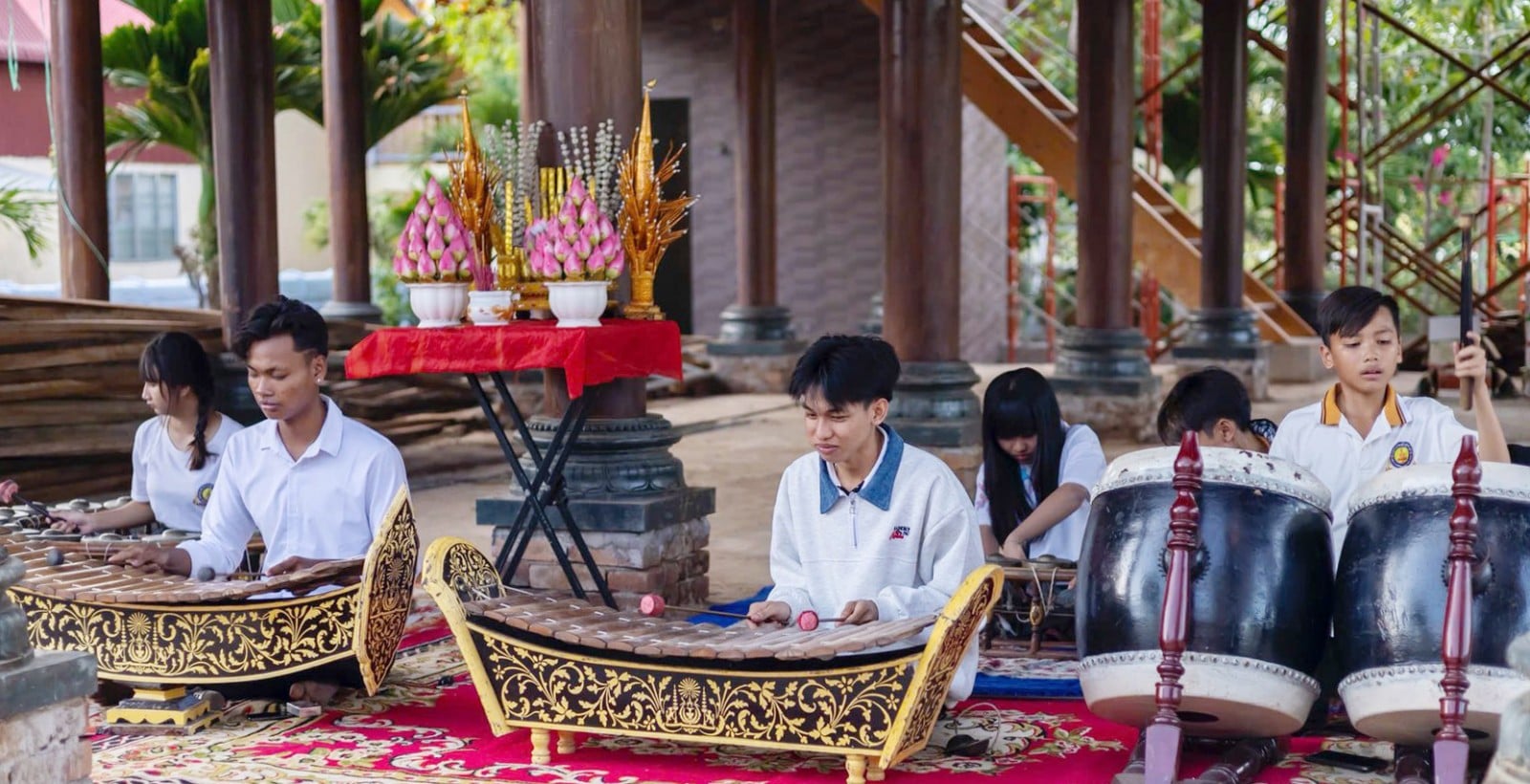
Members of the Khmer performing arts club at Thu Nam Pagoda practice the five-tone musical instrument. Photo: THI HOA
The Khmer performing arts club at Soc Sau Pagoda was established in 2019. On weekends, members gather at the pagoda to practice together. Those with more experience guide those who join later. From a few initial members, the club now has over 30 regular participants. Besides performing at major local festivals, members are also invited to perform in many nearby locations.
Every time the music plays, it strengthens the bonds among the villagers. Mrs. Thi Xem, a resident of Go Quao commune, couldn't hide her joy at having two grandchildren join the club. Watching the children practice in the temple courtyard, Mrs. Xem said: "I'm happy that the children know how to play the five-tone musical instruments and also know the traditional dances of our people. Every time there's a festival and a cultural performance, the villagers are very happy."
According to Mr. Nguyen Van Tam, Head of the Culture and Social Affairs Department of Go Quao commune, the locality is continuing to strengthen Khmer art clubs; at the same time, from the national target program's funding, additional musical instruments, costumes, and operating conditions are being provided to clubs, teams, and groups. “The Party and the State are very interested in supporting temples in preserving and promoting the cultural identity of the Khmer people. In the coming time, the locality will continue to improve the clubs, creating conditions for those who are passionate about maintaining the traditional art forms of the people,” Mr. Tam said.
In Dong Thai commune, the Khmer performing arts club at Thu Nam Pagoda was established in 2022, with about 20 members who are students and young people from the villages. As evening falls, the pagoda grounds fill with the sounds of music. After school, the children gather at the pagoda to practice dancing and singing together. The club has become a familiar place for Danh Thi My Nhan. “I’ve loved performing arts since I was little. I saw the older children dancing beautifully, so I started to learn. It was difficult at first, but I got used to it. I go to school in the morning, and in the evening I come to the pagoda to practice with my friends,” My Nhan said.
Having been involved in the Khmer arts movement for over 10 years, Mr. Danh An directly guides members of the Khmer Arts Club at Thu Nam Pagoda in their practice sessions. According to Mr. An, the most difficult thing is encouraging the children to participate and maintain long-term practice, because many of them currently use little Khmer and do not understand much about traditional ethnic art.
These efforts yielded encouraging results when the Thu Nam Pagoda Arts Club won the A prize at the An Giang Province Khmer Traditional Arts Festival in 2025. This achievement is not only a joy for the members but also shows that the vitality of the Khmer arts movement at the grassroots level is still being maintained and spread. “I want the children to love their ethnic culture more. Besides teaching dance and singing, I also directly encourage parents to let their children participate in the club. When they know how to dance, sing, and speak Khmer, they will have a sense of preserving their ethnic culture,” Mr. An shared.
Over the years, An Giang province has paid special attention to the preservation of traditional Khmer art through many specific projects and programs, such as the project on managing, protecting, and promoting the Di Ke theatrical art of the Khmer people in O Lam commune, An Giang province; the project on preserving and promoting the value of traditional Khmer art in Kien Giang province (formerly) in the period 2021-2025; the project on preserving and promoting the value of traditional Khmer art in An Giang province in the period 2026-2030… Director of the Department of Ethnic Minorities and Religion, Danh Phuc, said: “The province has implemented many policies, including policies to preserve the cultural identity of ethnic groups. In the future, the province will continue to implement stronger programs and projects to attract young people to participate, helping the cultural and artistic movement of the Khmer people to develop.”
The sounds of traditional Khmer five-tone music still resonate every weekend afternoon in the courtyards of Khmer Theravada Buddhist temples. Traditional dances are still enthusiastically practiced by the younger generation. This continuity contributes to preserving and spreading the cultural identity of the Khmer people in today's life.
THI HOA
(Department of Ethnic Minorities and Religions)
Source: https://baoangiang.com.vn/nguoi-tre-giu-hon-van-hoa-khmer-a485829.html

![[Photo] General Secretary and President To Lam presides over a working session with the Central Policy and Strategy Committee on the development of the materials industry.](https://vphoto.vietnam.vn/thumb/1200x675/vietnam/resource/IMAGE/2026/05/21/1779359935432_a3-bnd-3129-1412-jpg.webp)
![[Photo] National Assembly Chairman Tran Thanh Man working with the Standing Committee of the Law and Justice Committee](https://vphoto.vietnam.vn/thumb/1200x675/vietnam/resource/IMAGE/2026/05/21/1779378929214_ndo_br_1-4610-jpg.webp)

























































Comment (0)