

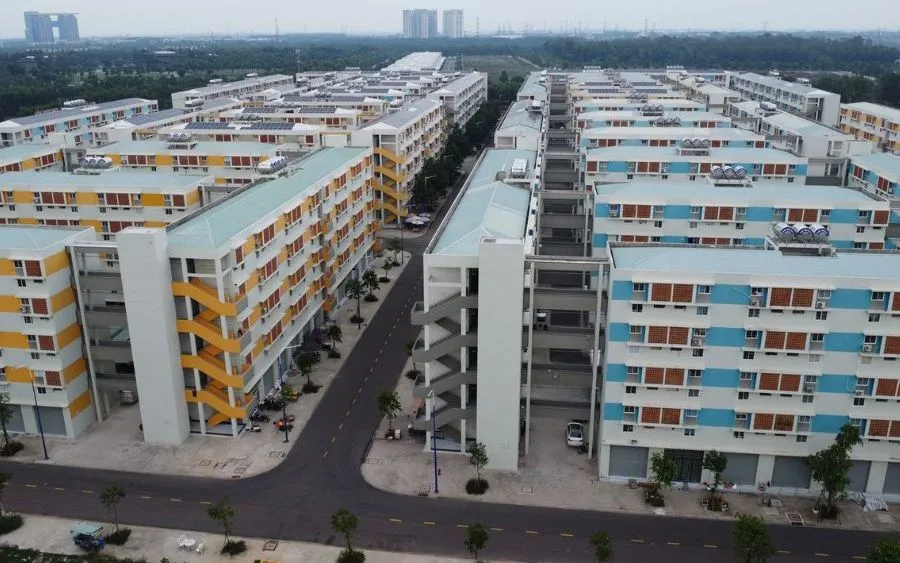
The plan to build 100,000 social housing units for workers in Ho Chi Minh City raises high expectations, but its effectiveness depends on how it is managed and how benefits are shared.
At a meeting on the morning of May 4, 2026, the Standing Committee of the Ho Chi Minh City Party Committee and the City's Labor Union agreed to implement a project to build 100,000 social housing units/dormitories for workers, with the first construction expected to begin in June 2026. The program focuses on stabilizing housing, reducing living costs, and improving the quality of life for union members and workers, with their well-being at the center.
New social security leverage
The program to develop 100,000 social housing units for workers over the next five years is putting Ho Chi Minh City to the test in a noteworthy policy experiment. Mr. Vo Khac Thai, Permanent Vice Chairman of the Ho Chi Minh City Federation of Labor, said the new model allows businesses to rent housing for workers free of charge or with only a small cost.
Four companies participated from the initial stage: Hoa Sen Group , Phu Cuong Group, Tan Thuan Industrial Development Company Limited (IPC), and LNT 7979 Company. Hoa Sen committed to investing in at least 20,000 units, LNT 7979 planned to develop 30,000 units, while IPC focused on Hiep Phuoc, An Phu Tay, and Tan My areas, which have a high concentration of workers in Ho Chi Minh City.
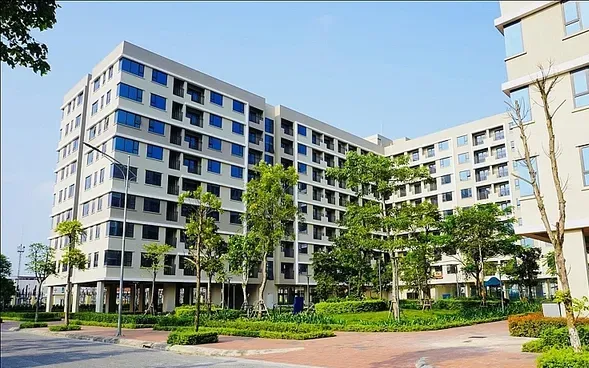
The Ho Chi Minh City Federation of Labor announced that the new model allows businesses to rent housing for workers free of charge or with workers paying only a small portion of the cost.
Notably, approximately 50,000 units will be offered for rent or rent-to-own. This represents a significant shift from the previous approach, which focused on selling properties. A survey of 200,000 workers by the Ho Chi Minh City Federation of Labor showed that 95% of workers desire social housing to stabilize their lives, a sharp increase from the previous figure of around 65%. This figure clearly reflects the housing pressure becoming the biggest bottleneck in the urban labor market.
From an economic perspective, when businesses cover housing costs, these expenses are essentially transformed into benefits. This helps businesses retain employees amidst increasing labor turnover in industrial zones. Workers have stable housing, reduced commuting time, and consequently improved productivity and health.
Speaking at the signing ceremony of the cooperation agreement between IPC and the Ho Chi Minh City Federation of Labor, Mr. Vo Hong Tai, Acting General Director of Tan Thuan Industrial Development Company Limited (IPC), emphasized that this is not only a milestone in realizing the goal of 200,000 social housing units by 2030, but also a direct solution to the housing shortage for workers. According to Mr. Tai, projects located near industrial parks and export processing zones will help workers feel secure and committed to long-term employment, while also creating a foundation for sustainable development for the city.
Following its merger with Binh Duong and Ba Ria - Vung Tau provinces, Ho Chi Minh City has over 7 million workers, the largest workforce in the country. Housing pressure is therefore no longer merely a social issue but has become a decisive factor in the competitiveness of the urban economy.
The way things are run determines success or failure.
However, behind this ambitious goal lies a complex operational challenge. No model is truly free. Ultimately, costs are still allocated among the state budget, businesses, and investors. Without a sound mechanism, policies can easily fall into a situation of imbalanced interests.
Ms. Truong Thi Bich Hanh, Standing Vice Chairwoman of the Ho Chi Minh City Fatherland Front, noted the need for a thorough review of land resources to avoid situations where available land fails to attract investors. She also emphasized the need to clarify the contribution ratios of each party to ensure fair benefits for workers. From a research perspective, Mr. Pham Binh An, Deputy Director of the Ho Chi Minh City Institute for Development Research, stated that the demand for housing between 2026 and 2030 is very high, especially for those renting and rent-to-own. The city cannot rely solely on one model but needs to diversify forms and quickly move from ideas to concrete actions.

Between 2026 and 2030, Ho Chi Minh City aims to complete 181,000 social housing units, with 28,500 units to be completed in 2026 alone.
The actual implementation over the past period shows that progress remains a challenge. From 2021 to 2024, the city only completed 5,103 units. In 2025, it is expected to reach 12,799 out of 13,040 units, equivalent to 98.2% of the plan. However, moving into the period from 2026 to 2030, the target has skyrocketed to over 181,000 units, with 28,500 units needing to be completed in 2026 alone. This pressure necessitates a significant streamlining of procedures.
The Ho Chi Minh City Department of Construction has proposed minimizing the time required for investment procedures while increasing penalties for investors who delay project implementation. Strengthening the Ho Chi Minh City Housing Development Fund to align with the national housing fund model is also seen as a solution to create a stable financial source and ensure that beneficiaries are properly targeted.
The biggest challenge lies in balancing interests. If the rental price businesses have to pay is too high, they won't participate. If the profit margin is too low, investors will withdraw. If there is too much reliance on the budget, sustainability will be questioned. Along with that comes the risk of misidentifying target groups, substandard construction quality, or project locations far from workplaces, reducing actual effectiveness.
Many experts also believe that the free housing program for workers is a significant step forward in urban development thinking. It not only addresses social welfare issues but also serves as a strategy to retain human resources. However, for the policy to be truly effective, Ho Chi Minh City needs a transparent operating mechanism, fair allocation, and a focus on the quality of life for workers.
Source: https://vtv.vn/nha-o-mien-phi-cho-cong-nhan-van-hanh-sao-cho-ben-vung-100260505163446016.htm






































































































Comment (0)