

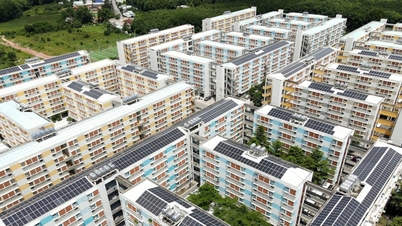
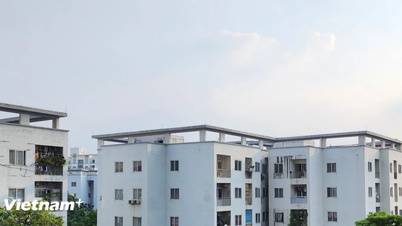
A prominent policy implemented recently has been the development of social housing. In particular, ministries, sectors, and localities have been focusing on implementing Directive No. 34-CT/TW, dated May 24, 2024, of the Party Central Committee on strengthening the Party's leadership over the development of social housing in the new situation, with the goal of completing the construction of at least 1 million social housing units for low-income earners and industrial zone workers in urban areas by 2030. To concretize this important task, according to the Ministry of Construction 's cumulative report to date, there are 781 social housing projects underway nationwide with a scale of 720,055 apartments. Of these, 231 projects have been completed, with a scale of 180,850 apartments. 234 projects have commenced construction or are under implementation, comprising 233,962 apartments, and 316 projects have received investment approval, comprising 305,243 apartments. Thus, the number of completed, commenced, or approved projects has reached approximately 72% of the target of 1 million social housing units set out in Directive No. 34-CT/TW of the Party Central Committee.
In particular, housing support policies through targeted programs for beneficiaries such as people with meritorious services to the revolution, poor and near-poor households in rural areas, and households in rural areas frequently affected by natural disasters and climate change have been implemented synchronously and achieved many positive results. A highlight in recent times is the nationwide emulation movement "The whole country joins hands to eliminate temporary and dilapidated houses," resulting in the elimination of 334,234 temporary, dilapidated, and substandard houses (solid foundation, solid frame, solid roof) across the country. In addition, the rapid "Quang Trung Campaign" repaired and built tens of thousands of houses for people in disaster-stricken areas...
Notably, most recently, the Ministry of Construction announced that it is coordinating with the Ministry of Finance to propose a capital requirement of 10,000 billion VND for the central housing fund in the medium-term public investment plan for the period 2026-2030. Regarding local housing funds, 13 localities have completed the establishment of their local housing funds and are currently in the process of reporting and submitting proposals to the People's Council for approval of additional funding. In addition, 20 localities are finalizing procedures to transfer existing financial funds within their areas to perform the functions and tasks of the local housing fund. Son La province, in particular, is finalizing the establishment of this agency by reorganizing public service units within the province.
It is commendable that, in addition to state resources, the development of housing for the people has received the joint efforts and contributions of the Vietnam Fatherland Front , mass organizations, the business community, philanthropists, and the support of international organizations, profoundly demonstrating the spirit of "national solidarity and brotherhood" in caring for people's housing. This is vivid evidence of the Party's will and the people's aspirations in ensuring the right to safe and stable housing for all citizens.
![[Photo] Ba Lang An Lighthouse - the "eye of the sea" amidst the "rock museum" of Quang Ngai province.](https://vphoto.vietnam.vn/thumb/1200x675/vietnam/resource/IMAGE/2026/05/29/1780038698840_anh-man-hinh-2026-05-29-luc-14-10-42.png)


![[Image] Pleasant weather helps students enter the 10th grade entrance exam with confidence.](https://vphoto.vietnam.vn/thumb/1200x675/vietnam/resource/IMAGE/2026/05/29/1780034401612_ngay-1-thi-lop-10-minh-duy-8-5009-jpg.webp)













































































Comment (0)