

I was at the office by 6 a.m.
I sensed something was amiss when the administrative staff brought in two women with dark circles under their eyes, and I could hardly believe my ears when the younger woman, also a daughter, supported her mother's shoulders and, with a choked voice, announced that the poet Nguyen Duc Mau - her beloved father - had just passed away suddenly.
I froze for half a minute, almost dropping the teapot I was holding. My glasses suddenly blurred, as if a burning grain of sand had been thrown directly into my eyes. I asked unconsciously, "Is Uncle Mau gone?"
 |
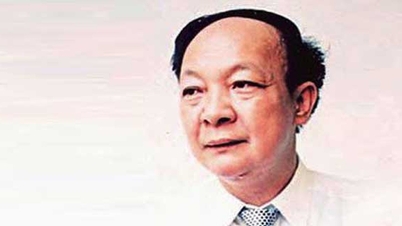
Poet Nguyen Duc Mau. |
The room was silent, with no reply.
The two women in front of me seemed unable to believe what I had just announced. How could it happen so quickly? I saw him just the day before yesterday morning! The poet shook my hand and walked about 10 meters, then suddenly turned back to congratulate me on winning the "New Spring" poetry competition organized by the Police Writers' Association.
It took me a few minutes to fully believe it was true.
The poet Nguyen Duc Mau was like a father or uncle to me, gentle as the earth, gentle as his eyes. Yet, they opened up to a serene, distant horizon.
Nguyen Duc Mau wrote poetry before I was even born, and went to the battlefield when I was just a speck of dust, yet somehow I always felt him so close to me later on.
I always call the poet "uncle." We've been uncle and nephew since the Do Son writing camp in 1996, right up until now.
Nguyen Duc Mau's poems are excellent:
The verses are both expansive and measured. That's good poetry.
"
"
Oh dear! Poetry doesn't need profound philosophical depth or enigmatic, convoluted language. The real challenge lies in a straightforward, realistic portrayal. Like, for example, "Your name is carved into the mountain stone." Or, for example, "Your long hair flows down in the autumn." That's all it takes to make it beautiful.
Nguyen Duc Mau was born in 1948 in Nam Dien commune, Nam Ninh district, Nam Dinh province (now Ninh Binh province). He enlisted in the army in 1966, went to the battlefield, and then worked in the Army Literature and Arts magazine until his retirement. His poems sent from the battlefield were always imbued with the smell of bombs and bullets, and sometimes the blood and bones of his comrades. Having those poems published in the Army Literature and Arts magazine was the ultimate joy for the soldier.
When Nguyễn Đức Mậu first arrived at the Army Literature and Arts magazine, he hesitated several times before daring to ring the doorbell at house number 4. Remarkably, the tall man who came out of the living room to open the gate and greet the young poet Nguyễn Đức Mậu was none other than the editor-in-chief, Thanh Tịnh. Thanh Tịnh – a famous pre-war poet known for his verses that resembled folk songs, perfectly reflecting his own life: "Having endured decades of hardship / Eating communal meals and sleeping in individual beds."
Nguyen Duc Mau was exposed early on to many illustrious figures he had long admired. These included Vu Cao, Tu Bich Hoang, Xuan Sach, Nhi Ca, Van Thao Nguyen, Nguyen Minh Chau... To the point that the young soldier in the Infantry Division, Nguyen Duc Mau, felt as if he were still dreaming.
The poet Nguyen Duc Mau was a calm, pensive, yet witty man. He knew everything, but didn't say it. If he did speak, it was through poetry. Not loudly. Certainly not boisterously. Just slowly, yet profoundly. He greatly feared bad poetry. Throughout his life, he had to confront countless low-quality poems sent to him. He had to read them. He had to reject them. Everyone else wrote poetry, making it a hardship for editors like him. He read. He sifted through that mass of dirt, sand, and slag to find the gold nuggets.
For over half a century, it's been like this. Looking at him, like a leaf swaying in the afternoon breeze on Ly Nam De Street, one feels truly sorry for him. He knows nothing of the good things in life, only to be dismissed by a few loudmouthed, poetry-weak poets, causing them to shriek, surround, and shout, leaving Nguyen Duc Mau, that swaying leaf, even colder in the winter wind.
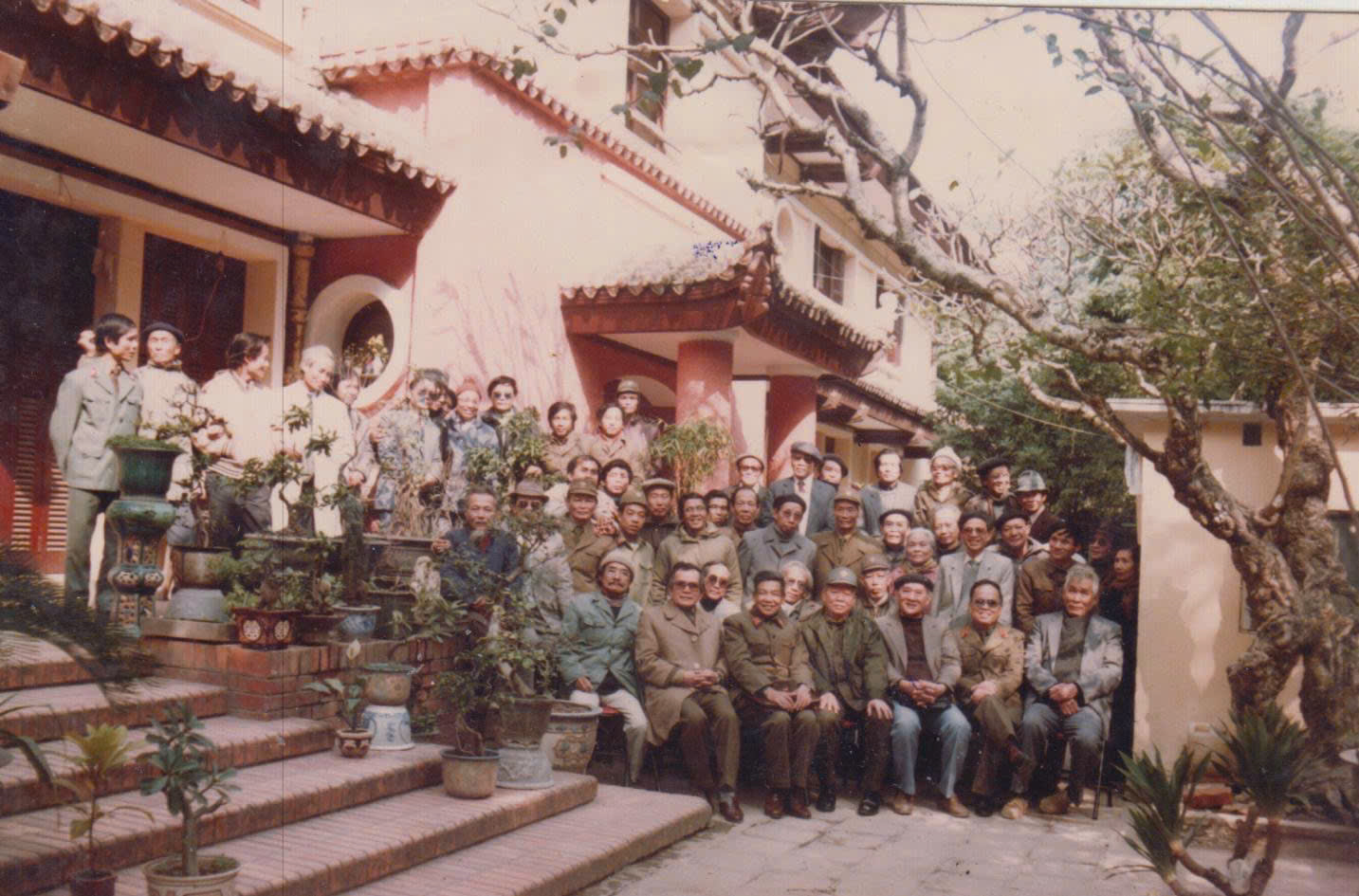 |
| Military writers and journalists in Dien Bien Phu . (Photo taken at the Military Arts and Literature Magazine, 2004). |
But that's the life of a poet. That's the life of a poetry editor. We editors are constantly on edge, sometimes even feeling a chill down our spines, because of the ever-increasing number of sloppy writers.
Nguyen Duc Mau was a man of moderation. He was also always very straightforward and hot-tempered, but sincere, devoted, and righteous. Never think that it's easy to bully poets in life or in literary works. Poets, with their seemingly carefree nature, can establish laws and build nations with ease. Some even led uprisings like Cao Ba Quat.
Nguyen Duc Mau is one of the last remaining "tough" poets of the anti-American war for national liberation. Without him, the ranks would immediately have a gap. Could the enemy infiltrate? Not at all! But the absence of him and Huu Thinh, Thanh Thao, Thi Hoang... would be very serious. He is a major pillar in the century-old temple of poetry.
Even the falling leaves of Nguyen Duc Mau evoke sadness, don't they? The inscription of his name on the mountain rock also stirs a sense of melancholy—that's the meaning of life in this human existence. The generation of poets who fought against America, so steadfast, yet they also knew the true value of sorrow.
Nguyen Duc Mau is like a single-plank bridge remaining after enduring sun, rain, storms, and wind, just as he once wrote: “Where I live, there are no Tham Tam, Tran Dang, Thoi Huu, Nguyen Thi. The generation of poets and writers who once went to fight in the resistance. Manuscripts lie in backpacks, characters and verses are like samples of ore. The cellar serves as a writing room, the lamp lit by tree resin burns brightly in the sun. (These poets and writers ate rations meant for soldiers, slept with their heads on tree roots, and carried sacks of rice. The resistance road was treacherous, with steep mountain passes. The literary road turned their hair gray in the long nights. The pen and the gun. They forgot they once had a time of youth.)
The jungle fevers, the enemy bullets, spilled onto the unfinished pages. The writer sacrificed himself, giving up his life's aspirations for the characters. Blood soaked the earth, blood flowed into the pages, blood replaced the wordless ending. The poet sacrificed himself like a fire burning itself out to transform. On the barren, rocky grave, the words are like leftover seeds, the language of green grass spontaneously forming rhymes.
The old banyan tree stands as a witness; the house where you gentlemen live now stands. The old room has had its lock changed several times. The number of poets wearing military uniforms has increased.
"Your hearts, where are they, in such distant lands? Hearts that beat restlessly on the pages of a book, never at peace."
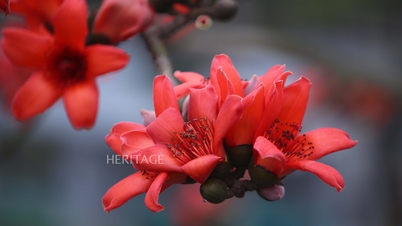
Poet Nguyen Duc Mau has quickly entered his late 80s, yet he still seems deeply indebted to poetry and literature. His generation seems to have all excellently fulfilled their duties. Everything that needed to be written and said was respectfully presented on paper. Just the poem "The Color of Red Flowers" alone deserves recognition as a contribution, a talent unmistakable to the people and the nation. The nation and its hardworking people have made boundless sacrifices, and they desperately need verses like those in "The Color of Red Flowers." The beauty of the soldier in "The Color of Red Flowers" has become a symbolic representation of sacrifice:
The generation of writers who opposed the US, the multifaceted figures in House No. 4, is dwindling, making our generation feel a sense of powerlessness. Just last year (2025), we had to bid farewell to writer Khuất Quang Thụy and literary critic Ngô Vĩnh Bình. I visited both of them many times at their bedside. Once, when we were alone, writer Khuất Quang Thụy even discussed with me republishing his novel "Intelligence is Not My Profession." Just a few months before his death, he, along with General Nguyễn Chí Vịnh, participated in a recorded talk at the National Library. He even instructed me: "You're halfway through writing a novel about intelligence. Now that you've completely retired from management, you can write freely, Khai. The manuscript will be finished in just a few weeks..."
Then he passed away suddenly, only managing to instruct his family to take him back to his hometown for burial.
Next up is former Editor-in-Chief Ngo Vinh Binh.
And today it's poet Nguyen Duc Mau.
For me personally, there seems to have always been a deep connection with the generation of writers who fought against the US and for national liberation. From my early days at the Army Television station, I was assigned to make documentary films about these writers and about House No. 4. Then I transferred to my favorite place, and it's been exactly 20 years since then. In those 20 years, amidst countless impressions, milestones, and turning points, there have been many permanent departures of writers from this house that is gradually becoming a legend.
Poet Nguyen Duc Mau - The red color of the flowers, from this moment on, has drifted away like a white cloud. Those who remain bear an even heavier burden on their shoulders, burdened with the heartfelt lessons passed down from their fathers' generation.
Source: https://www.qdnd.vn/van-hoa/van-hoc-nghe-thuat/nha-tho-nguyen-duc-mau-mau-hoa-do-da-may-bay-1034172

![[Image] Close-up view of the interchange connecting the two expressways and Long Thanh Airport.](https://vphoto.vietnam.vn/thumb/1200x675/vietnam/resource/IMAGE/2026/05/25/1779703378210_ndo_br_z7863716673926-224453a31600126cce10622af6290afd-4549-jpg.webp)


![[Image] Hanoi's urban life under the challenge of a "scorching hot" environment](https://vphoto.vietnam.vn/thumb/1200x675/vietnam/resource/IMAGE/2026/05/25/1779706979265_nang-nong-t5-2026-minh-duy-7-4636-jpg.webp)










































































Comment (0)