

Scaling up the low-emission rice farming model.
On February 24th, at the Nam Cuong Cooperative's rice fields (Yen Cuong commune, Ninh Binh province), the Department of Crop Production and Plant Protection ( Ministry of Agriculture and Environment ), in collaboration with the International Rice Research Institute (IRRI), the Ninh Binh Provincial Department of Agriculture and Environment, and domestic and international partners, held a ceremony to launch a high-efficiency, low-emission rice cultivation model, combined with a demonstration of mechanized row sowing technology and fertilizer application.
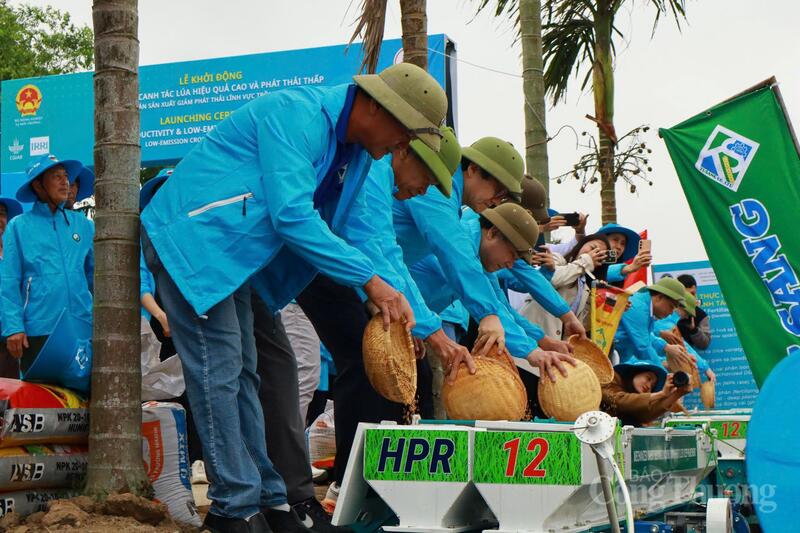
Launch ceremony for a high-efficiency, low-emission rice farming model in Ninh Binh . Photo: NH
This is the second event in a series of high-efficiency, low-emission rice farming models in the Red River Delta for the 2026 winter-spring crop, following the model implemented in Hung Yen on February 10th. The activity is part of the "Production with Reduced Emissions in the Crop Production Sector 2025-2035, Vision to 2050" project and the "Fertilize Right" project funded by the United States Department of Agriculture (USDA).
Ninh Binh is a province with a stable rice production area in the Red River Delta, with a cooperative system playing a crucial role in organizing production and transferring advanced technologies. After mergers, the total rice land area in the province reached over 25,000 hectares, creating a favorable foundation for developing commercial agriculture and building a brand for specialty rice associated with green production.
The model at Nam Cuong Cooperative was implemented on an area of 2.5 hectares, using the Thien Uu 8 rice variety with a sowing rate of approximately 45 kg/ha. The focus was on applying mechanized row sowing combined with machine-assisted fertilization; fertilizing according to the "4 correct principles"; managing water using the alternating wet-dry method (AWD); and integrated pest management (IPM).
Proper sowing density and precise fertilizer application at the beginning of the season reduce seed usage, the number of fertilizer applications, and save irrigation water and labor. More importantly, this process contributes to reducing greenhouse gas emissions in rice production – a sector considered one of the significant sources of emissions in agriculture.
Practical experience from pilot models in the Mekong Delta shows that the technology of sowing in rows combined with burying fertilizer not only has environmental significance but also creates clear economic benefits. Farmers reduce input costs, stabilize rice plant growth, and ensure yield and quality.
Speaking at the event, Mr. Nguyen Quoc Manh, Deputy Director of the Department of Crop Production and Plant Protection, emphasized that the implementation of the model is not only about transferring advanced technology but also a concrete step in realizing the Project on Reducing Emissions in Crop Production until 2035, with a vision to 2050.
During the 2026 winter-spring season, the models will be implemented in three localities, including Hung Yen, Ninh Binh, and Hai Phong, to test, evaluate, and refine the process to suit the production conditions of the Red River Delta region.
According to the project's objectives, by 2035, the agricultural sector aims to reduce greenhouse gas emissions by at least 15% compared to 2020, while simultaneously establishing a green, efficient, and sustainable production system. The overarching principle is that emission reduction must be linked to economic efficiency and the benefits for farmers. When farmers clearly see reduced costs and increased income, the solutions can be sustained in the long term.
A key aspect is the development and operation of a Measurement, Reporting, and Verification (MRV) system for agricultural emissions. This forms the foundation for Vietnam's agriculture to gradually participate in the carbon economy, moving towards a carbon market in the future.
According to Associate Professor Dr. Nguyen Van Hung, representing IRRI, the implementation of these models in the Red River Delta is an important step in adjusting low-emission farming solutions to suit the ecological conditions of the North.
Low-emission rice farming is not a trade-off between the environment and productivity. If designed and implemented correctly, farmers can still improve production efficiency while making a practical contribution to emission reduction goals.
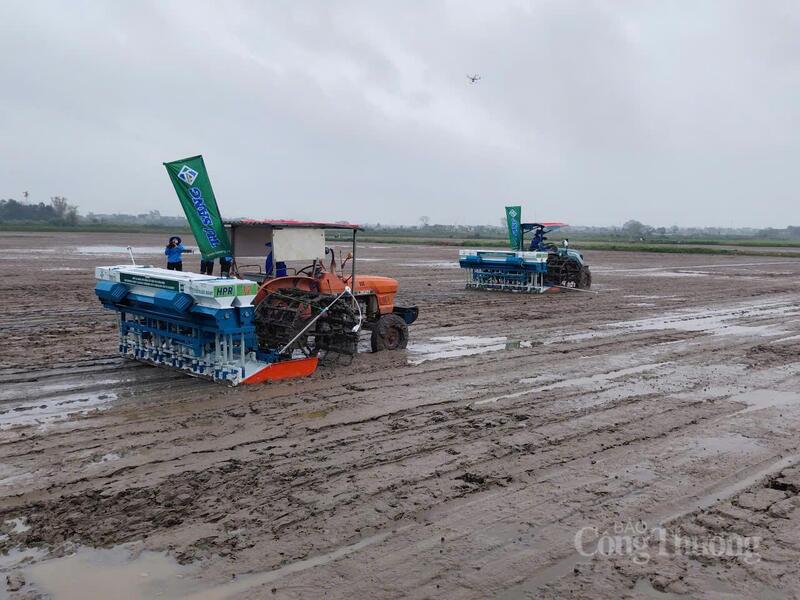
The implementation of highly efficient, low-emission rice farming models in the Red River Delta is a concrete step in realizing the Project on Reducing Emissions in Crop Production. Photo: NH
A significant milestone in the transformation of production methods.
Mr. Nguyen Sinh Tien, Deputy Director of the Department of Agriculture and Environment of Ninh Binh province, assessed that the model is an important milestone in transforming production methods towards green, high-value, and sustainable practices.
According to Mr. Tien, Ninh Binh is facing a dual challenge: complex climate change and increasingly high market demands for quality, traceability, and environmental friendliness. In this context, science and technology and mechanization are identified as key to promoting modern agriculture. "We cannot enter the digital economy with traditional manual farming methods," Mr. Tien said.
Synchronized mechanization from land preparation, sowing, fertilizing to harvesting not only reduces costs and minimizes losses but also addresses the shortage of rural labor, gradually forming a professional workforce of "agricultural workers".
Mr. Nguyen Van Du, Chairman of the Board of Directors of Nam Cuong Cooperative, shared that applying row sowing combined with burying fertilizer helps reduce the amount of seeds and labor compared to traditional methods, facilitating mechanization and improving production efficiency. The participation of businesses such as Vinaseed, Tu Sang Agricultural Machinery Company, and MTK Fertilizer Company contributes to ensuring synchronized technical solutions, gradually forming a production-consumption linkage chain.
At the Nam Cuong Cooperative's rice fields, techniques such as row planting, precise fertilizer application, and water-saving management are gradually shaping a new production method, where rice grains carry green value, carbon value, and higher competitiveness in the market. Green transformation in agriculture, therefore, is no longer just a policy slogan, but is beginning with concrete changes on each plot of land, each crop season, to enhance the efficiency and position of Vietnamese rice in this new development phase.
The launch ceremony of the high-efficiency, low-emission rice farming model in Ninh Binh marks a shift from policy to action, aiming to expand green rice production and enhance the value and competitiveness of Vietnamese rice.
Source: https://congthuong.vn/nhan-rong-mo-hinh-lua-phat-thai-thap-nang-hinh-anh-hat-gao-viet-444099.html
![[Image] Close-up view of the interchange connecting the two expressways and Long Thanh Airport.](https://vphoto.vietnam.vn/thumb/1200x675/vietnam/resource/IMAGE/2026/05/25/1779703378210_ndo_br_z7863716673926-224453a31600126cce10622af6290afd-4549-jpg.webp)


![[Image] Hanoi's urban life under the challenge of a "scorching hot" environment](https://vphoto.vietnam.vn/thumb/1200x675/vietnam/resource/IMAGE/2026/05/25/1779706979265_nang-nong-t5-2026-minh-duy-7-4636-jpg.webp)





























































Comment (0)