

Practical effectiveness
Can Tho City has areas for implementing the One Million Hectare Rice Project in 64 communes and wards, with an area reaching over 170,800 hectares by 2030, involving 171 cooperatives and cooperative groups, of which 104,500 hectares have already been implemented.

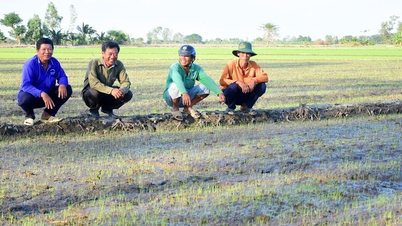
Rice harvesting at the CLC&PTT rice production model in Tien Thuan Cooperative and Thanh Quoi commune, Can Tho City.
Over the two-year implementation period of the Project, from 2024-2025, functional agencies in the city coordinated with the Ministry of Agriculture and Environment and relevant units and businesses to support farmers in cooperatives in implementing 12 pilot models, each covering 50 hectares. According to the Department of Agriculture and Environment of Can Tho City, these models helped increase profits by at least 20% compared to areas outside the models and reduced emissions by 2-12 tons of CO2 per hectare. Farmers in the pilot models increased profits by 1.3-6.5 million VND/hectare by reducing the amount of rice seeds used by 50%, reducing nitrogen fertilizer use by 30%, and reducing the number of pesticide sprays by 2-3 times, while increasing rice yield, quality, and selling price. Along with the implementation of pilot models from the central government, the Department of Agriculture and Environment of Can Tho City proactively coordinated with units, businesses, and localities in the area to develop 65 pilot models. These models help improve production efficiency, increase profits, and reduce greenhouse gas emissions, contributing to supply chain integration, creating quality products, and meeting market demands.
According to Mr. Vo Van Thanh, Deputy Director of Hung Loi Agricultural Cooperative in Dai Ngai commune, starting from the 2024 summer-autumn crop, the cooperative received support to implement a high-quality rice production model covering 50 hectares with 46 participating households. Over four rice seasons of implementing the model, the average rice yield reached 6.3-6.5 tons/ha, with a selling price of 8,800-10,800 VND/kg, resulting in an average profit of 47 million VND/ha for farmers, 4-5 million VND/ha higher than outside the model. The initial results are very promising, but the cooperative still faces difficulties in straw collection and expanding linkages with businesses. Therefore, the cooperative urgently needs further support from relevant authorities in replicating the model.
Focus on resolving difficulties.
The one million-hectare rice project implemented in the city has benefited from the attention, support, and guidance from the Ministry of Agriculture and Environment, the People's Committee of Can Tho City, and the close coordination of relevant departments, agencies, and localities. It has also benefited from the collaboration of many international organizations, research institutes, universities, and businesses, especially the active participation of cooperatives and cooperative groups. This has created a significant shift in farmers' production mindset, moving from agricultural production to an agricultural economy . The application of advanced technical packages has not only reduced the amount of rice seeds sown, the amount of chemical fertilizers and pesticides used, but also effectively implemented the alternating wet and dry irrigation process, minimizing environmental pollution, reducing emissions, lowering input costs, and improving production efficiency. However, the process of replicating these models still faces difficulties, and the Department of Agriculture and Environment is actively coordinating with city and local departments and relevant parties to overcome these obstacles and is determined to achieve the objectives of the Project.
According to Ms. Nguyen Thi Giang, Deputy Director of the Department of Agriculture and Environment of Can Tho City, the implementation of the One Million Hectare Rice Project is not only a technical task, but also an action to restructure the rice industry and agriculture in general, promoting a shift from an agricultural production mindset to an agricultural economic mindset. The Department of Agriculture and Environment will continue to closely coordinate with city departments, localities, and relevant units to overcome difficulties and promote the development of high-quality and advanced rice production.
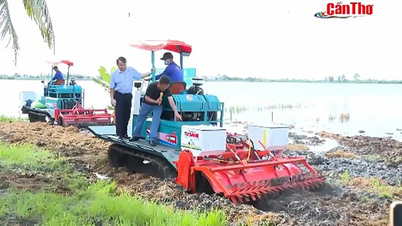
According to assessments by the Department of Agriculture and Environment of Can Tho City, along with many localities, units, businesses, and farmers in cooperatives, the implementation of the One Million Hectare Rice Project has achieved positive results but still faces difficulties that need to be addressed promptly. Specifically, the transportation and irrigation infrastructure serving production in many areas is not yet synchronized and does not ensure the application of the technical procedures of the One Million Hectare Rice Project, especially the application of alternating wet and dry irrigation. The mechanization rate in some stages is still limited, and there are not many organizations and individuals participating in providing mechanized services. Rice straw is not managed and exploited optimally due to difficulties in collecting it from the fields. The human resources of cooperatives are limited, thus hindering the effective development of production and business activities. Few businesses participate in linking and guaranteeing the purchase of rice from farmers. This limits the ability to create a stable and large-scale consumption chain for the entire rice output of the Project.
Based on this reality, the Department of Agriculture and Environment of Can Tho City and many localities in the city hope that more units and businesses will participate in the One Million Hectare Rice Project to create a sustainable value chain. Central ministries and agencies and the city continue to pay attention to supporting localities in investing in and completing infrastructure serving the production of high-quality and advanced rice. According to Mr. Lam Van Vu, Vice Chairman of the People's Committee of Long Phu commune, the number of businesses participating in linking rice production and consumption for farmers is still small, and the locality still faces difficulties in attracting and inviting businesses, so they hope for support and connection from the city's functional agencies. Especially support for cooperatives in investing in and applying effective mechanized equipment in production, especially in collecting and processing rice straw.
Text and photos: KHANH TRUNG
Source: https://baocantho.com.vn/nhan-rong-mo-hinh-san-xuat-lua-chat-luong-cao-va-phat-thai-thap-a196389.html




















































Comment (0)