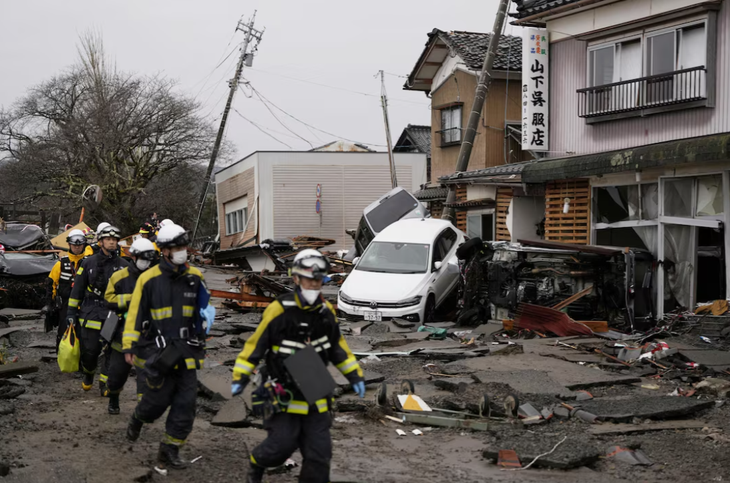
Firefighters conduct search and rescue operations in a tsunami-ravaged residential area in Suzu, Ishikawa Prefecture, Japan, on January 3, 2024. - Photo: KYODO/REUTERS
On September 1st, the Japanese government held a national-scale disaster prevention drill simulating a super-earthquake in the Nankai Trench causing severe damage across the western and eastern regions of the country.
The exercise aimed to test the initial response procedures and coordination among parties in handling complex situations. Japanese Prime Minister Shigeru Ishiba, ministers, and leaders from several local governments directly participated in the exercise.
The scenario assumes a powerful earthquake of magnitude 9.1 occurring off the coast of Wakayama Prefecture, followed by numerous aftershocks ranging from 6.0 to 7.0, causing intense shaking in many areas of western and eastern Japan, and tsunami warnings are issued along the Pacific coast.
Based on actual research from the earthquake that occurred on the Noto Peninsula in early 2024, the hypothetical earthquake scenario takes place on a winter evening.
At the Prime Minister's Office, the Prime Minister convened ministers and established an emergency disaster response headquarters to provide unified direction for the response, while also setting up a live video link connecting with Shizuoka and Wakayama prefectures.
After the governor of Shizuoka Prefecture reported on the earthquake and tsunami situation, as well as the initial damage and difficulties in rescue and relief efforts, members of the emergency response headquarters held discussions and developed a coordinated response plan.
Meanwhile, Prime Minister Ishiba inspected a drill in Saitama City, Saitama Prefecture, simulating a 7.3 magnitude earthquake near Tokyo, with aftershocks exceeding 6.0 magnitude.
The drill included exercises such as firefighters rescuing people trapped in collapsed and rubble-strewn buildings; performing cardiopulmonary resuscitation (CPR) with an automated external defibrillator (AED); and installing cardboard beds at evacuation centers.
Japanese authorities have determined that a mega-earthquake is likely to occur in the Nankai Trench, where the oceanic tectonic plate is subducting beneath the continental plate, stretching from Suruga Bay in Shizuoka Prefecture to the waters off Kyushu, near the Hyuganada Sea.
The Japanese Cabinet Office estimates that the probability of a mega-earthquake occurring is approximately once every 100-150 years. According to estimates by the government's Earthquake Research Committee, there is an 80% chance of a mega-earthquake with a magnitude of 8.0-9.0 occurring within the next 30 years.
Immediate evacuation would reduce tsunami deaths by 70%.
Last March, the Japanese government adjusted its projected damage scenario in the event of a magnitude 9.0 super-earthquake as follows:
First, aftershocks with a magnitude of 6.0 or higher will affect 600 cities and towns in 24 prefectures, from Kanagawa to Kagoshima. Meanwhile, aftershocks with a magnitude of 7.0 or higher will affect 149 cities and towns in 10 prefectures, from Shizuoka to Miyazaki.
Secondly, tsunamis of 3 meters or higher are expected in 25 prefectures, from Fukushima to Okinawa. Waves over 10 meters high will occur in 13 prefectures, from Kanto to Kyushu. Some areas in Kochi and Shizuoka prefectures may experience tsunamis exceeding 30 meters.
Third, the death toll could reach 298,000, including 215,000 deaths from the tsunami and 73,000 deaths from collapsed houses. Meanwhile, approximately 2.35 million homes were completely destroyed, production capacity plummeted, and the economy is estimated to suffer losses of 270 trillion yen (approximately $1.84 trillion).
However, experts believe that effective disaster prevention measures can significantly reduce damage. For example, timely evacuation of residents could reduce tsunami deaths by 70%. Increasing the percentage of earthquake-resistant houses to 100% could reduce the number of collapsed houses by 70% and the number of deaths from building collapses by 80%.
In addition, securing all the furniture in the house could reduce the number of deaths caused by falling furniture by 70%.
Back to the topic
VNA
Source: https://tuoitre.vn/nhat-ban-dien-tap-ung-pho-sieu-dong-dat-20250902080221623.htm



![[Photo] The courage of new recruits of Brigade 144 on the training ground.](https://vphoto.vietnam.vn/thumb/1200x675/vietnam/resource/IMAGE/2026/05/27/1779881651341_anh-man-hinh-2026-05-27-luc-18-32-52.png)

![[Photo] The heat at the fireworks display site on the opening night of the Da Nang International Fireworks Festival 2026](https://vphoto.vietnam.vn/thumb/1200x675/vietnam/resource/IMAGE/2026/05/27/1779889741485_ndo_br_z7872039145157-fecaba5112f39e8352544099d7ef4738-5140-jpg.webp)






























































![[Photo] The courage of new recruits of Brigade 144 on the training ground.](https://vphoto.vietnam.vn/thumb/402x226/vietnam/resource/IMAGE/2026/05/27/1779881651341_anh-man-hinh-2026-05-27-luc-18-32-52.png)































Comment (0)