

Despite the continuous addition of base stations by network providers, the density remains very low, resulting in inconsistent 5G speeds in many areas. Users should consider this when purchasing 5G data plans.
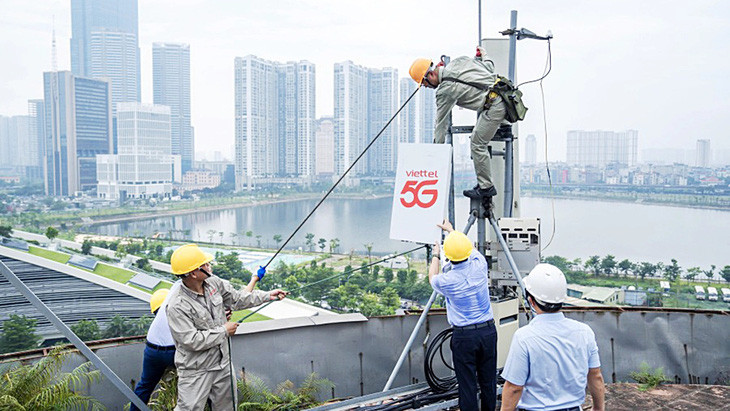
After 3 weeks of trying out the plan. 5G Many users of Viettel 's network report very high speeds in some areas and still low speeds in others... while the network provider gives a series of reasons why 5G is not yet strong.
The speed is still fluctuating.
Having used Viettel's network for over 20 years, Mr. Ngoc Khoa (Tan Phu District, Ho Chi Minh City) was very excited when the network provider offered him a free 5G trial package. Mr. Khoa said that his company is located in District 1 and he also has a garden in Hoc Mon District, so he can experience 5G speeds in many different locations.
"At the company in District 1, the speed is usually very fast, but at home in Tan Phu District, the speed is normal. When I go to Hoc Mon, YouTube lags, and even sending files via Zalo doesn't work. In general, the speed is still very inconsistent," Khoa commented.
Equally enthusiastic, Mr. Binh Minh (Him Lam Phu An apartment complex, Thu Duc City) said he has been continuously testing the speed of the 5G network - which has only appeared in his area for about a week now.
The results showed that "even indoors, 5G speeds varied significantly. Some locations recorded speeds of 160-170 Mbps, while others only reached slightly over 50 Mbps, even though they were only a few meters apart, measured using the same software on the same basic device at the same time."
Minh believes that with such inconsistent speeds, it's only suitable for "experiencing the internet for fun, but not yet a viable option for switching to a paid 5G plan."
Many other users have also reported that 5G speeds vary depending on the device's location. Many locations offer very good speeds, from 200 to 400 Mbps, but there are also many locations where speeds are only a few tens of Mbps, indistinguishable from 4G.
To verify this, a reporter from Tuoi Tre newspaper measured Viettel's 5G speed in several areas of Ho Chi Minh City on the afternoon of November 3rd. Accordingly, the speed was generally high in many areas of Phu Nhuan District, District 3, and District 5. Binh Thanh District Speeds range from 100 to 300 Mbps.
Many areas show fairly high speeds: nearly 600 Mbps. However, in some places, such as the Hoa Phuong street area (Phu Nhuan district), the speed, after several measurements, only reached 60-64 Mbps.
All of Tuổi Trẻ's measurements were taken using Ookla's SpeedTest software on the same smartphone.
A series of reasons why 5G is not yet powerful.
In response to feedback that 5G is still as ineffective as 4G in many places, Mr. Hoang Duc Thanh - vice president The Global Technical Center of Viettel Network Company explained: "The measured speed depends heavily on the customer's location, whether they are close to or far from the base station, and whether the signal is strong or not."
Secondly, there's the server we're routing (connecting) to for testing. Thirdly, there's the number of people using the experience simultaneously...".
Specifically, according to Mr. Thanh, because too many people are simultaneously testing their signals, and 5G base stations are not as numerous as 4G stations, the number of subscribers needing simultaneous testing is concentrated at 5G stations. This is one of the reasons why 5G sometimes feels comparable to 4G.
Explaining why 5G coverage is not as widespread as 4G, Viettel stated that in the initial phase, they focused on deploying 5G in provincial capitals and other areas. industrial zone, It's currently being implemented in tourist areas and areas with a high number of subscribers, but not on a large scale yet.
Furthermore, 5G uses a higher frequency band than 4G (5G uses 2.6GHz, 4G uses 1.8GHz), and the signal loss at 2.6GHz is greater than at 1.8GHz, resulting in a smaller coverage area compared to 4G, by 15-20%. "With the deployment roadmap and technical specifications, the frequency ranges as described above explain why 5G coverage is not yet widespread," a Viettel representative told Tuoi Tre newspaper.
In addition, Ms. Nguyen Thi Tam, Deputy General Director in charge of network planning at Viettel Network Corporation, said that 5G coverage also depends on the number of 5G terminal devices.
"When we started our research, it was 7-8% (of devices supporting 5G), but now, after several boosts, it has risen to 15%, and it will mainly be concentrated in urban areas."
"Therefore, our deployment strategy, and that of all network operators worldwide , for 5G is to focus on deployment in urban areas first, and then gradually expand over the years," Ms. Tam said.
Consider this when purchasing a 5G package.
Speaking to Tuổi Trẻ newspaper, Mr. Nguyen Thanh Phuoc (director of 24h Phone and Laptop Hospital) stated that there are several reasons why 5G speeds fluctuate erratically, even though network operators advertise that common 5G speeds can reach 1 Gbps, 10 times faster than 4G.
Firstly, 5G uses high-frequency bands to achieve fast speeds, but these are easily obstructed by materials such as walls, glass doors, or trees.
Therefore, 5G speeds may decrease in areas with many obstacles or where there is no clear line of sight to the base station. Meanwhile, 4G signals (which typically operate in a lower frequency band than 5G) are less affected by obstacles.
Secondly, 5G speed depends on the distance between the device and the base station (4G is similar). However, 4G coverage is now so extensive that users rarely notice signal "dead zones".
Thirdly, there's the capacity and processing capability of the base station. In densely populated areas or with many devices connected simultaneously, the base station's capacity can become overloaded, causing 5G speeds to decrease.
Small cell base stations are often deployed to provide support, but not all locations are fully equipped.
According to Mr. Phuoc, 5G is a developing technology, and its speed also depends on the time of day as network traffic fluctuates. In recent days, with network operators officially launching many 5G packages, network speeds may decrease significantly due to the surge in the number of users connecting simultaneously.
"Therefore, from an expert's perspective, we advise users to only consider switching to 5G if they live in an area with good 5G infrastructure. If you only use common network tasks and want to ensure stability, 4G is still a reasonable choice at the moment," Mr. Phuoc advised.
Source






































































































Comment (0)