

Classroom inside the mountain
Teacher Lu Van Thuy is small in stature, reserved, and speaks little. Judging by appearances, he is clearly a hardworking and honest man. This year, Mr. Thuy is 42 years old.
Mr. Thuy is currently a teacher at Sin Suoi Ho Ethnic Boarding Primary School (Phong Tho District, Lai Chau Province). The school is located in San Bay village. San Bay village is not flat like its name suggests; the roads are winding and bumpy. However, because it's the central village of the commune, the journey is less difficult than to the two schools where Mr. Thuy previously taught.
Teacher Thuy was born and raised in Khong Lao commune, Phong Tho district, Lai Chau province. In 2003, after graduating, he was assigned to teach at the Sang Ma Pho village branch of Sin Suoi Ho Ethnic Boarding Primary School.
The village of Sang Ma Pho is about 20 kilometers from the commune center, along a dirt road through mountains and passes. Whenever they run out of food, Mr. Thuy has to walk for half a day. “Even as a local, I find that journey incredibly difficult. If I didn't feel sorry for the children in that extremely disadvantaged area, I would have given up and gone home. And I also feel sorry for the effort my parents put into raising and educating me. Thinking about that, I motivate myself to stay in this profession,” Mr. Thuy confided.
Fresh out of school, Mr. Thuy "settled" in a remote village to teach literacy to Hmong children. At that time, the villagers gave him rice and vegetables, and he had to carry salt, noodles, and dried fish up to eat for a whole week. In 2003-2004, the village had no electricity. The classroom and the teacher's house were side-by-side, made from flattened bamboo panels, with a thatched roof. All the desks and blackboards were made from leftover wood when the villagers sawed timber for their houses.
The village has about 35 houses and 3 classrooms. Mr. Thuy's class is a mixed-age class. In that class, one group studying the second-grade curriculum faces upwards; another group studying the fourth-grade curriculum faces downwards, with the two groups back-to-back. Every day, Mr. Thuy moves from one end of the classroom to the other to teach these two groups, traveling several kilometers in the process. His poor students' literacy skills fluctuate with their daily hunger and satiety.
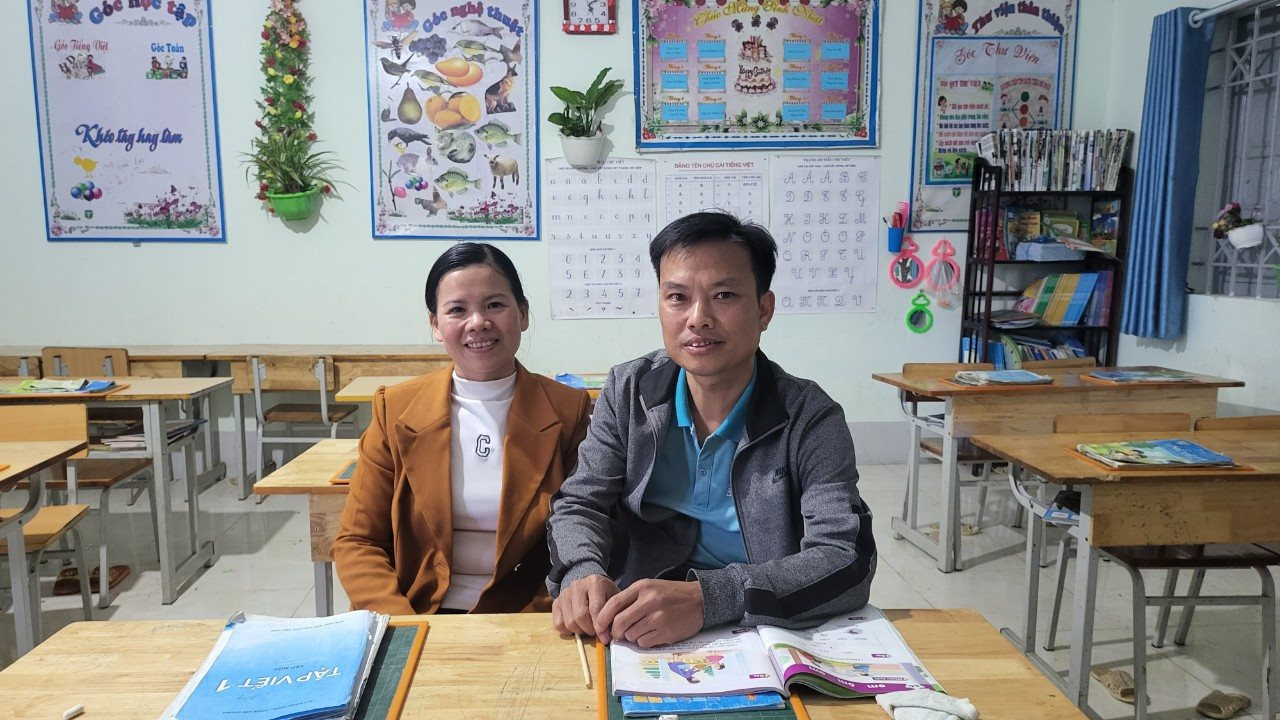
In 2005, the school administration transferred Mr. Thuy to another village called Chang Phang, 12 kilometers away from the commune center, but only an hour's walk from his old village. Chang Phang is also a village inhabited by the Mong ethnic group. Every week, Mr. Thuy walks for more than two hours from the commune center to his teaching location. If you calculate the distance from Lai Chau City center to Sin Suoi Ho commune center as about 30km, then the distance to the village where Mr. Thuy teaches is nearly 50 kilometers.
“Back then, fresh out of school, I was a young, healthy man, and being a local, the remote villages where the school was located needed me. In my life, and in my teaching career here, perhaps the cold in Sin Suoi Ho is the most unforgettable. Especially on winter nights, the biting cold penetrated to the bone; even under blankets and wearing multiple layers of socks, my feet still ached.” - Teacher Thuy recounted.
Sin Suoi Ho is located at an altitude of over 1,000 meters above sea level. The cold here seems to be drawn from the heart of the mountain; even sleeping under multiple layers of blankets and socks doesn't stop the chill. Of the four seasons, perhaps winter is when one feels the poverty of the highlands most acutely. The warmth inside the houses is scarce, leaving only a vast emptiness. The Hmong students, with only a single coat to protect them from the winter, go to class barefoot every day. "It's so heartbreaking!"
With his hands clasped together, the teacher gazed out at the rushing wind and dense clouds filling the valley. His voice, hoarse and muffled, drifted through the thick fog. “Winter is coming soon, the students up here are very cold. If you manage to get any warm blankets, please remember to send me a few…”
A lifetime, a lifetime of work…
Since Lai Chau province implemented a policy of bringing all students from grade 3 in remote villages to the main school and providing boarding meals, nearly 200 students from outlying schools have been transferred to the commune center. Only grades 1 and 2 remain in the villages.
Thanks to this policy, Mr. Lu Van Thuy and many other teachers "stationed in remote villages" had the opportunity to move to the central school in San Bay village to teach. In 2007, Mr. Thuy married Ms. Lo Thuy Luong (born in 1981), a secondary school teacher also from an ethnic minority group, who is currently the Deputy Principal of Sin Suoi Ho Ethnic Boarding Secondary School (abbreviated as Sin Suoi Ho Secondary School), in the same commune as Mr. Thuy's school.
Here, the primary and secondary schools are separated by only a wall. Opposite the two schools is the headquarters of the Sin Suoi Ho Commune People's Committee. According to Mr. Ly Van Xien, Deputy Secretary of the Commune Party Committee, the entire population of Sin Suoi Ho Commune is ethnic minority, with the Mong ethnic group accounting for 70%, mainly engaged in agriculture . The commune's poverty rate is 64%. Therefore, in addition to investments in infrastructure, education is expected to bring a brighter future to this challenging mountainous region. Teachers like Mr. Thuy and Ms. Luong, who have dedicated their lives to serving in the remote villages, are highly valued.
Mr. Dong Tat Thang, Principal of Sin Suoi Ho Secondary School, shared: "Ms. Luong and Mr. Thuy are the longest-serving teachers at Sin Suoi Ho Primary School and Sin Suoi Ho Secondary School here. Many current commune officials are former students of Mr. Thuy and Ms. Luong. We deeply appreciate their dedication and sacrifice for the sake of education for the people in our village."
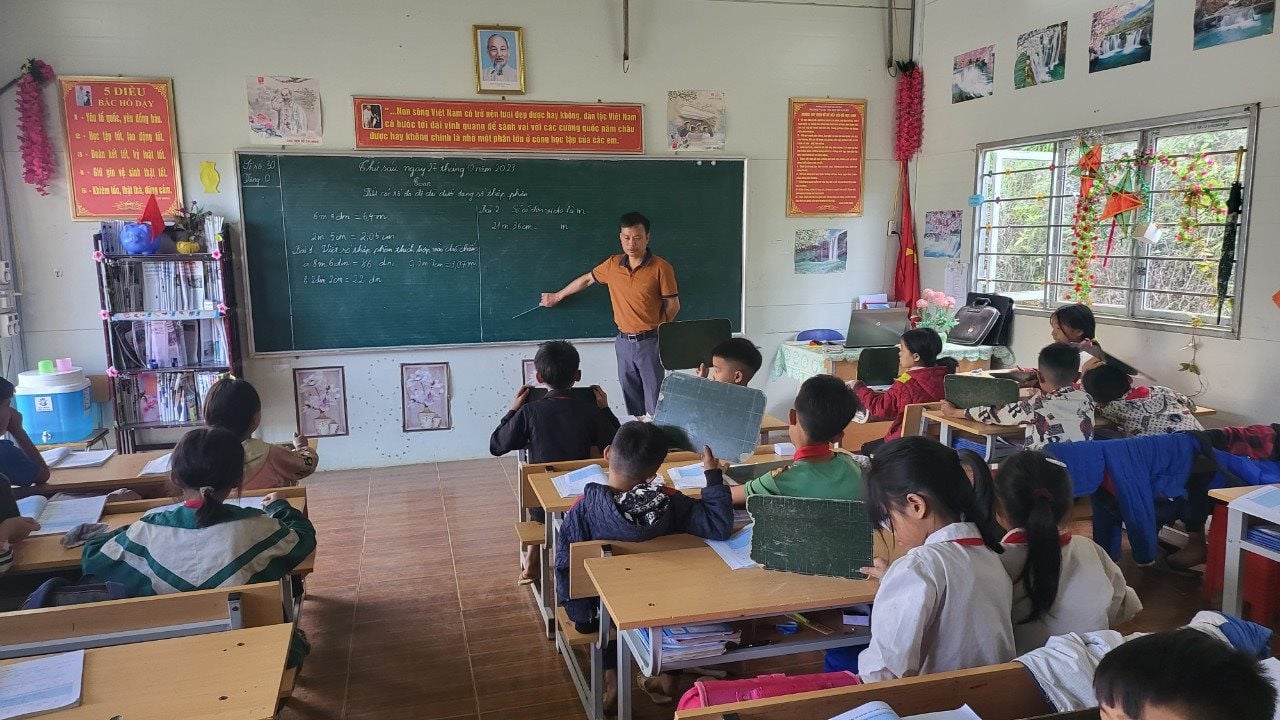
While Mr. Thuy and Mrs. Luong may have established a solid career in education , they still harbor concerns about their family life.
Ms. Luong recounted: “My husband and I have two children. The older one is in 7th grade this year, and the younger one is only 5 years old. Previously, the commune lent our family land near the school to build a house. Commuting and daily life were convenient. However, since 2020, the commune reclaimed the land, and the whole family moved to Lai Chau City. Every day, my husband and I travel about 60km from Lai Chau City to Sin Suoi Ho to teach. Both children stay at home with their grandmother; the older one goes to school, and the younger one is looked after by her grandmother, who is over 70 years old. My husband and I also want to transfer to a teaching position closer to home to take care of our family, but it's too difficult. We travel 60km back and forth every day. On warm, sunny days it's fine, but on rainy and cold days it's incredibly difficult. The road is rough and rocky, making it very dangerous if you can't drive steadily.”
Many teachers in Sin Suoi Ho also share similar feelings and concerns.
That day, in the school cafeteria, the teachers from both the primary and secondary schools welcomed us warmly and cheerfully, as if they were long-lost relatives. Everyone's face was radiant with small joys… But deep in their eyes, there were still worries. Just asking about their families was enough to make one teacher burst into tears. Most of their children were sent to live with elderly parents in the countryside or in the city. They poured all their love for their children into these poor students.
As soon as the 8 PM news ended, the village of San Bay fell silent and still… only the wind whistling from the valley and the teachers' voices, sometimes low, sometimes high, as they shared strong, spicy drinks to welcome guests. In that atmosphere, I truly felt the sacrifice and complete dedication of the teachers in this highland region. With Teachers' Day on November 20th fast approaching, I wish the teachers of Sin Suoi Ho continued good health so they can continue to sow the seeds of knowledge in this mountainous area.
Source






















































































Comment (0)