

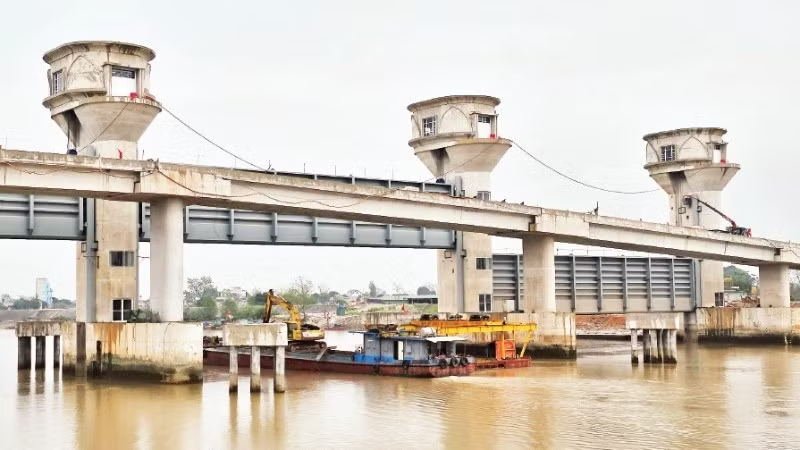
Avoid being caught off guard or surprised.
According to Tran Cong Tuyen, Head of the Dike Management Department (Department of Dike Management and Disaster Prevention and Control, Ministry of Agriculture and Environment ): Vietnam has a total length of 9,739km of dikes in 29 localities, including 6,065km of river dikes, 2,504km of sea dikes and estuary dikes, and 1,170km of embankment dikes and protective dikes.
Of these, 2,827km of dikes, ranging from level III to special level, are tasked with protecting people and agricultural production, as well as many important economic and political centers of the country, from floods and storms; mainly concentrated in the Northern and North Central regions.
In addition, there are approximately 7,315 irrigation dams and reservoirs with a total storage capacity of about 15 billion cubic meters, whose main function is to control flooding in downstream areas. However, these dikes and reservoirs were built a long time ago, and their ability to withstand increasingly extreme natural disasters has become limited.
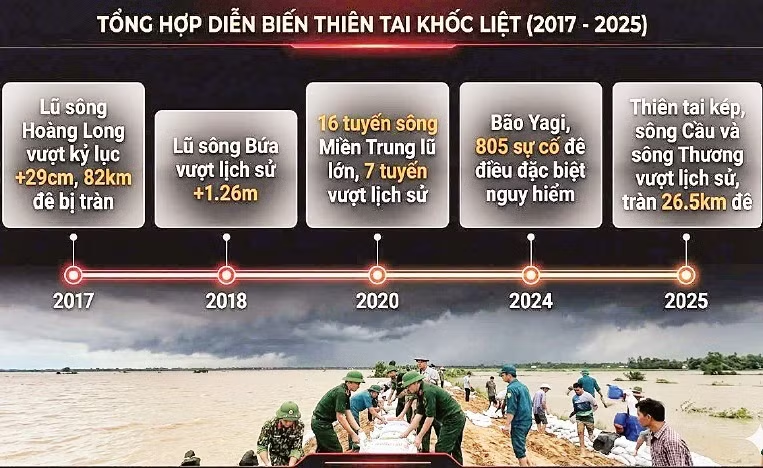
Deputy Minister of Agriculture and Environment Nguyen Hoang Hiep said: “Besides the unity and determination of the entire political system and the people to overcome difficulties and achieve the important result of minimizing damage, disaster prevention and control is being approached with new perspectives, long-term strategies, and systematic plans. With this understanding, mechanisms, policies, science and technology, digital transformation, and artificial intelligence are also being strongly invested in, which are key factors to enhance proactiveness and avoid being caught off guard by natural disasters.”
Under the scorching sun of early summer, at the construction site of the drainage culvert through the dike of the Cam Bao pumping station in Xuan Cam commune, Bac Ninh province, the atmosphere is one of urgency to ensure progress before the 2026 rainy and stormy season.
Mr. Ngo Van Kien, a technical officer at the Project Management Board of Nam Song Thuong Irrigation Works Exploitation One-Member Limited Liability Company, said: “In 2025, after heavy rains, widespread flooding occurred in the commune, and many seepage and bubbling springs appeared along the dikes. To protect the safety of people in the downstream area and the industrial zones under construction, Bac Ninh province urgently started the construction of this project in November 2025. To date, the pumping station has completed a large volume of work, striving to ensure flood drainage during this year's rainy season.”
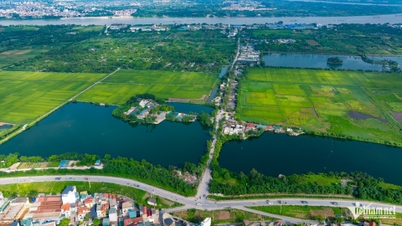
Taking us on a tour of the embankment along the left and right banks of the Chu River, Do Minh Chinh, Head of the Embankment Management Department (Water Resources Sub-Department, Department of Agriculture and Environment of Thanh Hoa Province), said: “In previous years, the embankments along the left and right banks of the Chu River were always strongly affected by the main current flowing directly towards the banks, causing serious erosion. To ensure the safety of lives and property of the State and the people, the province has invested in repairing the damage and erosion of the Phu Van embankment in Dong Tien ward. Due to the impact of heavy rains at the end of 2024 and the beginning of 2025, the erosion and damage along the Phu Van embankment have become even more complex, posing a threat to the safety of the embankment, the lives and property of more than 1 million people and more than 100,000 hectares of agricultural land, along with many important economic, political, and cultural facilities.”
Meanwhile, Pham Duc Luan, Director of the Department of Dike Management and Disaster Prevention, suggested that it is necessary to review, arrange, and relocate people in high-risk areas now; and adjust the structure of crops and livestock towards a more natural, efficient, sustainable, and safer approach in the face of natural disasters.
The system of dikes, reservoirs, and disaster prevention works, especially critical and damaged structures, needs to be repaired, upgraded, and renovated more quickly.
On the other hand, the agriculture and environment sectors need to review and adjust the operating procedures of reservoirs and interconnected reservoir systems, prioritizing the allocation of capacity to reduce flooding in downstream areas. Resources for disaster relief need to be increased, focusing on more sustainable reconstruction.
A long-term investment strategy is needed.
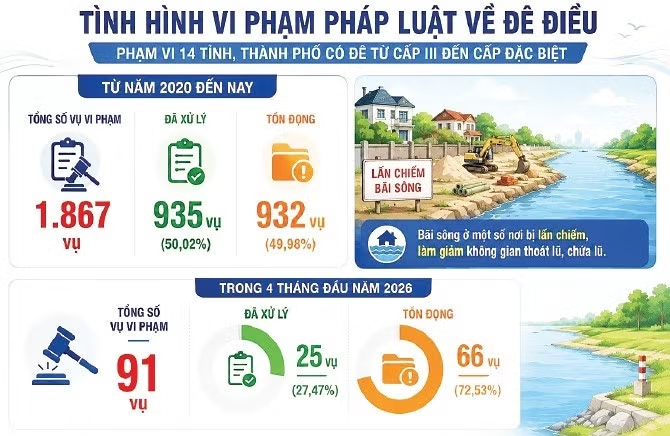
According to Tran Cong Tuyen, Head of the Dike Management Department of the Department of Dike Management and Disaster Prevention, in just 14 provinces and cities with dikes ranging from level III to special level, the total number of violations of dike regulations from 2020 to the present is 1,867 cases, of which 935 have been processed, leaving 932 cases unresolved; riverbanks in some areas have been encroached upon, reducing flood drainage and storage space.
In the first four months of 2026, there were a total of 91 violations, with 25 cases resolved and 66 cases remaining unresolved. The government, ministries, and localities consistently prioritize allocating resources for investment in the repair, upgrading, and maintenance of dikes and embankments.
Accordingly, the medium-term public investment plan for the period 2021-2025 has been implemented with seven independent projects and 37 component projects, with a total investment of over 6,681 billion VND; during the period 2021-2025, 2,160 billion VND has been allocated for maintenance, repair of damage to increase lifespan and prevent degradation of the dike system.
Currently, the Ministry of Agriculture and Environment is preparing to invest in the ADB 10 project with a total budget of over VND 5,260 billion and developing a medium-term plan proposal for the period 2026-2030 with an estimated budget of approximately VND 19,400 billion to repair and upgrade the dike system and prevent riverbank and coastal erosion.
Furthermore, according to Phan Tien An, Head of the Dam and Reservoir Safety Department of the Irrigation Department, the goal of applying technology to support the management and operation of irrigation dams and reservoirs is to ensure absolute dam safety in all situations, effectively reduce flooding downstream to minimize damage to people and property, and maximize water storage to serve agricultural production, domestic water supply, and other economic sectors.
Therefore, the requirement is to shift from traditional management methods to smart management based on digital platforms, building a decision-making support system for operating irrigation reservoirs that meets the criteria of timeliness, accuracy, flexibility, and proactiveness. For dikes and irrigation reservoirs to become "shields" against natural disasters, forecasting also needs to be improved, accurate, and systematic.
According to the Director of the Meteorology and Hydrology Department, Nguyen Thuong Hien, the meteorological and hydrological sector must be comprehensively modernized, with the development of high-quality human resources being a key factor.
In the short term, the sector needs to focus on training human resources; in the long term, it needs to improve the capacity for forecasting and warning of natural disasters, including promoting the expansion of the national meteorological and hydrological monitoring network, with a focus on strengthening the weather radar network; developing and perfecting an integrated forecasting model and technology system combining physical-statistical-artificial intelligence models, ensuring the requirements for early, timely, and accurate forecasting and warning of natural disasters, especially those that occur frequently and cause significant damage.
Source: https://nhandan.vn/nhung-la-chan-phong-chong-thien-tai-post964404.html

























































































Comment (0)