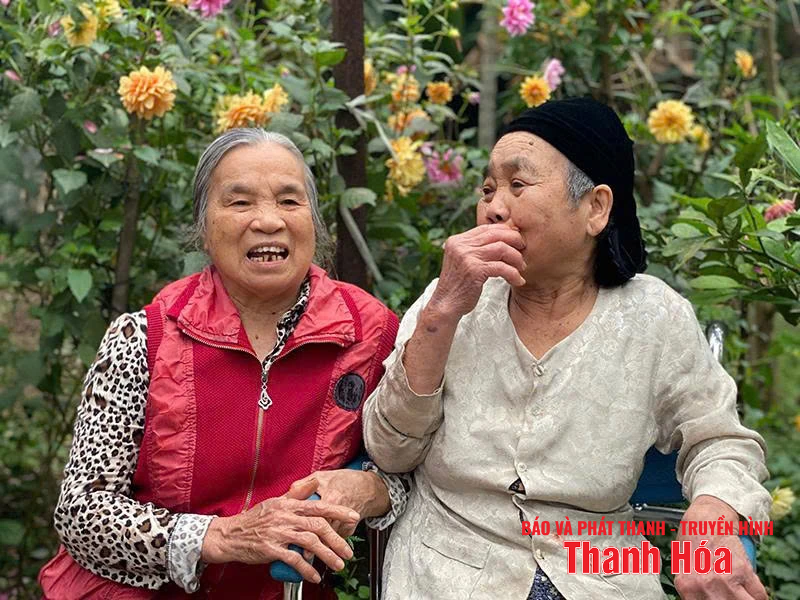
The joys of old age for Mrs. Nguyen Thi Huyen and Mrs. Nguyen Thi Tuyen - the female heroes of Yen Vuc village.
1. Mrs. Nguyen Thi Tuyen (82 years old) slowly recalled her beautiful youthful memories with a mixture of joy, pride, and emotion, choked with tears. She confided: "I am now 'close to death,' and many things have become a jumble of memories and forgetfulness..." Yet, the story of how Yen Vuc village fought to protect Ham Rong bridge, and how she participated in the fight against the Americans, is etched in her mind, as if a gentle brush away of the dust of time would immediately bring it back to life vividly and realistically.
The afternoon of April 3, 1965, marked a significant event in Thanh Hoa province's history: the US Air Force began its attack on Ham Rong Bridge. Groups of jet aircraft of various types, such as F-105s, F-8s, and F-101s, swooped down and bombarded the area. In an instant, Ham Rong became a "cauldron of fire," shaking the entire region. "The battle to defend Ham Rong Bridge by the army and people of Thanh Hoa was extremely fierce, with many losses and sacrifices," said Mrs. Tuyen, her eyes welling up with tears. Mrs. Tuyen was one of the female militia members from Yen Vuc village who participated in the fight to defend Ham Rong Bridge from the very beginning. “From April 3rd, 1965, many enemy planes entered Ham Rong. The deafening roar of the aircraft engines, followed by the sound of bombs and bullets, shattered the peaceful days of Ham Rong and the surrounding villages, including our village of Yen Vuc,” Mrs. Tuyen recounted in a somber voice.
On the northern bank of Ham Rong Mountain at that time, Yen Vuc village was like a "bombing zone." To avoid casualties, the villagers of Yen Vuc mobilized to evacuate, leaving only the militia to stay and serve in the fighting. A militia platoon was formed in Yen Vuc village with about 100 members, divided into 5 sections, undertaking various tasks such as: transporting the wounded, transporting ammunition, replacing artillerymen, on duty, logistics, burying fallen soldiers, patrolling and guarding, increasing production, digging trenches, assisting in the evacuation of civilians... Ms. Tuyen recounted: "The Yen Vuc militia at that time were arranged to eat and sleep together, and they still took care of farming and production work every day. When the enemy bombarded the area, they coordinated with combat units at the artillery positions."
Although she didn't know the shape, structure, or usage of the cannon beforehand, young militia member Nguyen Thi Tuyen, inspired by the spirit of "descendants of the homeland of Lady Trieu" and the motto "when the enemy comes to our house, even women will fight," eagerly volunteered for various tasks, from supplying provisions, transporting ammunition, and carrying the wounded to replacing artillerymen. Ms. Tuyen recalls that in those days, she always carried her K44 rifle on her shoulder. The fierce fighting made transporting ammunition and the wounded extremely urgent. To quickly and efficiently supply ammunition to the army units on the battlefield, Ms. Tuyen devised a way to add bamboo strips to her shoulders to increase their strength. "That means whatever the war needed, whatever the soldiers needed, the militia of Yen Vuc village was determined to do it, regardless of bombs falling, bullets flying, or ever-present danger; even death wouldn't deter us," Ms. Tuyen confided.
Through her many efforts and contributions in labor and combat, at the age of 24, Ms. Tuyen was honored to join the Party. Ms. Tuyen served as the Deputy Platoon Leader of the Yen Vuc Village Militia, the Vice Chairman of the Hoang Long Commune People's Committee, and also spent time involved in the commune's women's association... In every position, Ms. Tuyen was enthusiastic, dedicated, and responsible in her assigned work. She and her comrades shared a vibrant, beautiful, and proud youth together.
2. War memories are filled with sorrow and haunting memories of loss and sacrifice. The memories of a time of bombs and bullets shared by the female militia members of Yen Vuc village are no exception. Mrs. Nguyen Thi Huyen (80 years old) tearfully recalled the large-scale bombing raid by American planes on the Ham Rong - Ma River area on September 21, 22, and 23, 1966.
According to the operational plan, the US Navy mobilized over 80% of its attack aircraft to assault the area for three consecutive days in a "layered leaf-falling" pattern. The bombing targets were not only the Ham Rong Bridge but also neighboring targets. The time between each attack was only an hour, so that the enemy could not yet recover from the previous attack before facing the next. In each attack, the American forces dedicated over 50% of their forces to artillery positions first, before launching a swooping attack on the bridge. Ms. Nguyen Thi Huyen recounted: "During one bombing raid, the entire warehouse containing many soldiers was leveled; not a single survivor. When our militia was tasked with transporting the wounded, witnessing that scene was incredibly painful and heartbreaking. We tried to suppress our grief and brought the fallen soldiers back to the village to prepare for their funerals."
Ms. Huyen wiped away her tears and added, “I still remember vividly, when we were gathering the bodies of the fallen soldiers in the village, the women stood around in shock. An elderly villager spoke up to encourage us: ‘Children and grandchildren, try your best, take care of the soldiers properly so they can find some comfort.’ We feel so sorry for them, but we can’t do anything.” As she spoke, Ms. Huyen’s eyes welled up again, reddening. Her tears reflected both the shared grief of the nation and the sorrow of her own family. It is known that Ms. Huyen’s father also died from a bomb blast; Ms. Huyen herself had faced the brink of death countless times under a hail of bombs and bullets. But for Ms. Huyen: “No matter what, the militia of Yen Vuc village will always hold their ground, overcome all difficulties and hardships, and cooperate with the army to defeat the enemy.”
3. Losses and sacrifices were also something that Mrs. Nguyen Thi Thuyen witnessed while working as a medical transporter during the fierce battles of Ham Rong - Yen Vuc. Her hands had gathered the remains of civilians and soldiers. On one occasion, a bomb fragment grazed her, causing a cut and bleeding.
Now, Mrs. Thuyen lives alone in a small house. Her life story evokes much sympathy. Mrs. Thuyen's family had three siblings; she was the only daughter. Her older brother enlisted and later died. Partly due to her own determination, and partly wanting her younger brother to stay home and care for their parents, Mrs. Thuyen decided to join the Youth Volunteer Force. However, just as she arrived at the battlefield, she received news that her younger brother had also enlisted. Her brother later died, leaving her family with two martyrs. Mrs. Thuyen sighed, "In the end, I was the lucky one who survived." Returning from the battlefield, she remained single, caring for her parents.
The Ham Rong - Ma River area during the resistance war against American imperialism was truly a land of countless glorious victories, of ups and downs and triumphs, of ordinary people becoming extraordinary, rising to become beautiful symbols of fervent patriotism and bright revolutionary heroism. Yen Vuc village is a land that has inscribed its name in the history of Thanh Hoa province in particular, and the history of the nation in general, with resounding victories in the long resistance war against American imperialism. This is the homeland of 75 glorious heroes. Among them, the female heroes of Yen Vuc at that time, undeterred by hardship, suffering, or imminent danger, remained steadfast in their determination, striving towards a common aspiration - the aspiration for peace. Together, they wrote a beautiful song about the courage, intelligence, and qualities of Vietnamese women.
And as "the sun begins to set," one of the greatest joys for the female warriors of Yen Vuc village, such as Mrs. Tuyen, Mrs. Huyen, and Mrs. Thuyen, is to be reunited with their families and loved ones, to live close to their comrades who fought alongside them on their homeland, and to see their homeland change and develop day by day...
Text and photos: Thanh Huong
Source: https://baothanhhoa.vn/nhung-nu-dung-si-nbsp-lang-yen-vuc-255370.htm


![[Image] A brilliant symphony and explosive power in the skies of Da Nang.](https://vphoto.vietnam.vn/thumb/1200x675/vietnam/resource/IMAGE/2026/05/31/1780196945787_anh-man-hinh-2026-05-31-luc-10-08-51.png)







![[Video] Sunset at Lap An Lagoon – Where the sun sets over the fishing nets](https://vphoto.vietnam.vn/thumb/340x192/vietnam/resource/IMAGE/2026/05/31/1780192137701_beach-landscape-sea-water-nature-grass-745871-pxhere-com.jpeg)

























































Comment (0)