

The goal is to ensure that 100% of students have a place to study after lower secondary school, while reducing exam pressure and diversifying educational options.
The school network is expanding in scale.
According to data released by the Ho Chi Minh City Department of Education and Training at the end of April 2026, the total enrollment quota for 10th grade in 181 public high schools in the city reached 118,550 places, equivalent to approximately 70% of junior high school graduates having the opportunity to continue their education at public schools. Generally, most high schools maintained or increased their enrollment quotas compared to the previous academic year – a necessary adjustment given the significant increase in the number of junior high school graduates.
Among them, Phuoc Kien High School (Nha Be commune) saw the highest increase with 375 enrollment slots; followed by Thai Hoa High School (Tan Khanh ward) with 365 slots. Nguyen Van Tang High School (Long Binh ward), Vo Truong Toan High School (Tan Thoi Hiep ward), and Ho Thi Bi High School (Hoc Mon commune) each increased by 315 slots. Notably, many "hot" schools also expanded their enrollment: Tran Phu High School ( Phu Tho Hoa ward) increased by 135 slots; Tran Dai Nghia Secondary and High School (Saigon ward) and Nguyen Huu Huan High School (Thu Duc ward) both increased by 180 slots… Increasing enrollment slots at highly competitive schools not only broadens opportunities for admission but also helps to alleviate the pressure of the 10th grade entrance exam.
In the 2025-2026 school year, Ho Chi Minh City is expected to have over 169,000 junior high school graduates, an increase of 42,734 compared to the previous year. However, the increase is unevenly distributed: the former Ho Chi Minh City area saw an increase of 27,106 students; the former Binh Duong area an increase of 8,419 students; and the former Ba Ria - Vung Tau area an increase of 7,209 students. This significant increase and disparity create considerable pressure on the high school education system, especially in rapidly urbanizing areas.
In response to this situation, the Ho Chi Minh City Department of Education is implementing a plan to increase enrollment quotas for public high schools on a large scale. The new approach involves a flexible allocation of quotas, based on the population characteristics of each area and the capacity of each school, instead of the rigid system used previously. This allows for more efficient utilization of existing resources.
Simultaneously, the Ho Chi Minh City Department of Education and Training has requested schools to conduct a comprehensive review of their facilities, from classrooms and functional rooms to teaching equipment; based on this, they should propose repair and upgrade plans to improve their capacity to accommodate students. This is considered a solution to "utilize internal resources," helping to expand enrollment without relying entirely on new construction.
Besides increasing enrollment quotas in existing schools, the city is also promoting the development of its school network. For the 2026-2027 school year, Ho Chi Minh City will put into operation five new high schools, including two completely new constructions and three schools converted from former People's Committee headquarters, with a total enrollment capacity of approximately 3,330 students. This additional enrollment will significantly contribute to reducing pressure on the public school system.
From a grassroots perspective, Mr. Dinh Van Trinh, Principal of Nguyen Hien Secondary School (Tan Thoi Hiep Ward), believes that increasing enrollment quotas and adding more high schools has helped reduce psychological pressure on 9th-grade students during the entrance exam. “In areas with rapid population growth, if schools aren't added promptly, the pressure will be concentrated on a few central schools, leading to overcrowding. Even investment helps students have the opportunity to study near their residences, while also reducing travel costs and time for their families,” Mr. Trinh shared.
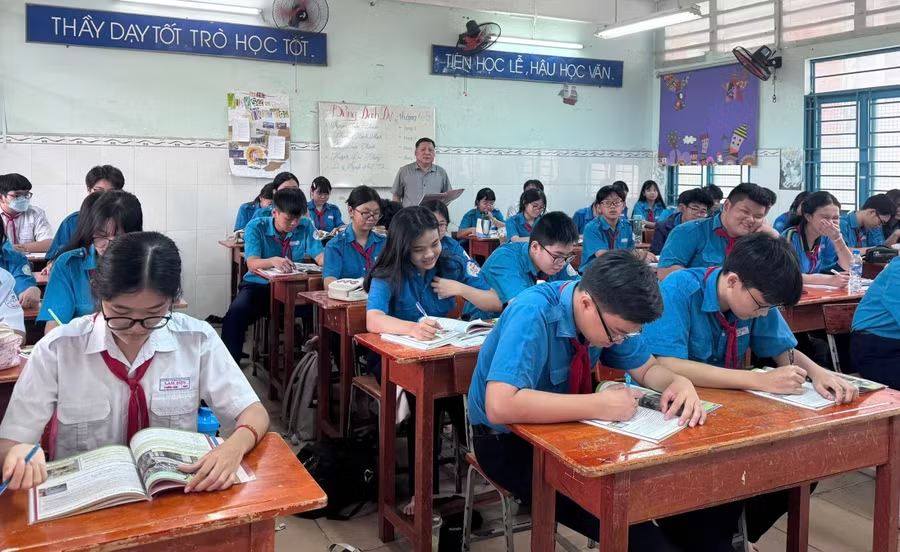 Students at Lam Son Secondary School (Binh Phu Ward) during class time. Photo: MA
Ensuring that all students have a place to study after lower secondary school.
A new feature in the 2026 10th grade admissions process is the adjustment of the admissions method by the Ho Chi Minh City Department of Education and Training. The exam will be held earlier, on June 1st and 2nd, shortening the timeframe and facilitating subsequent steps. Simultaneously, the two-stage admissions mechanism allows for supplementary admissions at schools that have not yet met their quotas, limiting localized oversupply and undersupply and optimizing resources.
According to the leaders of the Ho Chi Minh City Department of Education and Training, if one only looks at the enrollment quota for public high schools, many people may feel pressured because the acceptance rate does not reach 100%. However, the city's education system is designed to be multi-tiered, ensuring that all students have the opportunity to continue their studies. In addition to public high schools, the city also has approximately 18,000 enrollment slots in the public continuing education system.
Mr. Do Minh Hoang stated: “The current continuing education program at the high school level is recognized as equivalent to the 2018 General Education Program, ensuring students still acquire knowledge and have opportunities for higher education. Therefore, this is currently the 'priority' choice for many students who did not get admitted to public high schools.” In addition, Ho Chi Minh City is steadfast in its orientation of channeling students after lower secondary school, with a portion choosing to study at private schools, vocational schools, etc. This is a long-term strategy to diversify educational paths.
According to Ms. Bui Khanh Nguyen, an independent education expert in Ho Chi Minh City: "Non-public and vocational education models are increasingly improving in quality, opening up early and flexible career opportunities. If properly guided, this is a completely effective choice, no less effective than the traditional academic path."
In fact, if students don't get into public high schools, they still have many options such as: private high schools; vocational education and continuing education centers; continuing education centers; or vocational training at colleges and vocational schools. According to the Ho Chi Minh City Department of Education and Training, the total enrollment quota for all types of training is 180,662, which is 11,582 more than the number of students expected to graduate from grade 9. This shows that the city can completely guarantee school places for 100% of students after junior high school.
Mr. Ho Tan Minh, Chief of the Office of the Ho Chi Minh City Department of Education and Training, stated: “Admission to 10th grade in public high schools in Ho Chi Minh City is conducted in two forms: entrance exams for public high schools and selection based on academic records for private schools, vocational high schools, and some specialized high schools. For public schools, the Ho Chi Minh City Department of Education and Training will select students for the following schools: Thanh An Secondary and High School; Vo Thi Sau High School - Con Dao Special Zone; and the Ethnic Minority Boarding School.”
Source: https://giaoducthoidai.vn/no-luc-giai-bai-toan-cho-hoc-sau-cap-thcs-post776498.html



![[Image] Hanoi's urban life under the challenge of a "scorching hot" environment](https://vphoto.vietnam.vn/thumb/1200x675/vietnam/resource/IMAGE/2026/05/25/1779706979265_nang-nong-t5-2026-minh-duy-7-4636-jpg.webp)
![[Image] Close-up view of the interchange connecting the two expressways and Long Thanh Airport.](https://vphoto.vietnam.vn/thumb/1200x675/vietnam/resource/IMAGE/2026/05/25/1779703378210_ndo_br_z7863716673926-224453a31600126cce10622af6290afd-4549-jpg.webp)



















































































Comment (0)