

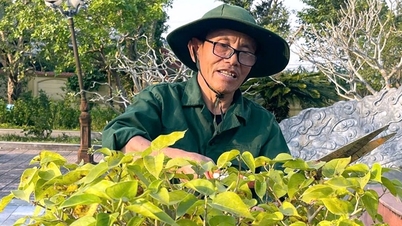
Amidst the scorching heat of over 40 degrees Celsius in early April 2024, the people of Hamlet 2/9, Chau Khe border commune (Con Cuong district), still braved the sun to visit their fields, preparing for the harvest of Solanum torvum (thorny eggplant). In the vast green fields of Solanum torvum, Mr. Nguyen The Dung's medicinal herb farm is located near the main road leading to the old Nong Trang hamlet, now Hamlet 2/9. At harvest time, the Solanum torvum plants are taller than half a person's height, their branches intertwining and covered in sharp thorns.
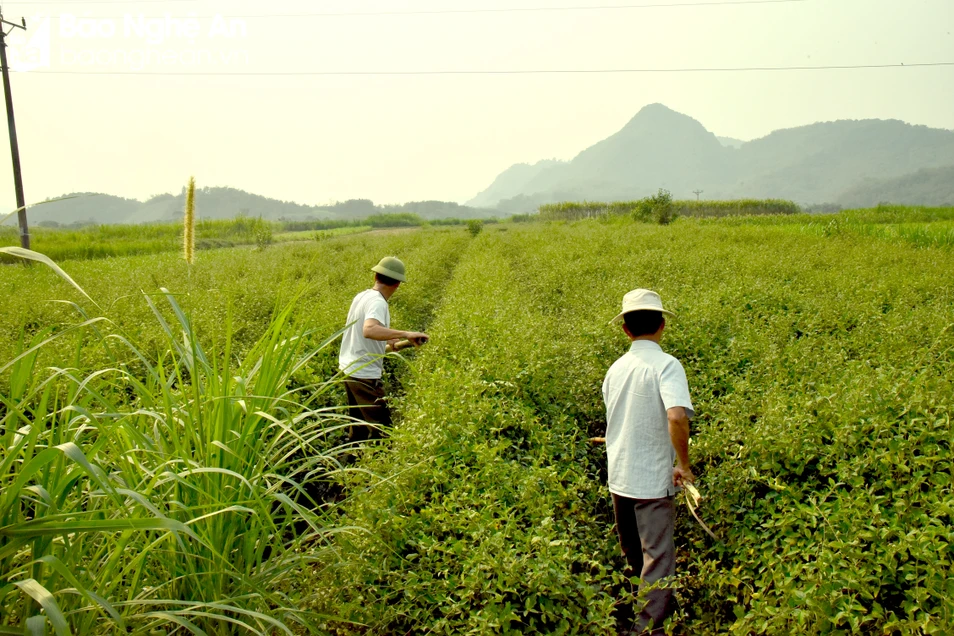
In the early afternoon, after attending the village Party branch meeting with Mr. Nguyen Van Ha, Mr. Dung and Mr. Ha took their tools to the medicinal herb field to harvest, in order to deliver the goods on time as scheduled with the company that buys the products.
“Before harvesting, we have to use bamboo poles to separate the tangled vines between two adjacent rows to ‘open a path’ into the field. To harvest this Solanum torvum plant, at least two people need to work together. One person cuts the roots, and the other uses a rake to wrap the vines into coils like this,” Mr. Dung explained while skillfully working.
Previously, sugarcane was the main crop in Hamlet 2/9, with almost every household in the hamlet growing sugarcane. However, compared to sugarcane, Solanum torvum (thorny eggplant) is a crop that yields much higher economic returns. For each hectare of Solanum torvum, our villagers invest approximately 2 million VND in fertilizer, 600,000 VND in plastic sheeting for weed control and moisture retention, and about 1 million VND in seedlings for the first year. The plants can be kept for 3-5 years without needing further investment. After 6-8 months of care, the yield is about 3-4 tons of fresh plants.
With the current purchase price of around 4,500 VND/kg, farmers earn 12-15 million VND/ha/crop. With two harvests per year, the average income is 25-30 million VND/ha. In Hamlet 2/9, even the smallest farms have about 2 sao (approximately 0.2 hectares), while larger farms range from 4-7 sao, such as Mr. Nguyen The Dung with 6 sao and Mr. Nguyen Van Ha with 5 sao…
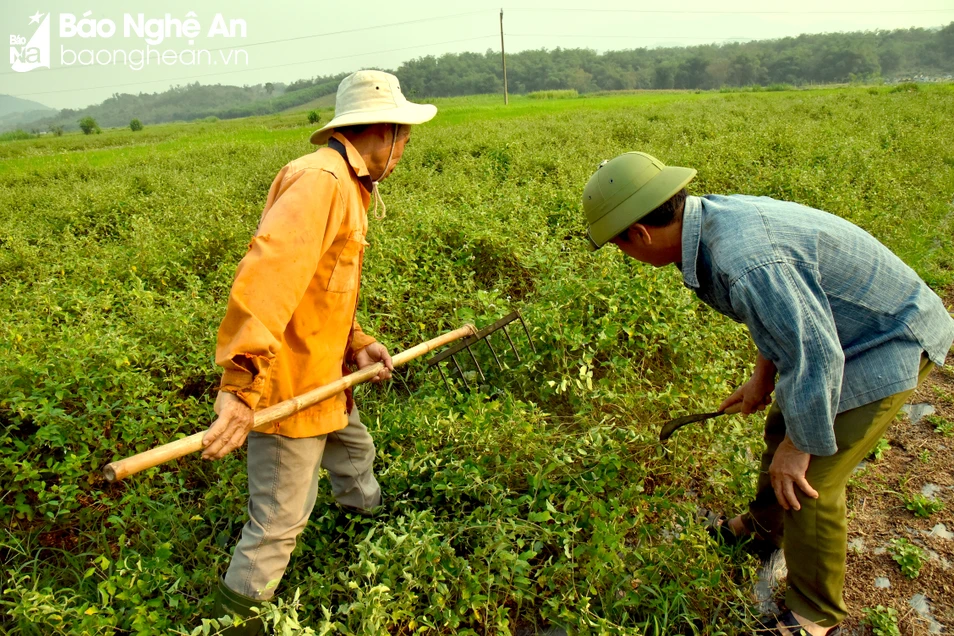
“From an initial 3 hectares of experimental land, the people of Hamlet 2/9 have now developed the Gynostemma pentaphyllum medicinal herb growing area to 10 hectares, bringing in significantly higher income than other agricultural products they previously cultivated,” said Mr. Nguyen Van Ha, Deputy Head of Hamlet 2/9. Mr. Ha is also one of the first households to participate in the pilot medicinal herb cultivation project in Chau Khe commune, supplying raw materials to a pharmaceutical company in the area.
Mr. Nguyen Van Ha stated that the product purchase contract signed with the purchasing company includes clauses guaranteeing green and clean quality, prohibiting pesticide residue, disease contamination, and organisms harmful to human health. The purchasing company also regularly conducts surprise quality tests, so any household whose product samples violate these regulations will have their purchase contract terminated.
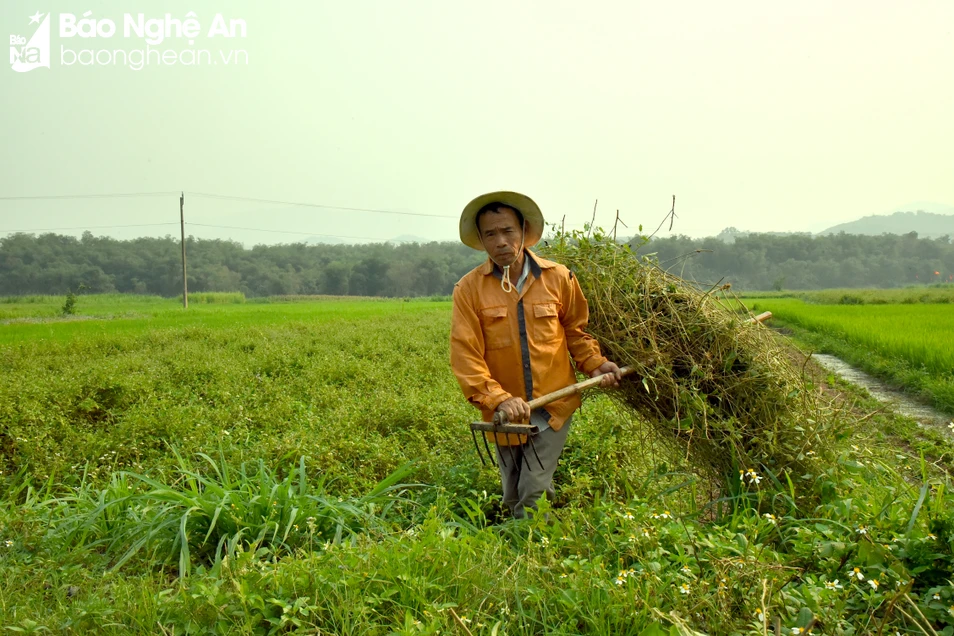
Mr. Nguyen Van Ha stated that if agricultural products do not meet quality standards, it will affect not only the income of the violating households but also the reputation of the entire community. Therefore, from the very beginning of implementing the cultivation of this new crop in Hamlet 2/9, participating households established a "cross-monitoring" system to ensure compliance with organic, green, and clean farming practices. The Solanum torvum plant is also rarely affected by diseases. During the planting process, only the plants that are 1-2 weeks old may be infected with bacterial leaf blight.
If diseased plants are detected, growers must report it to the village management board and spray with biological pesticides. Furthermore, households are only allowed to water and fertilize with organic microbial fertilizers according to the company's instructions. Thanks to this self-monitoring and mutual support among households, for nearly a decade, the 10 hectares of Solanum torvum cultivation in village 2/9 have consistently met the stringent standards of natural medicinal herb production areas. This is also a way to ensure credibility and maintain a stable income for households from Solanum torvum cultivation.
Source


![[Photo] Prime Minister Pham Minh Chinh presides over a meeting on private sector economic development.](/_next/image?url=https%3A%2F%2Fvphoto.vietnam.vn%2Fthumb%2F1200x675%2Fvietnam%2Fresource%2FIMAGE%2F2025%2F12%2F20%2F1766237501876_thiet-ke-chua-co-ten-40-png.webp&w=3840&q=75)








































































Comment (0)