

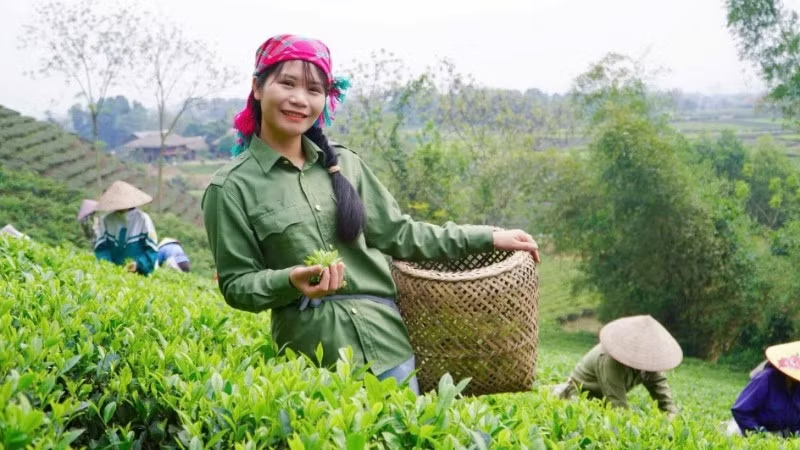
In La Bang commune, one of Thai Nguyen 's tea capitals, Bui Thi Mai's White Cloud Crane Wing Tea product is well-known to many people.
As a native of the tea-growing region, Ms. Mai was concerned about the inconsistent quality of tea purchased from her family. She nurtured the idea of producing clean tea, free from chemicals, in a sustainable ecological manner, combined with tourism development.
Since 2020, she has been working on renovating 5 hectares of tea plantations using natural farming methods, without the use of pesticides and chemical fertilizers. She applies organic fertilization, uses biological products, and weeds manually.
Although this method was arduous, after three years of perseverance, the entire tea plantation yielded clean tea products, meeting the stringent demands of the market.
Ms. Mai's White Cloud Crane Tea brand has expanded and gained popularity among customers.
Ms. Mai also applies electronic logs, weather-soil sensors, surveillance camera systems, and QR codes for traceability in tea production; developing the "Bach Van Smart Tea Garden - Towards agricultural blockchain" model.
In addition, agricultural education tours for students, groups, and organizations have been developed with the goal of expanding linkages with farmers in the surrounding area, aiming for 30 hectares of chemical-free tea plantations by 2026.
With an area of over 60 km², stretching more than 15 km along the foot of Tam Dao mountain, La Bang commune possesses unique soil and climate conditions suitable for tea cultivation and development.
The entire commune currently has over 1,135 hectares of tea plantations with an annual fresh tea leaf production of 14,845 tons. Of this, nearly 500 hectares of tea are produced according to VietGAP and organic standards; two tea products have achieved OCOP 3-star certification, and one tea product has achieved OCOP 4-star certification.
Over the past years, La Bang has implemented Resolution No. 05-NQ/DU on the development of the tea industry, enhancing the value of tea products, and linking it with tourism development in the period 2025-2030.
The objectives are to maintain a stable tea cultivation area of over 1,135 hectares throughout the commune; achieve a fresh tea leaf production of 16,086 tons; strive for 70% of the tea cultivation area to be certified according to VietGAP standards and granted planting area codes; and achieve a product value of 680 million VND per hectare of tea.
The commune strives to have at least three tea products certified as meeting OCOP 3-4 star standards, and one tea product certified as meeting OCOP 5 star standards.
According to Dang Thanh Tung, Secretary of the Party Committee of Dang Thanh Tung commune, the locality is focusing on directing the development of concentrated tea raw material areas linked with tourism; applying science and technology in tea production, processing and trading; strengthening promotion, trade promotion and consumption of tea products; preserving and enhancing cultural values, developing agricultural community tourism associated with tea culture; reviewing and proposing mechanisms and policies, and mobilizing resources to invest in the development of the tea industry.
Notably, in recent times, Thai Nguyen province has implemented a smart rice farming model using alternating wet and dry irrigation to reduce methane emissions, aiming to build agricultural carbon credits in Hop Thanh commune.
Initial results show that rice yield in the model field reached 6.79 tons/ha, 0.89 tons higher than the control field, equivalent to an increase of about 15%. Input costs were reduced, with seed usage decreasing by 50%, nitrogen fertilizer and pesticides by about 40%, and irrigation water usage by about 40%.
Profits reached nearly 66 million VND/ha, approximately 24 million VND higher than traditional production methods. Utilizing rice straw as on-site organic fertilizer contributes to improving cultivated land and reducing production costs.
Along with that, Thai Nguyen is gradually promoting production processes according to VietGAP and organic standards, and has initially achieved certain results. In the province, agricultural production models following this direction are being implemented quite widely, especially for vegetables, fruits, and tea.
The province has issued many policies to support VietGAP and organic agricultural production models. In addition, people participating in these models receive training in science and technology, and support with fertilizers, organic products, biological products, and biological pesticides.
According to statistics, in 2025, Thai Nguyen province granted VietGAP certification to an additional 520 hectares of tea plantations and 28 livestock farms. Currently, the province has over 7,900 hectares of rice, fruit trees, tea, and vegetables, and 211 livestock farms certified under VietGAP; over 320 hectares are certified organic.
The province has begun implementing a project on reducing emissions from crop production by 2035, with a vision to 2050, striving to contribute to achieving the national target of reducing total greenhouse gas emissions by at least 15% compared to the base year of 2020, as directed by the national project.
In addition, the locality will participate in building and developing the "Low Emission" label for agricultural products; implement at least two scalable models of reduced-emission production for tea and ginger; and pilot farming models with the potential to generate carbon credits as required by international organizations.
According to Vice Chairman of the Provincial People's Committee Nguyen Thi Loan, to realize this goal, the locality has directed the implementation of key tasks, including:
Transforming crop structures to suit ecological zones; developing and applying emission-reduction farming techniques for key crops; building regional-scale emission-reduction production models linked to value chains; enhancing capacity and changing perceptions among officials and farmers; connecting markets for low-emission products...
Source: https://nhandan.vn/nong-nghiep-sach-o-thai-nguyen-post962481.html

![[Image] Hanoi's urban life under the challenge of a "scorching hot" environment](https://vphoto.vietnam.vn/thumb/1200x675/vietnam/resource/IMAGE/2026/05/25/1779706979265_nang-nong-t5-2026-minh-duy-7-4636-jpg.webp)

![[Image] Close-up view of the interchange connecting the two expressways and Long Thanh Airport.](https://vphoto.vietnam.vn/thumb/1200x675/vietnam/resource/IMAGE/2026/05/25/1779703378210_ndo_br_z7863716673926-224453a31600126cce10622af6290afd-4549-jpg.webp)









![[Video] Weather forecast for May 26, 2026: Intense heatwave continues across the country.](https://vphoto.vietnam.vn/thumb/402x226/vietnam/resource/IMAGE/2026/05/26/1779750200173_ngay-26-png.webp)
































































Comment (0)