Nestled amidst the mountains of Muong Phang commune, Dien Bien province, Noong Luong Lake covers an area of over 12 hectares. Locals often refer to it as General Vo Nguyen Giap Lake because the structure was created out of the General's concern and dedication to the lives and livelihoods of the people in the former war zone.

Commercial sturgeon cages on Noọng Luông Lake open up a new direction for green agricultural development in Điện Biên. Photo: Mai Dũng.
Today, in addition to providing irrigation water for the fields, the lake is also home to thriving commercial sturgeon populations, opening up avenues for efficient water resource utilization and green agricultural development in the highlands of Dien Bien.
Understanding fish is key to raising them successfully.
Before the sun had even risen above the mountains surrounding Lake Noọng Luông, Vàng A Chỉa was already at his sturgeon cages. The lake's surface in the morning was as flat as a large mirror, with only a few ripples visible beneath the cages. As usual, Chỉa would spend a few minutes observing the area before beginning his daily work.
"It may look like it, but the fish are actually eating," he said, pointing down at the deep blue water below. Seeing our bewildered expressions, he explained further: "Unlike many freshwater fish that often surface to compete for food, sturgeon mainly feed at the bottom; you need to be familiar with them to notice."
Mr. Chia's familiar concept is quite interesting; it goes beyond ordinary observation. He explains that because sturgeon feed at the bottom, breeders need to carefully observe the small movements beneath the water's surface to determine the health of their fish. He says that after many years of raising sturgeon, he can tell if they are feeding well just by looking at the ripples in the water. If the fish swim slowly, react poorly, or surface unusually, they must be checked immediately.

Mr. Vang A Chia observes the water surface to monitor the health of the sturgeon he is raising on Noong Luong Lake. Photo: Mai Dung.
These sturgeon cages belong to the sturgeon farming model of Thai Cuc Consulting and Construction Co., Ltd., Dien Bien province, headed by Mr. Nguyen Van Huan. About four years ago, noticing the clean water, cool temperature year-round, and suitability for cold-water fish, Mr. Huan decided to bring sturgeon to the lake for experimental farming.
From just a few initial cages, the model has now developed into about 15 large and small cages with a total production of approximately 10 tons of commercial fish. Following Mr. Chia's gesture, we looked deep into the lake, where moving masses beneath the surface caused the water to darken and ripple. Mr. Chia said that many fish had reached weights of 10-12 kg, with the largest weighing around 15 kg. In other cages, the fish commonly weighed between 5-8 kg, while smaller batches were maintained for subsequent sales.
Sharing about his profession, Mr. Vang A Chia said that raising sturgeon is not too strenuous but requires patience and meticulousness. Every day, the fish are fed twice, at the coolest times of the day, from around 5-6 am and 5-6 pm. The main food source is small fish caught by locals right in Noong Luong Lake.
Using specialized fish-feeding tools, Mr. Chia scooped a handful of small fish from the blue basin and transferred them to a bucket for easier handling. The fish had just arrived early that morning and were very fresh; they have been a familiar food source for the school of fish for many years.

"Sturgeon prefer fresh food. We buy small fish from local people around the lake to feed them. The food source is readily available locally, which makes the farming process easier," he said.

Fresh food sources from local small fish help the sturgeon population grow steadily. Photo: Mai Dung .
For sturgeon farmers, the biggest worry isn't the hot weather, but the sudden changes in weather. Whenever there's prolonged heavy rain or a change of seasons, the farmers must constantly monitor the fish, check water quality, and operate the aeration system. As Mr. Chia explains: "Sturgeon are very sensitive to their environment. Just a change in water quality or a lack of oxygen can affect them. Therefore, monitoring must be done daily, even hourly; there can be no negligence."
Therefore, around midday, when the sun began to cover the lake's surface, the fish dived deep below and the water became calm again, Vang A Chia still didn't rest. He continued walking along the cages to check each area. "That's the nature of this job; there's no time to rest. Besides working, I also have to constantly acquire more knowledge to understand the fish. Only by understanding the fish can I raise them successfully."
Leveraging advantages and developing green agriculture.
Looking at the thriving fish populations today, few know that the journey of bringing sturgeon to the highlands of Dien Bien once caused much concern, and in fact, the company faced many difficulties in the beginning. Nguyen Van Huan, Director of Thai Cuc Consulting and Construction Co., Ltd., shared that when starting the model, he and his company spent a great deal of time researching the fish's growth habits, assessing the water environment, and perfecting the farming process to suit the local conditions.

Many of the sturgeon raised in Noọng Luông Lake reach weights of 10-15 kg. Photo: Mai Dũng.
"Sturgeon farming is a highly valuable economic activity, but it also requires very strict technical expertise. We had to monitor it continuously for a long time to gradually perfect the care process as it is today," Mr. Huan said.
The advantage is that Noọng Luông Lake has clean water, a large surface area, and is minimally affected by industrial activities. These are important factors that help the fish grow and develop well. Not only does it take advantage of natural resources, but the model also aims for environmentally friendly production methods. Using natural food sources from small fish harvested in the lake reduces reliance on industrial feed and effectively utilizes readily available local resources.
According to Mr. Huan, this is also a direction that aligns with the current trend of green agricultural development, as producers are increasingly concerned about product quality and the sustainability of the farming environment.
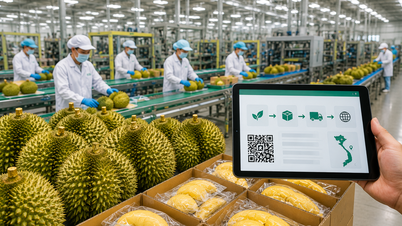
To enhance product value, the company received support from the Dien Bien Provincial Department of Science and Technology to implement a traceability system using QR codes. By scanning the code, consumers can access basic information about the product before making a purchase, contributing to increased transparency and improved market trust.

Sturgeon products are being traced using a QR code system. Photo: Mai Dung.



Currently, most of the sturgeon products from the facility are consumed in markets outside Dien Bien province. With a selling price of approximately 180,000 VND/kg, the unit hopes to have more opportunities to connect with distributors, restaurants, and hotels in the area in the future so that the Dien Bien sturgeon brand becomes more widely known.
Nevertheless, the business owner chose a cautious approach. “We need more time to further evaluate the model’s effectiveness before scaling up. The most important thing remains maintaining product quality and sustainable development,” Huân shared.
Late in the afternoon, only small ripples spread across Lake Noọng Luông, originating from the fish cages. Beneath the clear blue water, sturgeon swim at the bottom. Sourced from the cool, fresh water amidst the mountains of Mường Phăng, these fish cages today not only bring economic value but also demonstrate Điện Biên's ability to effectively exploit its natural advantages.
On that lake, a new direction for green agriculture is being nurtured day by day through the diligence of fish farmers and the aspiration to build the Dien Bien sturgeon brand to reach further afield.
Source: https://nongnghiepmoitruong.vn/nuoi-ca-tam-tren-ho-dai-tuong-d816899.html































![Official launch of the carbon exchange: [Part 1] Vietnam is ready](https://vphoto.vietnam.vn/thumb/402x226/vietnam/resource/IMAGE/2026/06/29/1782693127828_1715-vfs-nongnghiep-121703.jpeg)