


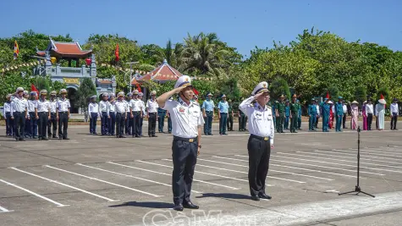
Lieutenant Colonel Nguyen Quoc Tuan, Political Officer of Nam Yet Island, said that most of the tree species that can thrive on the island are wind- and salt-tolerant varieties such as casuarina, Terminalia catappa, Terminalia catappa, and Terminalia catappa... Among them, the Terminalia catappa tree is considered a native species, which has been cultivated and propagated by officers and soldiers on the island over many years. Notably, Nam Yet Island has a Terminalia catappa tree recognized as a heritage tree, along with the largest Terminalia catappa population in the Truong Sa archipelago. The lush green coconut groves also create a unique impression, once earning it the nickname "coconut island". Recently, many other trees such as the Morinda citrifolia have also been developed, contributing to greening, serving daily life, and even becoming a sought-after medicinal herb.
According to Lieutenant Colonel Nguyen Quoc Tuan, the nursery on the island can now supply many native saplings, not only serving the needs of local planting but also supporting neighboring islands. Greenery is therefore gradually becoming the foundation for a sustainable ecosystem in the middle of the ocean.
On smaller islands, where conditions are harsher, maintaining greenery is even more valuable. Sergeant Van Ba Nam, a soldier stationed on Da Lon C Island, shared that caring for the trees isn't physically demanding but requires perseverance.
“In the afternoon, we water the plants, mainly sea almonds, coconut trees, and Terminalia trees. Here, we live together like family; everyone considers taking care of the plants a shared responsibility,” Nam said. For the young soldier from Quang Ngai , the months spent on the island are not just a duty but also a profound experience of youth, as he gets to live, contribute, and grow in this unique environment.

Ms. Pham Bich Thuy, a member of Task Force No. 9, who visited Truong Sa and the DK I platform in 2026, said that what impressed her most was the image of a young soldier patiently caring for a small seedling amidst the sand and coral on Da Lon C Island. Every day, the soldier carefully saved every bottle of fresh water after his daily activities to water the plant, even though he didn't know if the green sprout could survive the harsh summer.
"I only hope that by the time I finish my duty and return to the mainland, the tree will have already sprouted leaves," Thuy recounted the words of a soldier. For Thuy, it's not just a story about planting trees, but also a clear manifestation of perseverance and quiet dedication, as soldiers nurture life in harsh conditions without seeking recognition.
According to Colonel Ngo Dinh Xuyen, Head of Task Force No. 9, the Truong Sa Greening Program launched by the Navy has mobilized many resources to plant trees on the islands, gradually improving the living environment. Trees not only provide shade and reduce the impact of sun and wind, but also help to block wind and sand, creating conditions for increased production and improving the lives of officers, soldiers, and civilians. The selection and planning of tree species are implemented systematically, prioritizing those with high adaptability and long-term effectiveness.

"We believe that, in the not-too-distant future, the islands will be covered in greenery, helping to alleviate the difficulties caused by the weather," Colonel Xuyen said.
For Mr. Tran Anh Tuan, a member of Task Force No. 9, what remained after the trip was admiration. As a soldier serving on the mainland, he said that witnessing firsthand the conditions of freshwater scarcity and harsh sun and wind, yet still seeing his comrades persevere in planting and maintaining trees, he understood even more clearly the significance of greening the island.
It's not just about protecting the environment and creating an ecosystem, but also about improving living conditions and creating a better living space. Furthermore, vegetation helps to create a more harmonious and private environment on the island when needed, Mr. Tuan shared.

The reality on the islands shows that many trees, despite their withered leaves due to lack of water, still bloom and bear abundant fruit. This vitality is clear evidence of nature's strong adaptability and reflects the spirit of the soldiers stationed there. Amidst the harsh sun and wind, they are like those trees, their skin tanned and weathered, but inside they possess a simmering, enduring vitality. Each flower and sweet fruit on the branch can be seen as the culmination of their careful nurturing over the years, as well as the way the soldiers cultivate their will, faith, and responsibility to the sea and islands. Without fanfare or ostentation, everything grows quietly, and in retrospect, both the trees and the people stand firm amidst the vast ocean.
In particular, the ancient Terminalia catappa trees, recognized as heritage trees, and the rows of Terminalia catappa and coconut trees on the islands, not only provide shade and beautiful scenery but also bear witness to the passage of time, a testament to the preservation and continuation through generations of Vietnamese officials, soldiers, and people. Each tree trunk and leaf seems to hold the story of a persistent journey, where humans and nature walk hand in hand to protect the islands and seas.
In Truong Sa, trees are not just for greenery. They withstand the wind and salt, growing slowly but persistently, much like the soldiers who guard the sea and sky day and night. And like the people here, each green sprout is learning to be a soldier, contributing to the preservation of sovereignty at the forefront of the waves.
Source: https://baotintuc.vn/xa-hoi/o-truong-sa-cay-cung-hoc-lam-linh-20260422160300143.htm



![[Image] Close-up view of the interchange connecting the two expressways and Long Thanh Airport.](https://vphoto.vietnam.vn/thumb/1200x675/vietnam/resource/IMAGE/2026/05/25/1779703378210_ndo_br_z7863716673926-224453a31600126cce10622af6290afd-4549-jpg.webp)
![[Image] Hanoi's urban life under the challenge of a "scorching hot" environment](https://vphoto.vietnam.vn/thumb/1200x675/vietnam/resource/IMAGE/2026/05/25/1779706979265_nang-nong-t5-2026-minh-duy-7-4636-jpg.webp)


































































Comment (0)