

DAK NONG: 'This macadamia orchard will be a sustainable ecotourism destination . That's why I planted seedlings at a low density and cultivated them organically.'
DAK NONG : 'This macadamia orchard will be a sustainable ecotourism destination. That's why I planted seedlings at a low density and cultivated them organically.'
This is the statement of Mr. Le Van Quyen, 51 years old, owner of a 13-year-old macadamia orchard in Duc An town, Dak Song district, Dak Nong province.
Mr. Quyen's macadamia orchard, planted with seedlings, covers a total area of over 2 hectares, with a planting density of 7 x 7 meters, meaning approximately 200 trees per hectare. However, during the growth process, some trees died or developed poorly, so he cut them down and replaced them with durian trees, also grown from seedlings. He does not plant grafted trees and practices organic farming with the aim of creating a "legacy" for future generations.
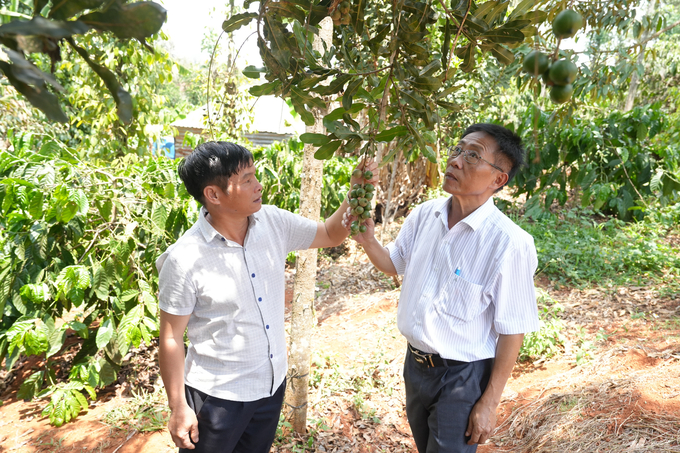
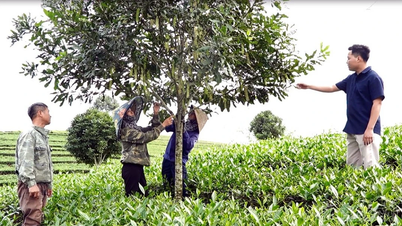
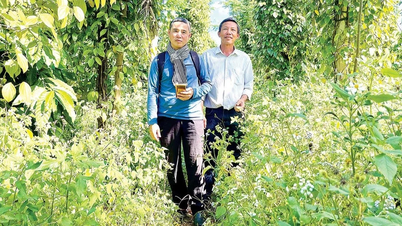
Mr. Le Van Quyen (left) introduces his family's 13-year-old macadamia nut orchard, cultivated organically. Photo: Hong Thuy.
“This macadamia orchard is full of seedlings (grown from seeds), not grafted trees. Back then, not many people planted macadamia, and when they did, they got grafted seedlings from reputable sources. I, on the other hand, bought seeds, so when I first started planting, everyone advised against it because it was very risky. But luckily, the trees grew very well, and the yield was quite good, not inferior to grafted trees. Maybe I was lucky to get good seeds with stable yields,” Mr. Quyen said.
Present at Mr. Quyen's orchard, Mr. Ho Gam, Chairman of the Dak Nong Provincial Farmers' Association, explained that macadamia trees grown from seedlings take about 7 years or more to flower. Furthermore, the fruit from seedlings is prone to segregation. However, the trees are healthier and can live for over 100 years, resulting in a longer harvesting period.
Meanwhile, grafted macadamia trees offer several advantages, such as bearing fruit in just 3-4 years. By the sixth year, the trees are producing abundant fruit. From the tenth year onwards, they yield a stable output of 20-25 kg/tree/year. Therefore, experts still recommend grafted macadamia trees, ensuring quality and a shorter harvest time.
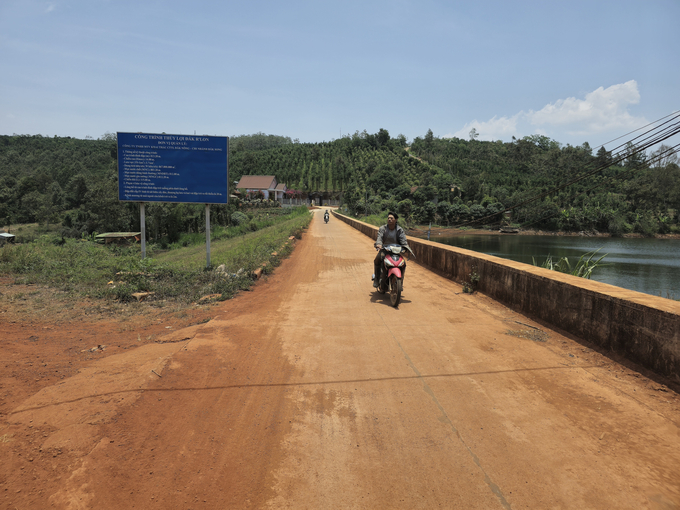
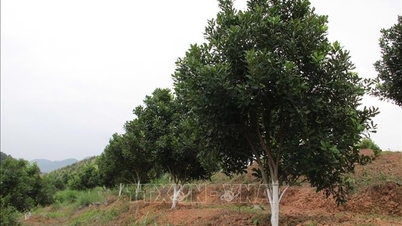
Le Van Quyen's farm is located on the banks of the Dak R'lon irrigation lake, a picturesque location perfectly suited for tourism development. Photo: Hong Thuy.
Speaking about his reasons for taking the risk and only planting seedlings, Mr. Quyen said that seedlings have a long lifespan, and he hopes that the macadamia and durian trees will continue to thrive for generations to come, and that this place will become an ancient fruit orchard.
“My garden is located on a hillside, but not at a high altitude. Right below the garden is the Dak R'lon irrigation lake, a very beautiful and convenient location for irrigation. I didn't spend much on investing in a pumping system; for drip irrigation, I just draw water from the lake. Therefore, this is one of the very favorable conditions for developing eco-tourism in the garden. And for sustainable development, the inevitable path is to practice organic farming. The garden must not only be beautiful but also clean, and the products must be of guaranteed quality and safe for consumers.”
"Just imagine, if I process macadamia nuts harvested from my own garden to sell to tourists, and they see me using chemical pesticides and fertilizers, with a strong, pungent smell, when they visit the garden, how could they dare to buy and eat them?", Mr. Quyen said.
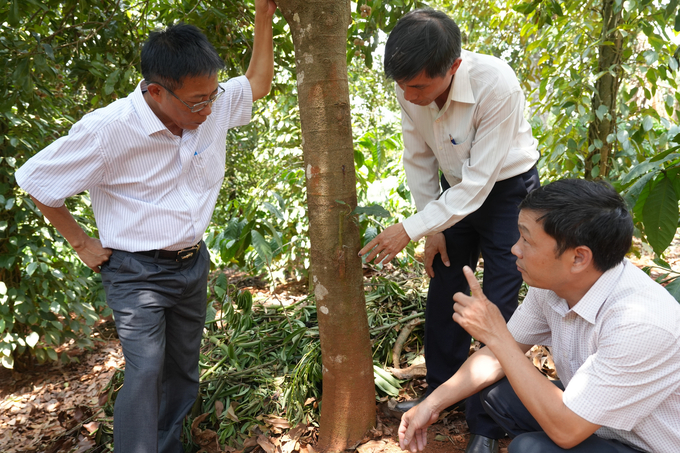
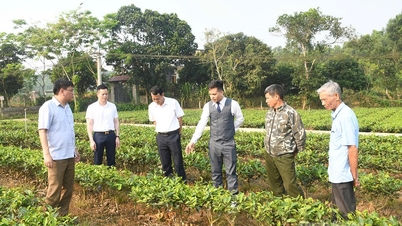
Mr. Ho Gam (left) - Chairman of the Dak Nong Provincial Farmers' Association and leaders of the Agriculture and Rural Development Department of Dak Song district examine a macadamia graft performed by Mr. Quyen. Photo: Hong Thuy.
Currently, Mr. Quyen's macadamia orchard only has about 200 trees left, but each tree is large with a wide canopy. The average yield is 18-20 kg/tree/year. "On average, I harvest about 3.5 tons of macadamia kernels each year, selling them to a regular purchasing company at a price of 150 million VND/ton. Of that, after deducting costs, including labor for about 1 ton of kernels, the rest is profit. Compared to many other crops, macadamia still provides a good income," Mr. Quyen said.
Speaking about the cultivation process, Mr. Quyen said that before planting macadamia trees, he already had a pepper garden cultivated organically, mainly using biological products and fermented cow manure. “When I bought this garden, I also intended to cultivate organically. Before I bought it, this land was a mixed orchard. Because the previous owner was a local person, they didn't invest much in cultivation, and the soil didn't have any chemical residue, so cultivating according to organic methods was simple,” he said.
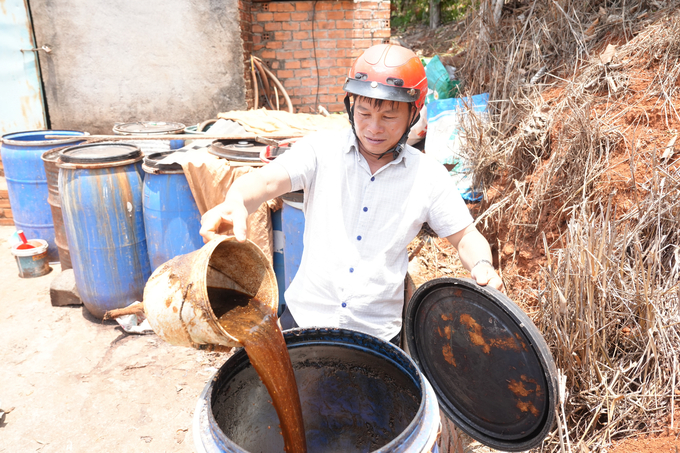
Mr. Quyen uses a tank of fermented fish fertilizer to fertilize his macadamia orchard. Photo: Hong Thuy.
According to Mr. Quyen, macadamia trees don't require much nutrition; on average, each tree needs about 30kg of fermented cow manure per year. He also utilizes agricultural by-products such as fresh macadamia shells, ground coffee husks, and fermented discarded vegetables and fruits. In addition, he ferments fish emulsion to fertilize the trees. Regarding pests and diseases, he uses biological preparations to prevent and control diseases before flowering and after fruit setting.
According to Mr. Le Hoang Vinh, Head of the Agriculture and Rural Development Department of Dak Song district, macadamia is a perennial tree that not only has high economic value but also plays an important role in increasing land cover. Compared to other long-term crops such as coffee and pepper, macadamia is an easy-to-grow crop with low investment and simple care techniques, while having a stable market and high prices.
However, for sustainable development and to enhance the value of macadamia trees, organic farming practices must be applied to produce high-quality products with many other benefits. “This tree grows and develops quickly, is not picky about soil, is resistant to pests and diseases, and is drought-tolerant, so organic farming is much simpler than many other crops. Meanwhile, the harvesting, processing, and preservation of macadamia nuts are also simple. If there is investment in machinery and further processing, the value will increase even more,” Mr. Vinh said.
Currently, Mr. Le Van Quyen has invested in a factory and drying machines to package finished macadamia products. After receiving encouragement from local leaders, he established a macadamia farming cooperative with 16 members. The cooperative's goal is to support each other in cultivating macadamia trees organically and sustainably, processing them further, and finding stable markets for the products.
Source: https://nongsanviet.nongnghiep.vn/ong-chu-vuon-mac-ca-huu-co-voi-tu-duy-an-chac-mac-ben-d410399.html

![[Image] Hanoi's urban life under the challenge of a "scorching hot" environment](https://vphoto.vietnam.vn/thumb/1200x675/vietnam/resource/IMAGE/2026/05/25/1779706979265_nang-nong-t5-2026-minh-duy-7-4636-jpg.webp)


![[Image] Close-up view of the interchange connecting the two expressways and Long Thanh Airport.](https://vphoto.vietnam.vn/thumb/1200x675/vietnam/resource/IMAGE/2026/05/25/1779703378210_ndo_br_z7863716673926-224453a31600126cce10622af6290afd-4549-jpg.webp)










































































Comment (0)