

Community-based tourism
Visiting My Tho (Tien Giang province), an ancient city on the Tien River, and exploring Thoi Son islet, also known as Lan islet, one of the four sacred islets (Long, Lan, Quy, Phung), attracts a large number of visitors even during the off-season. Poet Le Quang Vui, a native of Ca Mau who has lived and worked in Tien Giang for over 20 years, said: “Of the four sacred islets, Long and Lan belong to Tien Giang, while Quy and Phung arelets belong to Ben Tre province. Thanks to tourism, the residents living on these islets are becoming increasingly prosperous. The great thing is that tourism is well-organized, paying close attention to the livelihoods and benefits of the local people.”
At Con Lan islet, visitors can experience the unique culture of the riverine region. From premium longan honey, traditional cakes, the rich flavors of local fruits, rustic dishes, and the simple folk music of the region... all are locally sourced tourism products, but organized very professionally and are highly attractive to visitors. Even more impressive is the vibrant and friendly atmosphere of tourism among the people of Thoi Son islet. Talking to Ms. Nguyen Thi Thuong, who has been involved in rowing traditional boats to take tourists around the islet for quite some time, revealed many interesting things about how tourism is conducted here.

Foreign tourists visit Thoi Son islet, Tien Giang province.
Ms. Thuong shared: “There are about 300 passenger boats here, providing regular employment for 600 workers. Passenger trips are distributed evenly among everyone, averaging 3-4 trips a day, and salaries are paid at the end of the month. The local government prioritizes selecting boat operators from disadvantaged households who don't have stable jobs. For example, my family has two children in school, so we were given priority to participate in tourism. When things get better, we'll let others take over.”
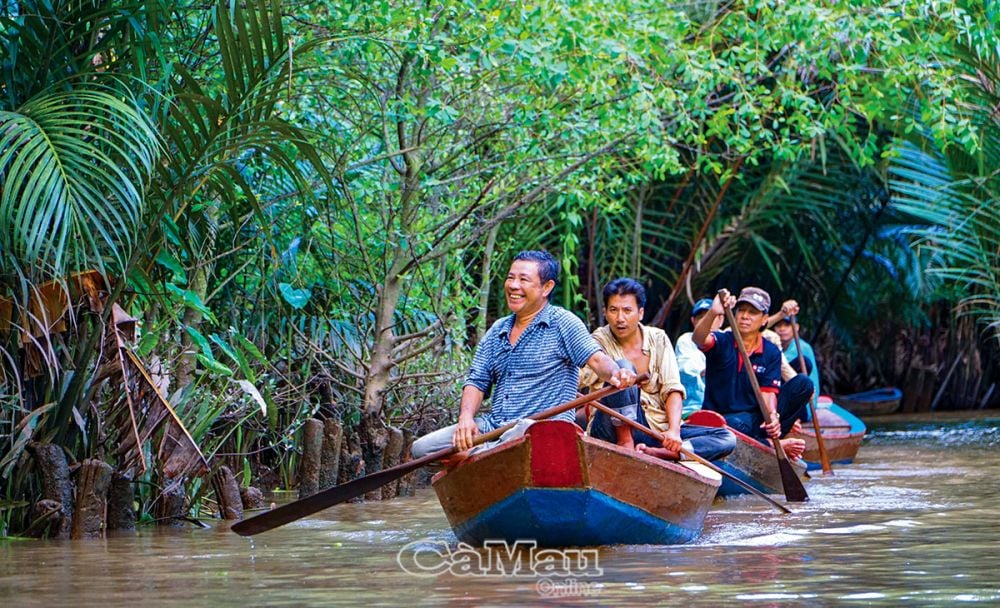
The job of rowing boats to transport tourists at Thoi Son islet, Tien Giang province, has provided employment and regular income for 600 unemployed local workers.
In Con Lan, everyone, in every household, is involved in tourism and benefits from it. This is also what Ca Mau province is aiming for and is beginning to show optimistic signs. Examples include community-based tourism destinations in Con Mui hamlet, Dat Mui commune; and the traditional craft village area near Nguyen Phich, U Minh. In the future, these places can be developed into tourism villages and tourism communities with the participation, connection, harmony, and sustainability of the local people's interests. Ca Mau has also identified a tourism strategy with key types being eco-tourism, agricultural tourism, cultural tourism, etc., and the approach to tourism in Thoi Son islet is a valuable, practical, and suitable suggestion.
Something needs to happen.
The current trend in tourism is that visitors not only seek experiences but, more importantly, gain knowledge and understanding of the land, people, and culture of the places they visit. Therefore, the storytelling aspect is extremely important, if not decisive, in determining visitor satisfaction. When visiting the Royal Mausoleum at Giồng Sơn Quy (Gò Rùa), Hoàng Gia Hamlet, Long Hưng Commune, Gò Công Town, Tiền Giang Province (dedicated to Mr. Phạm Đăng Hưng, father of Empress Dowager Từ Dụ and maternal grandfather of Emperor Tự Đức), we were very surprised by the presentation and storytelling skills of Mr. Võ Thành Sơn, a farmer who claims to only specialize in offering incense to his ancestors and has no expertise in tourism.
When introducing the Royal Mausoleum, Mr. Son demonstrated a thorough, detailed, and coherent understanding of the stories related to the history, the ancestral lineage, and the folk tales passed down about this mausoleum. What we felt was that Mr. Son not only possessed a deep understanding, but his introduction also conveyed a profound pride and affection for his homeland and the heroic figures of Go Cong. Tourism expert Phan Dinh Hue, a Master of Tourism of the Mekong Delta, has repeatedly emphasized: “In all tourism products, people are the most important tourism product, the very soul of tourism. No one else but the farmers, intimately connected to the land and their lives, are the most credible and persuasive brand ambassadors.”
Our trip also included a detour to Dong Thap to visit Xeo Quit (Cao Lanh district), the tomb of Deputy Scholar Nguyen Sinh Sac, the father of President Ho Chi Minh (Cao Lanh city); and through An Giang, to visit the Ton Duc Thang Memorial Area (Ong Ho islet, Long Xuyen city). Each place holds beautiful stories, imbued with gratitude, the mark of merit, and overflowing pride of the land and people of the Mekong Delta. I secretly hope that in Ca Mau, these heroic stories of the southernmost region of the country will be increasingly cherished and disseminated in a more systematic and professional way, adding more flavor to local tourism.
On the other hand, travel stories are also a continuation, extension, and crystallization of the cultural values of the homeland. Beautiful scenery can captivate people, delicious food can evoke nostalgia, but only knowledge will be etched in their hearts and minds forever. This is also a very useful suggestion for Ca Mau's tourism in the coming period.
Pham Hai Nguyen
Source: https://baocamau.vn/dong-lai-nhung-cau-chuyen-du-lich-a29904.html

![[Photo] The heat at the fireworks display site on the opening night of the Da Nang International Fireworks Festival 2026](https://vphoto.vietnam.vn/thumb/1200x675/vietnam/resource/IMAGE/2026/05/27/1779889741485_ndo_br_z7872039145157-fecaba5112f39e8352544099d7ef4738-5140-jpg.webp)
![[Photo] The courage of new recruits of Brigade 144 on the training ground.](https://vphoto.vietnam.vn/thumb/1200x675/vietnam/resource/IMAGE/2026/05/27/1779881651341_anh-man-hinh-2026-05-27-luc-18-32-52.png)































![[Photo] The courage of new recruits of Brigade 144 on the training ground.](https://vphoto.vietnam.vn/thumb/402x226/vietnam/resource/IMAGE/2026/05/27/1779881651341_anh-man-hinh-2026-05-27-luc-18-32-52.png)

















Comment (0)