A love overflowing
For a retired person in the countryside, the yard or path is usually a place to grow flowers or place a few potted plants for the pleasures of rural life. But at Mr. Nong's house, the path from the gate to the yard is a display area for countless artifacts. His house grounds have become a miniature museum, showcasing artifacts from time and the past...
This year, Mr. Nong is 81 years old. He owns a collection of nearly 2,000 diverse artifacts. It can be considered a unique family museum, a private museum; a vibrant "collection" of the lives of the people. The collection includes over 700 stone artifacts, more than 200 traditional agricultural tools of the Red River Delta inhabitants, along with household items from the past. It also includes a number of other diverse ancient artifacts; relics and memorabilia from the wars against French colonialism and American imperialism...
It can be said that Mr. Nong possesses a unique and unparalleled cultural treasure. What is truly admirable is that his collection of antiques is not for profit, but rather driven by a desire to preserve traditional cultural aspects for future generations. When I asked him where this idea came from, he smiled kindly and enthusiastically shared: “I love history and grew up in Cau Den village, Quang Tien commune, Tan Yen district, Bac Giang province – this is the ‘Hill of Resistance Culture,’ a provincial-level historical site. From here, you can see the entire area where the Yen The resistance fighters operated in the past. I also love museology and am always passionate about collecting old objects. And so, this ‘museum’ gradually took shape, and after more than 30 years, it has the appearance it has today.”
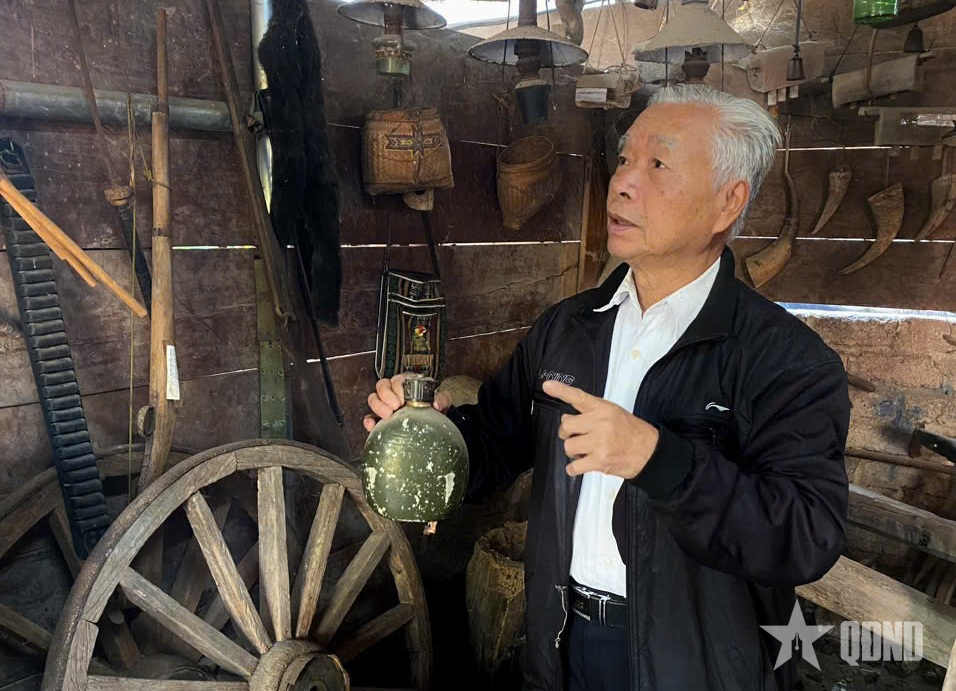 |
| Mr. Nguyen Dac Nong. |
To create this museum, Mr. Nong invested a great deal of time, effort, and money. He single-handedly traveled around on his old motorbike, searching everywhere and collecting antique items little by little. It can be said that each artifact in the museum is imbued with the sweat and effort of its owner. Financial matters were also a challenge. He confided: “Initially, some family members didn’t support my work because they worried it would cost a lot of money and affect our lives. I had to find a way to be financially independent while also ensuring my family’s livelihood. I also faced difficult decisions when having to spend considerable sums of money. A pair of antique jars cost 3 taels of gold, an antique clock cost over 10 million dong, an antique cabinet cost 15 million dong (about 10 years ago), and nearly 600 stone mortars cost a significant amount of money.”
It's ironic that these expenses always seemed to "turn their backs" on his meager civil servant salary and later his modest pension. But his boundless passion helped him overcome all obstacles. Thus, the immense effort he devoted to this hobby over several decades was the culmination of a wondrous, somewhat sacred and romantic passion, not tainted by worldly material gains.



The spirit of the homeland gathers
Mr. Nong's museum is a collection of old objects. Each object seems to have its own life, its own "identity," connected to the arduous daily lives of farmers in a bygone era. These are the lime-tipped plows, the 51 plows with worn-out blades and smooth handles... The lime-tipped plow is a primitive farming tool, shaped like a lime pick, without a "cushion" under the blade to maintain balance while plowing. The farmer had to strain to control the blade, a laborious and strenuous task. At one time, the lime-tipped plow was scorned: "Condemn the lime-tipped plow / Elevate the 51 plow." The 51 plow is an improved farming tool, invented in 1951, and was enthusiastically received by farmers. Today, in a corner of the museum, the lime-tipped plow seems to quietly nestle beside the imposing 51 plow, beaming with a triumphant smile.
Many more ancient objects, once deeply connected to the people of the past, are gathered together in the museum: the old mill that was used by farmers day and night to grind rice; the buckets and pails that helped farmers fetch and channel water to distant fields; the storm lamp that illuminated pigsties and chicken coops on stormy nights; the oil lamp that accompanied mothers as they quietly went out at night to cast shrimp nets; and the copper tray that evokes memories of ancestral worship ceremonies and New Year celebrations...
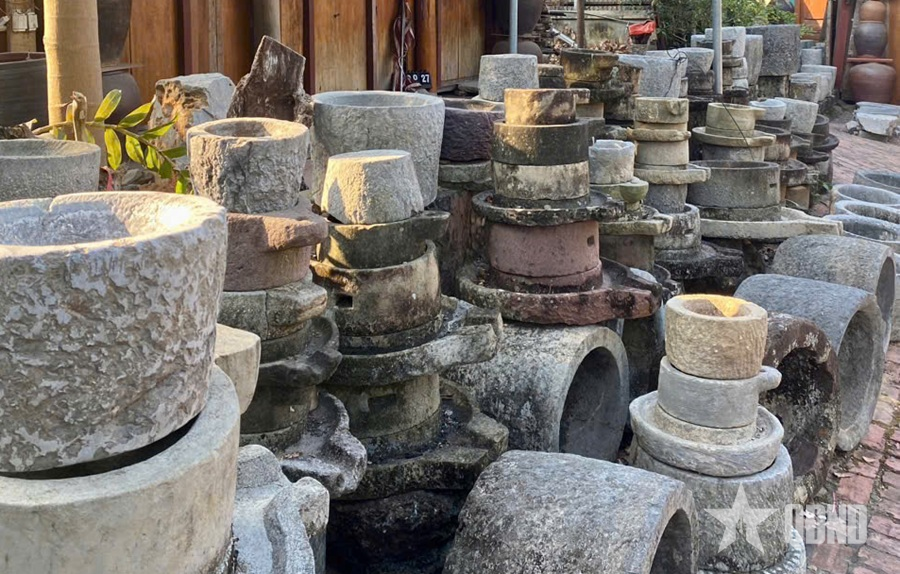 |
| Over 700 stone artifacts are the museum's impressive "highlights". |
Everyone gathered here, creating a warm and cozy atmosphere.
When an object or tool is first created, it is merely an inanimate object. Through human hands and over the years, through its deep connection with people, that object acquires a soul, a life, a identity, a voice, and experiences joy and sorrow... That's what "all things have spirits" means!
The rocks remain "unyielding to the passage of time".
Upon entering the museum, we were impressed by the " world of stone" that unfolded before our eyes. Overall, in terms of quantity and exhibition space, stone artifacts predominated. This was certainly no coincidence; it must hold some interesting significance related to the museum's owner. I asked Mr. Nguyen Dac Nong about this, and he revealed: "I don't know why, but I really like stone artifacts. Stone objects endure through time, are easy to preserve, and, more profoundly, stone seems to embody the soul of the nation... Some might think that having too many stone artifacts in a museum would be monotonous and boring. That's up to everyone. As for me, I want to collect even more stone artifacts."



After listening, I pondered for a long time about the heartfelt and unique insights shared by the museum owner. It could be said that he has a special connection, a calling, a karmic affinity with stones. That was truly fascinating and impressive.
In today's society, for many reasons, there seems to be a "disconnect" between the past and the present, even a not-so-distant past. Children today seem to have no concept of the hardships and struggles of their ancestors. Stories about the daily lives of people during the anti-American war and the subsidy period are considered "fairy tales" by the younger generation. If such a disconnect, a discontinuity, or a fading of history exists, it is truly thought-provoking. Because history and tradition are a continuation, a continuous flow, a silently circulating source. In this context, it can be said that the museum of educator Nguyen Dac Nong truly serves as a "bridge" between the past and the present, contributing to fostering the connection between young people and their ancestors, and awakening a sense of appreciation and love for their homeland and country in the younger generation. That's why whenever schools organize visits to the museum for their students, Mr. Nguyen Dac Nong is overjoyed.
In this day and age, to find someone who cherishes the past, respects history, and dedicates nearly half their life to spreading the values of national heritage and history to the younger generation... like him, is truly admirable!
Source: https://www.qdnd.vn/phong-su-dieu-tra/cuoc-thi-nhung-tam-guong-binh-di-ma-cao-quy-lan-thu-17/ong-nong-luu-giu-hon-que-1046536



































































![[Infographic] Details of 6 toll stations on the North-South Expressway through Ha Tinh](https://vphoto.vietnam.vn/thumb/402x226/vietnam/resource/IMAGE/2026/06/29/1782685020813_fb_anh-dai-dien-infographic-khanh-phuong-1-png.webp)