

Although the Ministry of Industry and Trade organized a conference to explain Decree 135/2024/ND-CP related to the development of self-produced, self-consumed rooftop solar power, both investors and the electricity sector still have many unanswered questions.
Self-sufficient rooftop solar power: Further guidance is needed.
Although the Ministry of Industry and Trade organized a conference to explain Decree 135/2024/ND-CP related to the development of self-produced, self-consumed rooftop solar power, both investors and the electricity sector still have many unanswered questions.
This is just the beginning.
Mr. Nguyen Ngoc Cuong, Operations Director of EverSolar Investment Joint Stock Company, believes that the promulgation of Decree 135/2024/ND-CP (Decree 135) is a great effort from the drafting committee and the Government because its content has reflected a large part of the recommendations of the rooftop solar power development community.
"The decree has facilitated investment and development of rooftop solar power for self-production and self-consumption, serving the needs of green transition, meeting the requirements of export businesses and the sustainable development goals (ESG) of foreign investors. At the same time, it also provides a more flexible mechanism for people who want to produce and consume their own solar power to install it," this person said.
Also welcoming the promulgation of Decree 135, Mr. Le Quang Vinh from BayWa re Solar Systems Vietnam said that the Decree has helped investors in manufacturing to have a basis for building rooftop solar power systems to achieve emission reduction targets and obtain green certifications for goods when exporting to markets with high requirements.
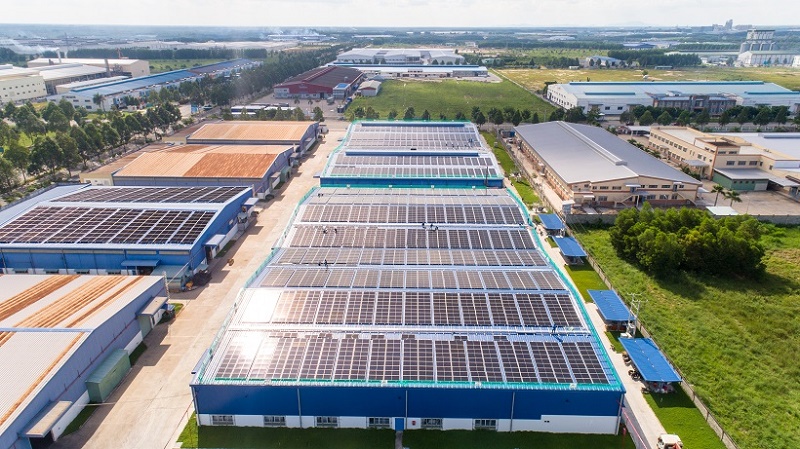 |
| A rooftop solar power project is being invested in at Bau Bang Industrial Park, Binh Duong. |
“In 2024, approximately 800 MW of solar photovoltaic panels will still be imported into Vietnam. This shows that the market still has demand for rooftop solar power installation. However, Decree 135 only addresses the symptoms. Investors, the Departments of Industry and Trade, and the Vietnam Electricity Group (EVN) still have many questions that have not been clearly answered by the Ministry of Industry and Trade, so we don't yet understand how the implementation and payment will be handled,” Mr. Vinh shared.
Sharing the view that more specific guidelines are needed, a representative of a foreign fund interested in solar power projects in Southeast Asia, including Vietnam, said that even if the authorities provide guidelines with up to 1,000 conditions and bullet points that investors need to follow when implementing a project, it would still be clearer than the phrase "according to the law".
"In reality, we may not be fully aware of all the regulations during the project implementation process, so when inspection agencies point out legal issues in documents from other ministries and agencies, we are also very confused. Therefore, we hope that legal issues need to be clarified and detailed from the beginning, so that investors can have a firm grasp of them and feel secure in planning and implementing transactions in Vietnam," this person said.
Responsibilities are not clearly defined.
Many questions were raised during the explanation session on Decree 135 organized by the Ministry of Industry and Trade, with the participation of 789 locations. However, not all answers were as clear and concise as expected by investors, the electricity sector, and the Departments of Industry and Trade.
For example, in Quang Nam province, the Electricity Company was very confused about the criteria for allocating the 48 MW of solar power development quota mentioned in the Power Development Plan VIII, and the Ministry of Industry and Trade's answer was "it is decided by the Provincial People's Committee".
Currently, Decree 135 stipulates that the Department of Industry and Trade, in coordination with local electricity units, shall publicly review and disclose the total capacity of rooftop solar power for self-production and self-consumption connected to the national power grid, as allocated according to the national power development plan.
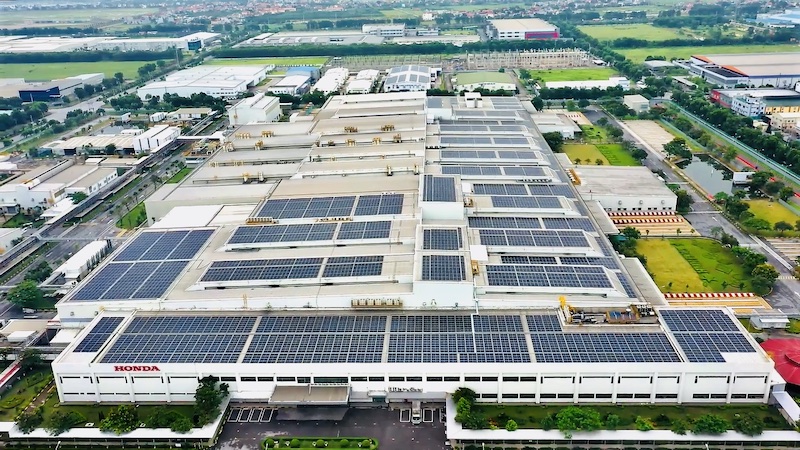 |
| Honda Vietnam Company's rooftop solar power system. |
Speaking with Baodautu.vn , Mr. Manh Tuan, an expert in the electricity sector, said that because planning is very costly, many localities only develop provincial power plans up to 110 kV. Since smaller levels are subject to change, localities don't create overly specific plans to avoid being constrained when changes are needed. However, this also takes time to review and provide feedback on proposals from those wanting to install rooftop solar power in the area.
Notably, according to Clause 1, Article 8, households and individual houses developing rooftop solar power for self-production and self-consumption with a capacity of less than 100 kW are exempt from electricity operation licenses and there is no capacity limit.
However, the National Power Development Plan VIII is currently restricting the development of grid-connected rooftop solar power to no more than 2,600 MW from now until 2030. So, assuming approximately 30,000 households develop grid-connected rooftop solar power systems of around 100 kW – meaning there is no capacity limit – the total capacity of this group would reach approximately 3,000,000 kW, equivalent to 3,000 MW. Whether this violates the 2,600 MW limit of the National Power Development Plan VIII remains an unanswered question.
According to experts, this issue needs to be taken into account because as of January 1, 2021, the whole country had 104,282 rooftop solar power systems with a total capacity of 9,580 MWp that were eligible for FIT (Feed-in Tariff) rates, most of which had been developed within the past year.
Furthermore, it must be considered that many rooftop solar power systems of both households and businesses, which experienced FIT price fluctuations as of December 31, 2020, are now permitted to sell surplus electricity to the national grid under Decree 135, provided they follow the prescribed procedures.
Therefore, it is entirely possible that the number of rooftop solar power systems that "missed" the FIT and want to connect to the grid alone will exceed 2,600 MW, leading to a system of requests and approvals to get into the grid connection category.
Examining Decree 135, experts also pointed out that Articles 15 and 16 stipulate that those installing rooftop solar power systems must "purchase equipment in accordance with the regulations in this Decree and in compliance with applicable standards and regulations." However, Decree 135 does not specify what those standards are. This will cause controversy later on regarding whether the equipment complies with regulations and, if not, whether it is permissible to connect to the grid and sell surplus electricity for profit.
It's unclear how to determine the 20% surplus power capacity.
A point of particular interest to investors is the provision allowing them to sell surplus electricity to the national grid, but not exceeding 20% of the actual installed capacity; however, the exact method for determining this is currently unclear.
Mr. Le Quang Vinh said that his house is using a rooftop solar power system. After Decree 135 was issued, he inquired with Long Bien Power Company and Hanoi Power Corporation but has not yet received an answer regarding the procedure for selling surplus electricity back to the grid.
"I understand that the electricity sector is also waiting for guidance from the Ministry of Industry and Trade," Mr. Vinh said.
Reportedly, EVN is currently researching options and solutions involving the use of limiting devices to ensure that the excess electricity generated by the solar power system is not fed back into the grid beyond the permitted limit.
EVN claims this method simplifies monthly electricity bill calculations, eliminating the need for manual processing like other options, and customers only need to invest in a standard electronic meter that can collect data remotely.
Following this approach would require the installation of an additional bidirectional control and metering device, as well as accurate monitoring of the power limiting device, especially since the efficiency of photovoltaic panels degrades over time. However, the Ministry has not clearly defined whether the electricity seller or buyer should install this equipment, and if EVN installs it, the cost will naturally increase and be included in the electricity price.
On another note, experts from electricity distribution companies say that currently, the meter's measurement cycle is 30 minutes/time, and there are 48 cycles per day. It's highly possible that during a 30-minute cycle, for about 2-3 minutes, the excess power consumption exceeds 20% of the regulated capacity. How would this be handled?
"If the electricity sector completely excludes that 30-minute period from billing, it would be detrimental to those with rooftop solar power feeding into the grid. However, if they don't, it's unclear how to record the readings because current metering and recording technology is automated and only displays the data as it is; humans cannot intervene," Mr. Manh Tuan explained.
Furthermore, Decree 135 calculates 20% of the surplus electricity sold based on power capacity (kW) but charges based on electricity output (kWh), which shows an inconsistency in the measurement units.
Furthermore, experts also questioned why Decree 135 limits the amount of surplus electricity sold to 20%, but the system could still face a power shortage requiring the mobilization of additional rooftop solar power . How would the additional payment be calculated in such a situation? Should rooftop solar power be allowed to contribute to the system through self-production and self-consumption, given its full capacity?
Another concern is that Decree 135 stipulates that the average market price of the previous year should be applied to surplus rooftop solar power . However, if the price of fuel (gas, coal) surged dramatically in the previous year, causing a sharp increase in the overall market price, is it fair for only surplus rooftop solar power to benefit from this price, compared to other solar power sources that are currently enjoying lower fixed prices?
From an investor's perspective, Mr. Nguyen Ngoc Cuong suggested that businesses should first focus on developing rooftop solar power projects that produce and consume their own electricity. As for the 20% of capacity currently facing obstacles and awaiting official approval, they should take their time and consider this as an added bonus.
"I also have concerns about how the post-audit of payments for the 20% surplus electricity sold to the grid by rooftop solar power systems will be conducted, since EVN is a state-owned enterprise. Therefore, detailed guidelines are needed before payments can be made," Mr. Cuong said.
According to Mr. Vinh, foreign funds are still trying to find ways to do so, but doing so now carries a high risk because they are investing money but there is no guarantee that there will be laws protecting them from issuing invoices for electricity sales.
Before October 22, 2024 (the effective date of Decree 135), the Fund could issue invoices to the factory below because it had already invested in a rooftop solar power system. However, after October 22, if a new system is installed, Decree 135 must apply, meaning that third parties are no longer allowed to buy and sell electricity with the factory below. In that case, the Fund must register its business as a property leasing company.
According to Mr. Vinh, there needs to be legal guidance from ministries and agencies on whether the Fund is allowed to lease assets. Because Decree 135 currently stipulates that to engage in electricity sales, authorization from EVN is required, and EVN does not have the right to allow foreign businesses or individuals to conduct electricity sales.
"I think there needs to be more clear explanations, otherwise businesses that jump in now risk getting involved. Circumventing the rules by leasing would still be a violation, so the legal departments of the Funds are currently investigating further," commented Mr. Le Quang Vinh.
Source: https://baodautu.vn/dien-mat-troi-mai-nha-tu-san-tu-tieu-phai-cho-huong-dan-them-d229476.html




![[Photo] General Secretary and President To Lam presides over a working session with the Central Policy and Strategy Committee on the development of the materials industry.](https://vphoto.vietnam.vn/thumb/1200x675/vietnam/resource/IMAGE/2026/05/21/1779359935432_a3-bnd-3129-1412-jpg.webp)










































































Comment (0)