

When Ukrainian leader Volodymyr Zelensky addressed the United Nations General Assembly (UNGA) on September 25, he described Russia's military campaign in Ukraine as a threat to Europe and beyond, warning of the growing threat of nuclear catastrophe and the possibility of war spreading to Eastern Europe.
The atmosphere in the hall this year was different, with only a sparse audience. The empty seats reflected the issue that Zelensky's speech aimed to address: much of the world 's attention had shifted away from Ukraine as the situation in the Middle East threatened to spiral out of control.
The 46-year-old leader condemned Russia's targeting of his country's infrastructure, saying that "80% of the country's energy system has collapsed." He said the attacks not only left millions of Ukrainians without electricity for a harsh winter but also put Ukraine's nuclear power plants at risk.
Zelensky accused Russia of trying to disconnect the Zaporizhzia nuclear power plant from the grid, leaving Europe just a drone strike away from a potential "nuclear catastrophe" where "radiation would not obey state orders."
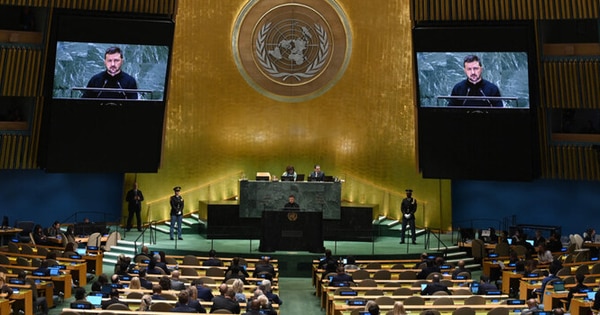
President Zelensky speaks at the 79th session of the United Nations General Assembly (UNGA) at UN headquarters in New York, USA, on September 25, 2024. Photo: Arab News
The Ukrainian leader used his trip to the U.S. this week to outline a “win-win plan”—which includes a call for more aid and a request for the deployment of U.S.-made long-range weapons deeper inside Russia to bolster Kyiv’s position to the point where it would force Moscow to the negotiating table.
Recognizing that battlefield support alone would not be enough to force the enemy to reach an agreement on Ukraine's future, Zelensky also requested that the West increase economic, political , and diplomatic pressure to compel Russia to negotiate. On September 26 (local time), Zelensky will meet with US President Joe Biden to discuss this plan.
On the other side, Russian President Vladimir Putin updated Russia's nuclear doctrine on September 25, stating that Russia would use nuclear weapons if attacked by a non-nuclear state but with the participation or support of a nuclear-armed state, and this would be considered a hybrid attack against Russia.
Fundamental changes to Russia's nuclear doctrine were announced by Putin when he chaired an event called the "Permanent Meeting of the Russian Security Council on Nuclear Deterrence," which was restarted after a hiatus of more than a year. Events like this are usually held behind closed doors and out of public view, but this time the Kremlin leader delivered a public speech.
On the ground, on September 25th, Russian forces advanced to the outskirts of Vuhledar in the Donetsk region and may now be threatening the town from three sides. The British Ministry of Defence assesses that Russia is likely to continue putting pressure on this heavily defended area in the coming week.
Information from pro-Russian military bloggers and open-source monitoring organizations suggests that Ukrainian forces here are at risk of being surrounded. According to geo-tracked footage, Russian troops have broken through east of Vuhledar and are advancing into the town through it.
Located 50 km south of Pokrovsk, Vuhledar is a strategic road junction and logistics center, often referred to as a "fortress." This stronghold has held out for 30 months since Russia began its military operation in Ukraine.
There are concerns about the potential consequences of the fall of the Vulhedar stronghold, specifically about how it could pose a threat to the southern flank of Pokrovsk – a priority target for the Russian military in the Donetsk region.
But the Institute for the Study of War (ISW) argues that Russia's potential capture of Vuhledar is unlikely to fundamentally alter the course of offensive operations in the region.
The Washington DC-based think tank argues that Vuhledar is not a particularly important logistical node, and therefore, capturing it would not immediately provide Russian forces with access to a new route or cut Ukrainian forces off from a vital supply route.
Minh Duc (According to GZero Media, TASS, Euronews)
Source: https://www.nguoiduatin.vn/phan-lon-su-chu-y-cua-the-gioi-khong-con-dat-vao-ukraine-204240926111438595.htm

![[Photo] Closing Ceremony of the 15th Conference of the Central Committee of the 13th Party Congress](/_next/image?url=https%3A%2F%2Fvphoto.vietnam.vn%2Fthumb%2F1200x675%2Fvietnam%2Fresource%2FIMAGE%2F2025%2F12%2F23%2F1766462841764_a1-bnd-3731-1647-jpg.webp&w=3840&q=75)



























































Comment (0)