

 |
| Electronic identification and authentication systems contribute to providing convenience for citizens in the digital transformation. (Illustrative image) |
In line with the Fourth Industrial Revolution, the dominant trend among countries worldwide today is to modernize national governance, applying science and technology in all areas of state management.
With great ambition, strategic vision, and groundbreaking thinking, the Party and Government have issued many important guidelines and policies to mobilize the entire political system, making the most of the opportunities and advantages brought about by the Fourth Industrial Revolution to implement the national digital transformation revolution.
Establish a national population database.
In 2021, a major success in building e-government, moving towards a digital government, digital economy , and digital society, was the completion of the national population database and the system for producing, issuing, and managing citizen identification cards (CCCD). This brought about tremendous efficiency, fundamentally transforming state management of the population towards modernization and contributing to the thorough reform of administrative procedures related to citizens.
After three years of implementing the national population database, its value for administrative procedure reform and the development of e-government and digital government is becoming increasingly evident.
Firstly, synchronizing data from the central to local levels allows for completely electronic residence management, reducing paperwork and simplifying the registration process for citizens. Furthermore, citizens can register for their Citizen Identity Card at their temporary residence without having to return to their permanent residence.
Secondly, the national population database has been connected to specialized databases (to date, it has been connected and shared with 13 ministries and agencies; 1 state-owned enterprise (EVN) and 63 provinces and cities), contributing to reducing administrative costs for citizens by hundreds of billions of VND annually.
With the current population recorded in the system reaching 104 million people, as of May 12, 2023, the national population database has processed 935,148,051 requests for identity verification to clean up stored data and newly generated data in public administrative transactions between citizens and administrative and public service agencies of ministries, departments, and localities; replacing the requirement for citizens to present and submit certified copies of identity documents, contributing to simplifying administrative procedures.
At the same time, the national population database also provides accurate and consistent basic information about citizens. Utilizing citizen information from the national database helps citizens reduce the time spent preparing applications and declarations; citizens do not have to present or submit copies or certified copies of their citizen documents.
Thirdly, the national population database is built with the purpose of being a shared database, providing citizen information to ministries, departments, and localities to serve state management and handle administrative procedures for the people.
Based on the national population database, these databases share, utilize, and update population information, thereby minimizing information duplication and reducing investment costs from the state budget for information technology infrastructure of specialized databases serving state management at each level, sector, and field, as well as for formulating socio-economic development policies from the central to local levels.
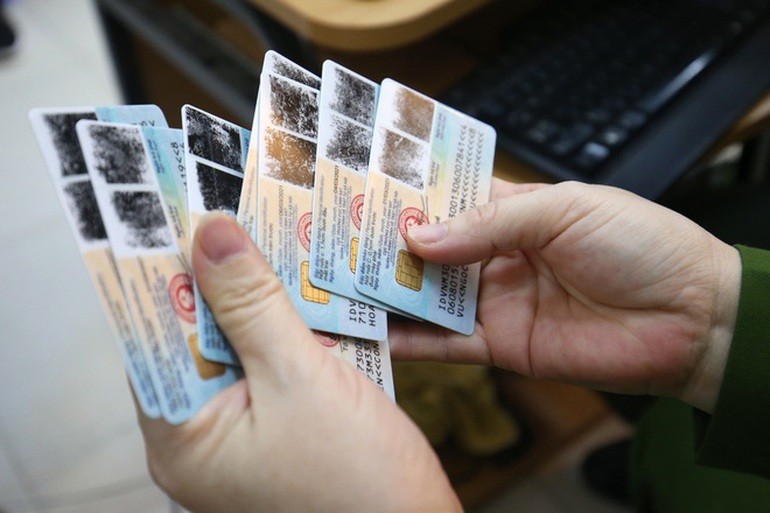 |
| Based on the national population database and citizen identification database, the Ministry of Public Security has successfully built an electronic identification and authentication system, which serves as the foundation for establishing and successfully providing online public services and developing e-commerce. (Source: Dan Tri Newspaper) |
Applying population data, identification, and electronic authentication to serve national digital transformation.
To promote the nation's digitalization efforts and develop and apply citizen information in the national population database to streamline administrative procedures and electronic transactions accurately and quickly, on January 6, 2022, the Prime Minister, Chairman of the National Committee for Digital Transformation, signed and issued Decision No. 06/QD-TTg approving the Project on the Development of Population Data Applications, Electronic Identification and Authentication to Serve the National Digital Transformation in the period 2022-2025, with a vision to 2030 (hereinafter referred to as Project 06).
After one year of implementation, Project 06 has achieved very important results, creating many breakthroughs in the national digital transformation and has been recognized and highly appreciated by the Party, the State and the people.
Some key highlights include the application of the national population database and chip-embedded citizen identification cards (CCCD) to enable the Ministry of Education and Training to register nearly 1 million candidates for online exams (reaching a rate of 93.1%); the decentralization of motorcycle registration to over 2000 communes; the issuance of online passports; the use of CCCD cards to replace health insurance cards in medical examinations and treatment (to date, 12,427, or 96.99% of medical facilities nationwide, are using them); and the replacement of ATM cards in banking transactions.
According to the Ministry of Public Security, over 80 million electronic chip-embedded citizen identification cards have been issued to date. This is of great significance in the process of building an e-government, contributing to administrative reform to serve the people, improving the quality of state management in security and order; serving the fight against crime and other professional activities…
Based on the national population database and the citizen identification card database, the Ministry of Public Security has successfully built an electronic identification and authentication system as a foundation for establishing and successfully providing online public services and developing e-commerce. This is an essential element for socio-economic development in the online environment, replacing the use of identity cards, citizen identification cards, passports, etc.
Electronic identification is recognized as a crucial element for conducting electronic transactions, contributing to the development of digital government and fulfilling Vietnam's e-government initiative. The electronic identification and authentication system provides convenience for citizens and other social groups, ensuring the rights and interests of people in the digital transformation.
For citizens , this is a tool that allows people to conduct transactions electronically, ensuring reliability, accuracy, speed, simplicity, cost-effectiveness, and efficiency, just like conducting transactions using traditional methods (personal identification documents, face-to-face meetings, etc.).
Through the electronic identification and authentication system, citizens can conduct transactions anytime, anywhere, especially essential transactions, while still ensuring strict management, information security, data confidentiality, and preventing fraud, thus ensuring safe transactions.
Simultaneously, integrating various types of documents into electronic identity accounts helps citizens minimize the number of personal documents. By using the national electronic identity application, they can ensure that information from their documents is fully integrated and legally valid, replacing traditional physical documents and being used in the electronic environment. Citizens can provide and share their information with agencies, organizations, and businesses through QR code scanning or other technical solutions, ensuring speed, convenience, security, and reliability.
As a result, an ecosystem is being built that creates convenience for citizens in all areas, such as public services, e-commerce services, electronic payment platforms, cashless payments, and replacing citizens' paper documents in electronic transactions.
For agencies and organizations , connecting to and using the electronic identification system ensures speed, convenience, cost-effectiveness, efficiency, and accurate verification of citizen information and integrated personal identification documents.
Organizations and agencies can minimize manpower, save time, and reduce storage and printing costs for documents when citizens use electronic identification. In addition, organizations and agencies can process administrative procedures online for citizens, ensuring accuracy, speed, and efficiency, especially helping to maintain social distancing and avoid large gatherings during disease outbreaks.
For businesses, using electronic identification services ensures safety, speed, convenience, cost-effectiveness, efficiency, and accurate verification of citizen information and integrated identification documents with the citizen's consent.
Electronic identification also provides businesses with a secure, fast, convenient, accurate, and cost-effective payment method, minimizing paperwork.
For administrative agencies , implementing public administration in an electronic environment instead of the traditional environment helps to minimize human resources, reduce inconvenience, paperwork, and costs when handling administrative procedures.
This benefits both citizens and management, ensuring that information is always updated, guaranteeing that data is "accurate, complete, clean, and relevant," contributing to socio-economic development and serving the state management work of relevant agencies. From practical implementation, management agencies can analyze frequently used features, achieved results, and difficulties and obstacles to support policy planning and management, helping to drive the country's economic development.
Source








































































































Comment (0)