

The two-wheeled vehicle created by the German inventor Karl von Drais caused a sensation in many European countries in the early 19th century.
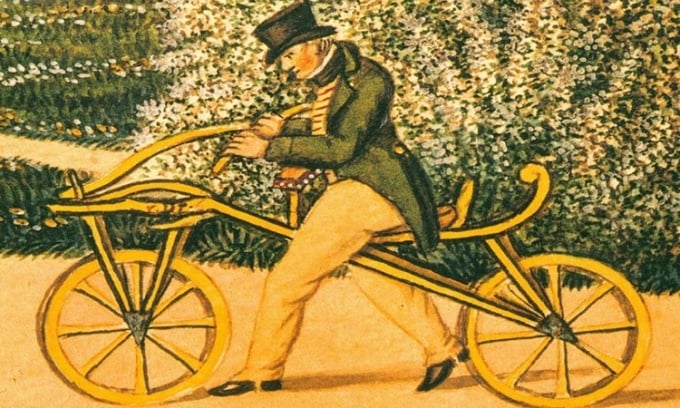
A replica of Karl von Drais's two-wheeled vehicle. Photo: Amusing Planet
In April 1815, Mount Tambora on what is now Sumbawa Island in Indonesia erupted with unprecedented force. A massive amount of rock debris, estimated at 10 billion tons, was ejected into the atmosphere. This rock and ash rose into the stratosphere and spread, covering the sky and obscuring sunlight for months. The eruption also released large amounts of sulfur dioxide into the atmosphere, leading to the formation of sulfate aerosols, which significantly cooled the Earth's surface temperature. The cold temperatures and altered weather patterns caused crop failures and famine in many parts of the world .
Scarce resources profoundly impacted daily life, making it impossible for many to support traditional transportation animals like horses and mules. In this difficult situation, Karl von Drais, a young German inventor, found the impetus to create a new form of transportation that did not rely on horseback. This led to the creation of the world's first two-wheeled vehicle.
The Laufmaschine designed by Von Drais consisted of two wheels aligned in a straight line, similar to modern bicycles and motorcycles. The vehicle was made of wood, with a horizontal bar connecting the two spoked wooden wheels. A small leather-covered seat was placed between the bar, providing seating for the driver. A vertical axle with a series of control levers connected to the front wheel was used for steering. The vehicle's propulsion relied entirely on the driver's strength. The driver sat on the leather seat, pressing their feet to the ground and moving back and forth to generate momentum. Each pedal stroke propelled the vehicle further than a pedestrian could.
On June 12, 1817, Von Drais set off from Mannheim along the scenic roads to Baden in his Laufmaschine. Following a southwest route, he traveled nearly 7 kilometers before arriving at a roadside inn called the Schwetzinger Relaishaus. While it is unclear whether Von Drais stopped at the inn to rest, historical records confirm that his round trip took just over an hour, less than half the time it would have taken to walk the same route from Mannheim to the inn and back.
Six months later, Von Drais applied for a patent in France and introduced the term vélocipède to describe his invention. The patent application was successful, and the vehicle quickly attracted the attention of French society. Von Drais introduced the pioneering vehicle in several European capitals, captivating large audiences with its novel design and functionality, and bringing in many orders for human-powered vehicles. Because Von Drais manufactured each part himself, the delivery time was very long. Therefore, the initial craze surrounding the vehicle gradually faded in Europe by the end of that year. However, recognizing the increasing demand, many manufacturers in France and England sought to capitalize on the vélocipède's popularity by launching their own versions. Among these, the version manufactured by London-based seat maker Denis Johnson was considered the most useful.
Denis Johnson introduced several improvements to the two-wheeled vehicle he marketed in London. Most notably, the crossbar on Johnson's cart sloped downwards in the middle, allowing for larger wheels and thus improving handling. Additionally, the iron steering mechanism provided the rider with greater control. Furthermore, the integration of iron bands along the outer edges of the wheels significantly increased their durability. Johnson's version quickly gained popularity in early 1819.
However, this craze for transportation quickly encountered many obstacles, such as rough roads and frequent encounters with horse-drawn carriages, posing a challenge to maintaining balance. Some reckless individuals even rode on sidewalks, endangering pedestrians. Recognizing the dangers of the burgeoning trend, authorities in Germany, England, the United States, and even Calcutta restricted or outright banned cycling. By the end of 1819, the craze for the rickshaw had almost completely subsided. Von Drais went on to create many other inventions, such as the first typewriter.
An Khang (According to Amusing Planet )
Source link






































































































Comment (0)