

Beyond simply being a tool for organizing urban space around metro lines, the Transport-Oriented Development (TOD) model in Ho Chi Minh City is being approached as a comprehensive strategy to simultaneously address traffic, environmental, urban finance, green transformation, and enhance the city's competitiveness.
The new policies and mechanisms of the Central Government and Ho Chi Minh City are being urgently implemented, demonstrating the formation of a new generation TOD model, where transportation infrastructure becomes the core for creating integrated, smart, and sustainable urban ecosystems.
Urban spatial restructuring, green transformation
The commissioning of Metro Line 1 (Ben Thanh-Suoi Tien) from the end of 2024 not only marks a significant development in Ho Chi Minh City's public passenger transport system but also opens a new phase in realizing a public transport-oriented urban development model.
For many years, TOD (Transit-Oriented Development) has generally been understood as a model of high-density urban development around public transport hubs aimed at reducing reliance on private vehicles, increasing access to public transport, and efficiently utilizing land resources. However, in the context of major cities facing increasing pressure from climate change, the urban heat island effect, environmental pollution, and the need to shift to a green growth model, the concept of TOD is expanding significantly.
One of the notable research directions today is the integration of nature-based solutions (NBS) into TOD development. According to experts from the Ho Chi Minh City University of Architecture, incorporating NBS solutions into the planning and landscape design of areas surrounding metro stations, following the Green-TOD approach, is an essential strategy to improve the efficiency of public transport operations while simultaneously enhancing the quality of the urban environment.
"Integrating nature-based solutions into the planning and landscape design of metro station areas according to the Green-TOD (Transit-Oriented Development) approach is an essential strategy, bringing outstanding dual benefits to both the public transport infrastructure system and the tropical compact urban ecosystem," experts from the Ho Chi Minh City University of Architecture emphasized.
Unlike the single-sector approach based on traditional engineering solutions, the Green-TOD model aims to address one of the biggest challenges facing Ho Chi Minh City's central area today: the urban heat island effect (UHI).
Based on practical research at the three central underground stations of Ben Thanh, City Theatre, and Ba Son, experts from the Ho Chi Minh City University of Architecture proposed solutions including increasing shaded areas, enhancing natural evaporation, reducing surface heat absorption of materials, and expanding green infrastructure within a 500-meter walking radius around the station.
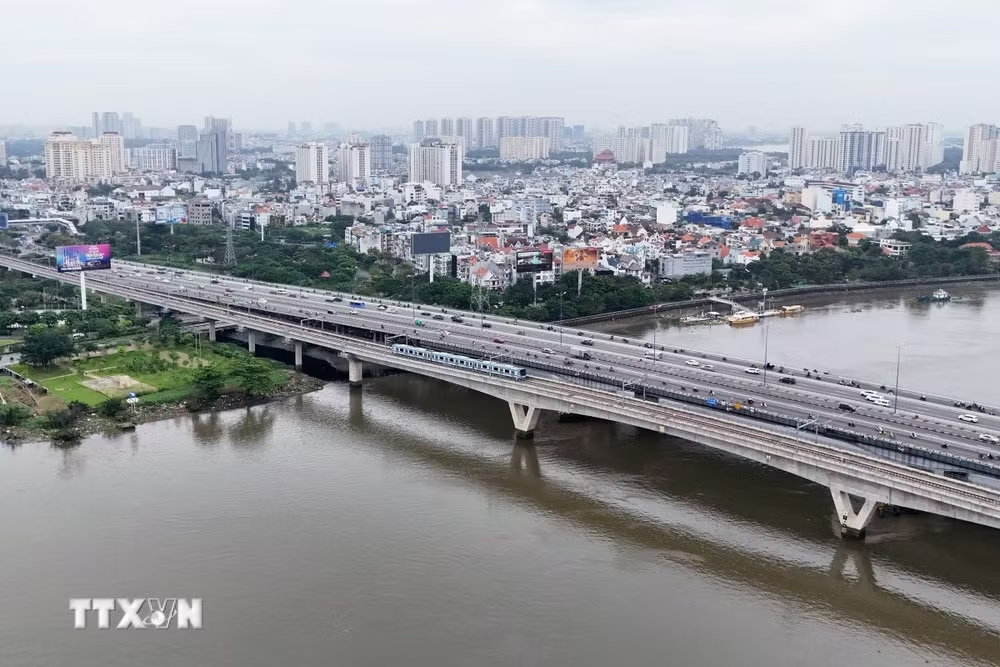
The goal of these solutions is not only to facilitate people's access to the metro but also to create urban ecological corridors, transforming the model from "compact infrastructure" to "transitional ecological corridors." This is a crucial step that helps Ho Chi Minh City maintain the efficiency of high-density urban development while enhancing climate adaptability and moving towards the goal of net-zero emissions.
Along with environmental aspects, the orientation of TOD (Transit-Oriented Development) in Ho Chi Minh City is also seen as a driving force for conducting research, improving institutions, and innovating urban governance.
According to Associate Professor Dr. Phan Thi Bich Nguyet and Dr. To Cong Nguyen Bao (Ho Chi Minh City University of Economics ), the biggest obstacles to TOD (Transit-Oriented Development) today do not lie in technology or planning, but in bottlenecks related to legal frameworks, finance, data, and multi-sectoral coordination mechanisms. TOD should not only be a solution for transportation planning and land use, but should also be approached as a controlled institutional and financial testing mechanism for urban development to promote green transformation and sustainable urban development.
Based on their research, experts from the Ho Chi Minh City University of Economics proposed building a TOD sandbox mechanism – a controlled experimental model that allows the city to implement new management mechanisms, mobilize social resources, and innovate urban governance methods. The proposed operational framework is based on six pillars: integrated planning, land finance, urban data, risk management, resource mobilization, and multi-stakeholder coordination mechanisms. In particular, it emphasizes the role of new financial instruments such as recovering added value from land around train stations, issuing TOD green bonds, urban railway development funds, and mobilizing international climate capital.
It can be said that, if implemented effectively, this will be the basis for Ho Chi Minh City to shift from a model of infrastructure investment dependent on the budget to a model of exploiting added value from urban development, similar to many major cities around the world such as Tokyo, Hong Kong (China) or Singapore.
Creating urban "mega-destinations".
The shift in the TOD approach is also clearly reflected in Ho Chi Minh City's strategic directions. The Resolution of the Standing Committee of the Ho Chi Minh City Party Committee on the implementation of Resolution 188/2025/QH15 identifies the goal of building a modern, integrated urban railway system that will serve as a cornerstone of the city's public passenger transport.
According to the roadmap, Ho Chi Minh City aims to complete 6 urban railway lines with approximately 187 km in the period 2025-2030. In the period 2030-2035, an additional 8 lines will be completed, bringing the total operational length to approximately 462 km. By 2045, the city aims to complete a network of 19 lines with approximately 700 km of urban railway.
Notably, in this development orientation, TOD (Transit-Oriented Development) is no longer a supporting element but has become a central component of the urban development strategy. The Resolution of the Standing Committee of the City Party Committee clearly defines the requirement to comprehensively review and update the urban railway network plan in conjunction with the TOD model; and at the same time, concretizes the investment mechanism combining the development of housing, commerce, services, public works, and other urban functions in the station area and its surroundings.
The implementation of the above solutions also significantly contributes to the concretization of the task: "Planning with interconnectedness between areas: the city center, riverside areas, coastal areas, and urban development models integrated with public transport (TOD). Implementing integrated sectoral planning linked to land fund creation methods, urban finance, transport development, housing policies, water resource management, and flood control," as stated in Resolution 09 of the Politburo on building and developing Ho Chi Minh City in the new era, which has just been issued.
Current realities show that Ho Chi Minh City is gradually shifting from the mindset of "building metros to serve the city" to "building cities around metros." According to urban planning experts, this is the foundation for forming a multi-centered urban structure, reducing pressure on the central core and expanding development space to new growth poles.
While previous TOD models primarily focused on public transport connectivity, the new TOD model is shaping towards multi-functional integration, where the station becomes the center of an ecosystem encompassing commerce, work, accommodation, and urban experiences.
Neil MacGregor, Managing Director of Savills Vietnam, stated that combining public transport infrastructure with unique experiential elements is key to transforming an ordinary transport hub into a super-destination that attracts tourism and boosts global trade.
In fact, many successful international complexes develop according to the same logic: using infrastructure as a foundation but prioritizing experience and urban operational capabilities as long-term attractive features. Complexes like King's Cross or Battersea Power Station in London have developed into new commercial, cultural, and creative centers.
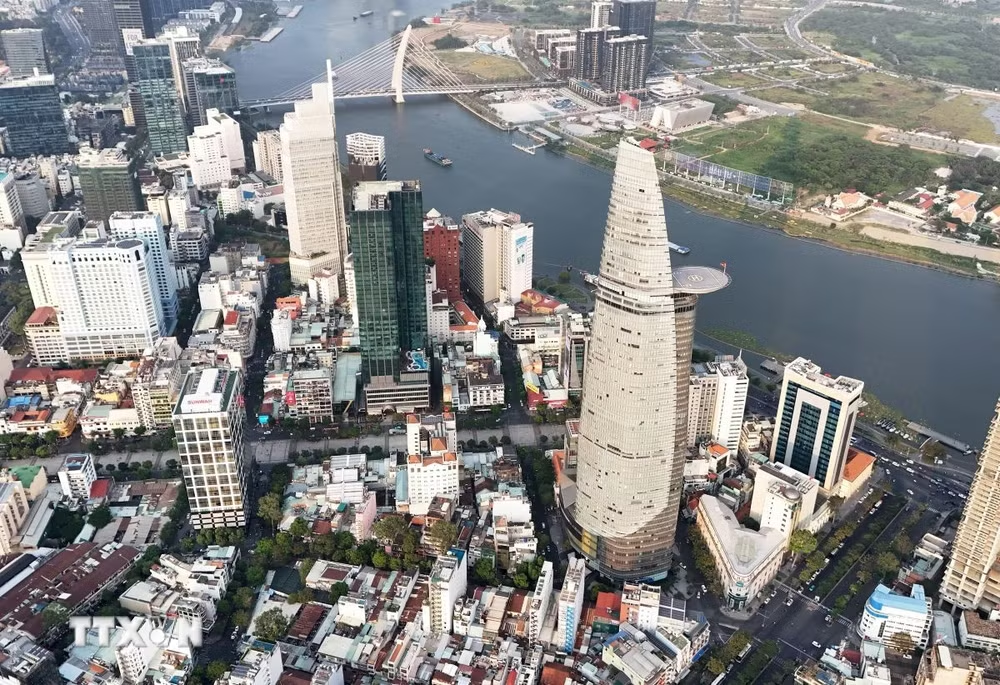
In Singapore, Jewel Changi Airport and ION Orchard have become popular tourist destinations and catalysts for regional economic growth. According to Savills Vietnam, the common thread among these models is the integration of transportation, commerce, public spaces, green landscapes, and urban experiences within a single integrated structure.
Neil MacGregor stated that projects with "wow factors" such as iconic architecture, public parks, urban art, interactive technology, or retail-entertainment ecosystems are becoming the deciding factors in the long-term appeal of next-generation TODs (Transit-Oriented Development).
In Ho Chi Minh City, the Thu Thiem area is considered to have many favorable conditions for development following this trend. The development concept for the Thu Thiem Railway Station Complex aims for a model that directly connects the railway station with an ecosystem of offices, hotels, shopping centers, public spaces, and high-quality residential areas.
Experts believe that, if implemented in conjunction with the metro system and specific mechanisms regarding finance, land, and governance, Thu Thiem has the potential to become one of the new development centers in Southeast Asia.
Looking at international trends, it's clear that TOD (Transit-Oriented Development) in Ho Chi Minh City is entering a pivotal stage of development. From a transportation planning model, TOD is expanding into an integrated urban development strategy with pillars including transportation infrastructure, green transformation, urban finance, institutional innovation, and experiential economy development.
Therefore, the journey of building a 700 km metro network is not simply about developing public transportation. It is also an opportunity to reshape the urban spatial structure, promote green growth, and create new development hubs, bringing Ho Chi Minh City closer to its goal of becoming a global, livable, and sustainably developed city in the 21st century.
Source: https://www.vietnamplus.vn/phat-trien-he-thong-metro-kien-tao-he-sinh-thai-do-thi-moi-post1113554.vnp
![[Photo] First session of the 14th Congress of the Vietnam Trade Union](https://vphoto.vietnam.vn/thumb/1200x675/vietnam/resource/IMAGE/2026/06/03/1780465947883_ndo_br_img-3852-jpg.webp)

![[Photo] General Secretary and President To Lam presides over a meeting with the Central Organizing Committee.](https://vphoto.vietnam.vn/thumb/1200x675/vietnam/resource/IMAGE/2026/06/03/1780482764658_a1-bnd-4741-3342-jpg.webp)

![[Photo] Secretary of the National Assembly Party Committee, Chairman of the National Assembly presides over the meeting of the Standing Committee and Executive Committee of the National Assembly Party Committee.](https://vphoto.vietnam.vn/thumb/1200x675/vietnam/resource/IMAGE/2026/06/03/1780480353201_ndo_br_bnd-2585-jpg.webp)










































![[Video] Sunset at Lap An Lagoon – Where the sun sets over the fishing nets](https://vphoto.vietnam.vn/thumb/1200x675/vietnam/resource/IMAGE/2026/05/31/1780192137701_beach-landscape-sea-water-nature-grass-745871-pxhere-com.jpeg)






















Comment (0)