

King Duy Tan was captured after the uprising against the French.
On May 6, 1916, King Duy Tan was arrested by the French colonial authorities after participating in an uprising initiated by patriotic scholars such as Tran Cao Van in Central Vietnam.
Despite ascending the throne at a young age and being considered "easy to control," he soon displayed a patriotic spirit, secretly allying with anti-French forces. The rebellion failed, and the king was exiled to Réunion Island, beginning his life in exile.
The event was not militarily successful, but it had great spiritual significance, demonstrating the will to resist the French within the royal family. Along with Thanh Thai and Ham Nghi, Duy Tan became a symbol of patriotism in the colonial context.
Press briefing instructions from the training conference.
At the First National Conference on Training and Education on May 6, 1950, President Ho Chi Minh emphasized the requirement that training officers must be "proficient in their profession," setting an example in ideology, morality, and work style.
Notably, he directly addressed the press as an important ideological tool, emphasizing the need for practicality and effectiveness. He stressed: "The press must also be rationalized… Do less, but do it properly… otherwise it will be costly and no one will read it."
This perspective criticizes formalism and superficiality, while setting standards for quality and social responsibility in journalism. To this day, it remains a core principle in modern media practices.
Establishing the foundation of a national banking system during the resistance war.
On May 6, 1951, President Ho Chi Minh signed a decree establishing the National Bank of Vietnam and appointing Nguyen Luong Bang as its General Director.
This event marked a turning point in the establishment of an independent financial and monetary system for the Democratic Republic of Vietnam. The bank undertook important functions such as issuing currency, managing credit, and coordinating finances to support the resistance war.
In the midst of wartime difficulties, the establishment of banking institutions was not only of economic significance but also affirmed national sovereignty , laying the foundation for a modern financial system later on.
The birth of Vietnam's civil aviation industry.
On May 6, 1956, President Ho Chi Minh signed a decision to establish the Civil Aviation Department (under the Ministry of Transport and Public Works), laying the foundation for Vietnam's civil aviation industry.
This was a strategic step in building modern transportation infrastructure, despite the country's many difficulties and divisions. From its humble beginnings, the aviation industry has gradually developed through war and peace.
Today, aviation has become a vital pillar of the economy, contributing to domestic and international connectivity and reflecting a long-term vision for national infrastructure development.
Approving the Strategy for Cultural Development in the Era of Integration
On May 6, 2009, the Prime Minister issued Decision No. 581/QD-TTg approving the Strategy for Cultural Development until 2020.
The document outlines the goal of building a comprehensively developed Vietnamese person, while also emphasizing the task of preserving and promoting heritage values.
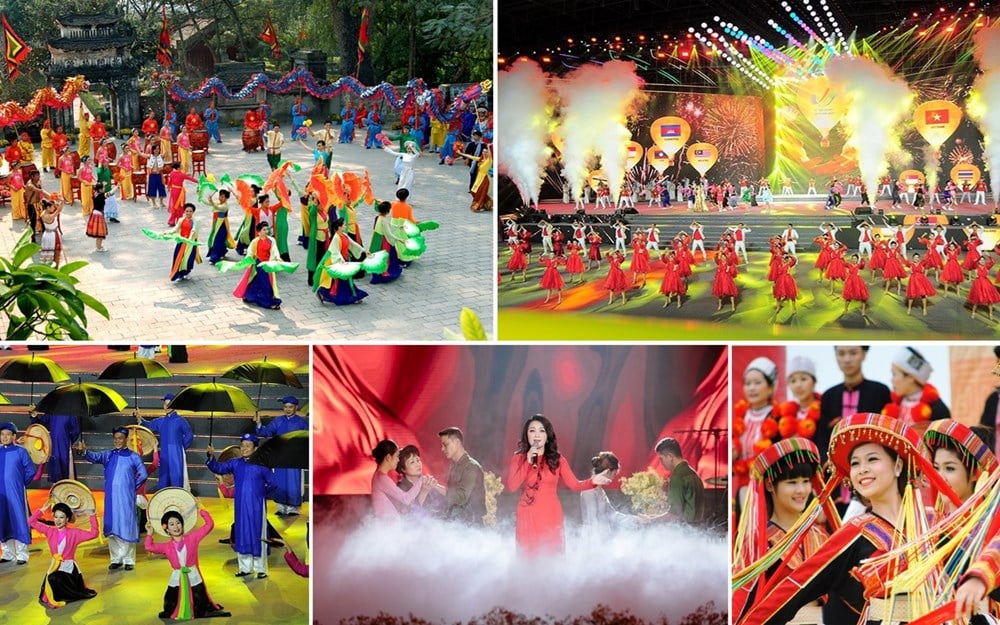
The strategy also opens up avenues for developing the cultural industry as a component of the economy. In fact, many programs on heritage, art, film, and cultural tourism have been implemented, contributing to improving the spiritual life and cultural standing of Vietnam.
Birthday of writer Nguyen Huy Tuong
On May 6, 1912, writer Nguyen Huy Tuong was born in Duc Tu, Tu Son, Bac Ninh (later part of Dong Anh, Hanoi).
He was a major figure in modern Vietnamese literature, excelling in historical novels and plays. Prior to the August Revolution, he participated in the national salvation cultural movement, and later continued to contribute to the arts and literature of the resistance.
Besides writing, he was also one of the founders of Kim Dong Publishing House. Works such as Vu Nhu To , Long Tri Night Festival , and Living Forever with the Capital ... have profound artistic and historical value, contributing to the cultivation of national consciousness.
The world's first postage stamp was issued.
On May 6, 1840, the first postage stamp – the Penny Black – was issued in England, as proposed by Rowland Hill.
For the first time, postage fees were paid in advance using stamps instead of being collected from the recipient, helping to standardize and increase transparency in postal operations.
The stamp featuring the portrait of Queen Victoria marked the beginning of the tradition of printing images of heads of state on stamps. From there, the modern postal system rapidly spread, contributing to the promotion of trade and global social connectivity.
Hindenburg airship disaster
On May 6, 1937, the LZ 129 Hindenburg airship caught fire upon landing in New Jersey (USA), killing 36 people.
The explosion lasted only a few dozen seconds but was captured on video and broadcast live, shocking the world.
This event shattered confidence in large-scale airship transport – a method that had been very popular in the early 20th century. From then on, the aviation industry shifted towards modern aircraft, marking a turning point in the history of transportation.
Channel Tunnel inaugurated.
On May 6, 1994, the Channel Tunnel was officially inaugurated, connecting England and France after nearly a decade of construction.
Spanning over 50 kilometers, with nearly 38 kilometers lying on the seabed, this is one of the world's largest underwater transportation projects.
The project, worth approximately £10 billion, demonstrates a high level of technical expertise and large-scale international cooperation. Since its completion, the tunnel has significantly boosted trade, tourism, and European connectivity.
Source: https://baovanhoa.vn/van-hoa/phe-duyet-chien-luoc-phat-trien-van-hoa-trong-thoi-ky-doi-moi-225170.html
















































































Comment (0)