

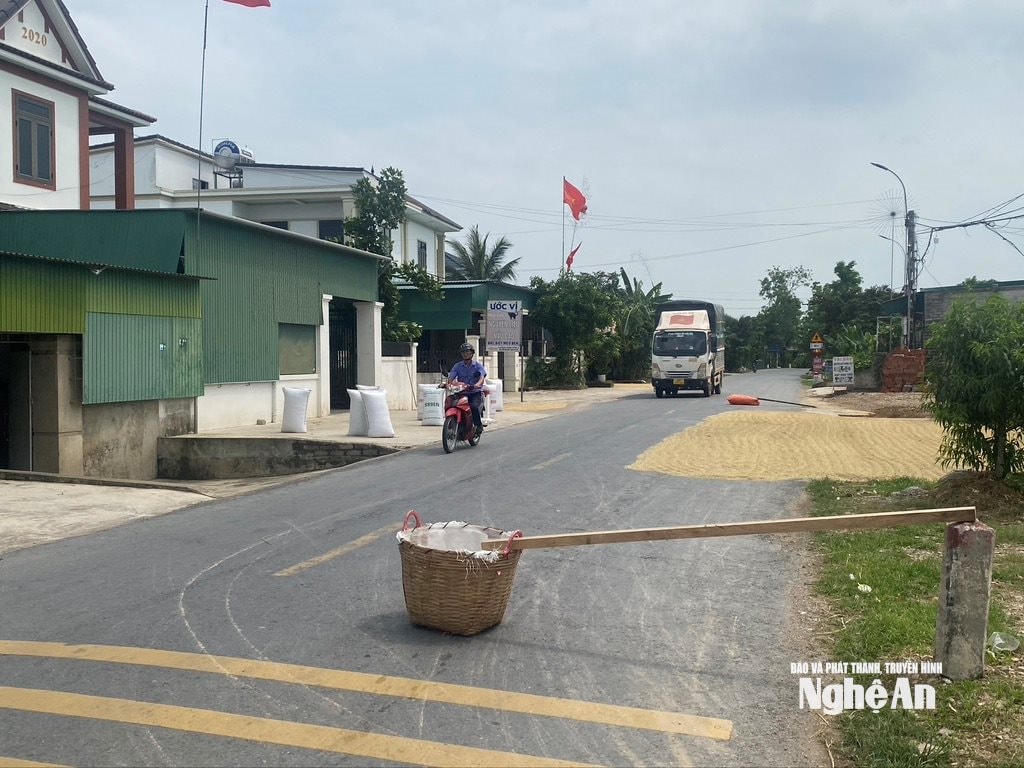
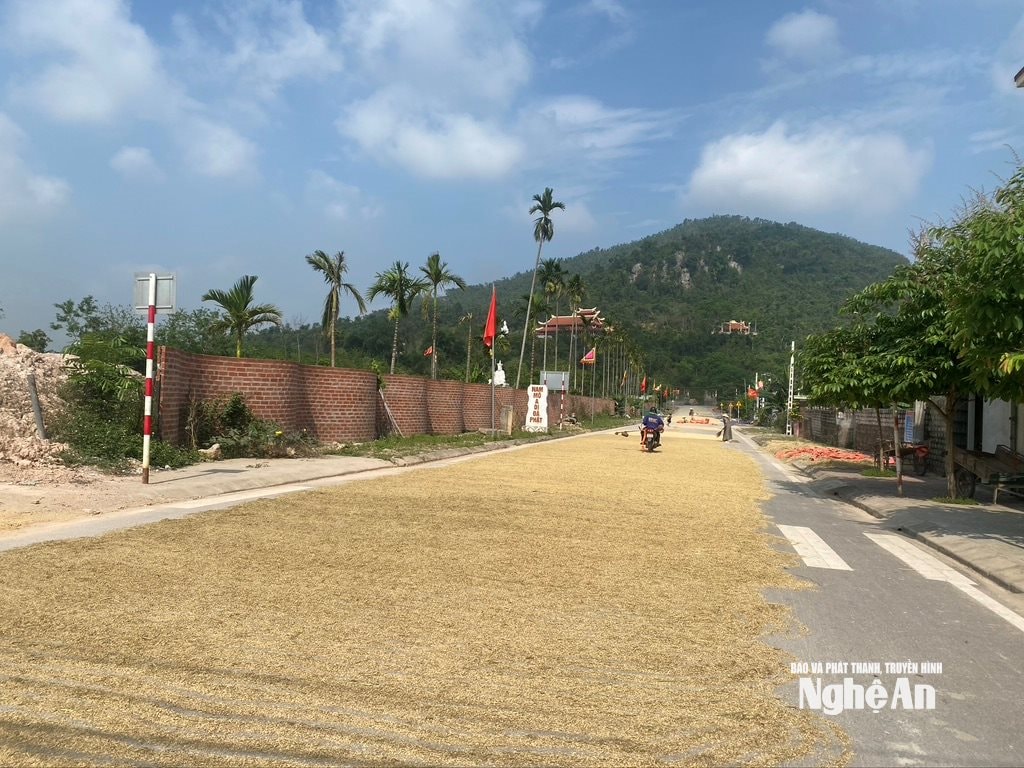
Observations made in Hop Minh commune on May 3rd along National Highway 48E revealed that it was easy to spot rice drying all over the road surface. Many households even used bricks, stones, wooden stakes, or ropes to mark the boundaries for drying rice, inadvertently turning the road into temporary "drying yards." These obstacles pose a direct risk to road users, especially in the early morning or late evening when visibility is limited.
Mr. Le Van Minh, a car driver in Hung Chau commune who frequently travels through the area, expressed his concern: "There are sections of road where rice is being dried, and bricks and stones are placed across the road as barriers. If you're not careful, your car could collide at any time. In unexpected situations, drivers have to swerve sharply, which is very dangerous, especially for trucks."
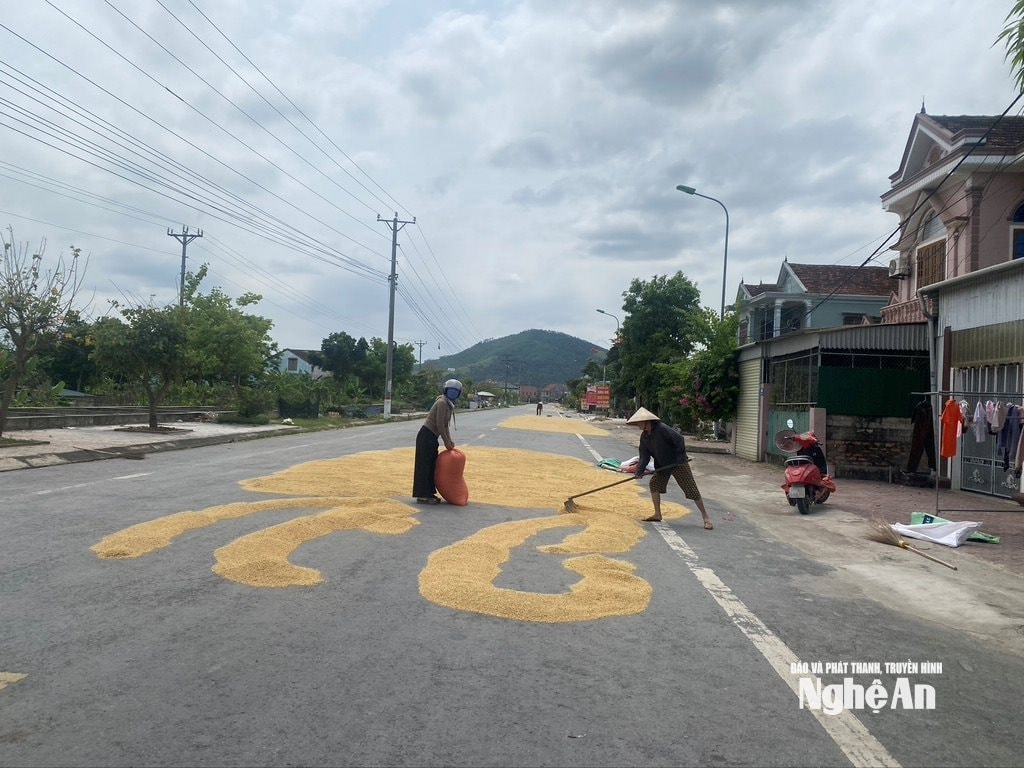
It's not just car drivers; many motorcyclists share the same concern. Mr. Tran Van Hoa, a resident who commutes daily through Quan Thanh commune, said: "Rice drying on the road can easily fall over if you brake suddenly. We feel really unsafe every time we pass through such sections of road."
Meanwhile, from the perspective of the farmers drying their rice, the story takes on a different point. Ms. Nguyen Thi Tam (Hop Minh commune) shared: “The harvest season coincides with days of intense heat. If we don't dry the rice immediately, it easily gets damp and moldy, reducing its quality. Houses now all have corrugated iron roofs and no large yards, so people have to make use of the road surface.”
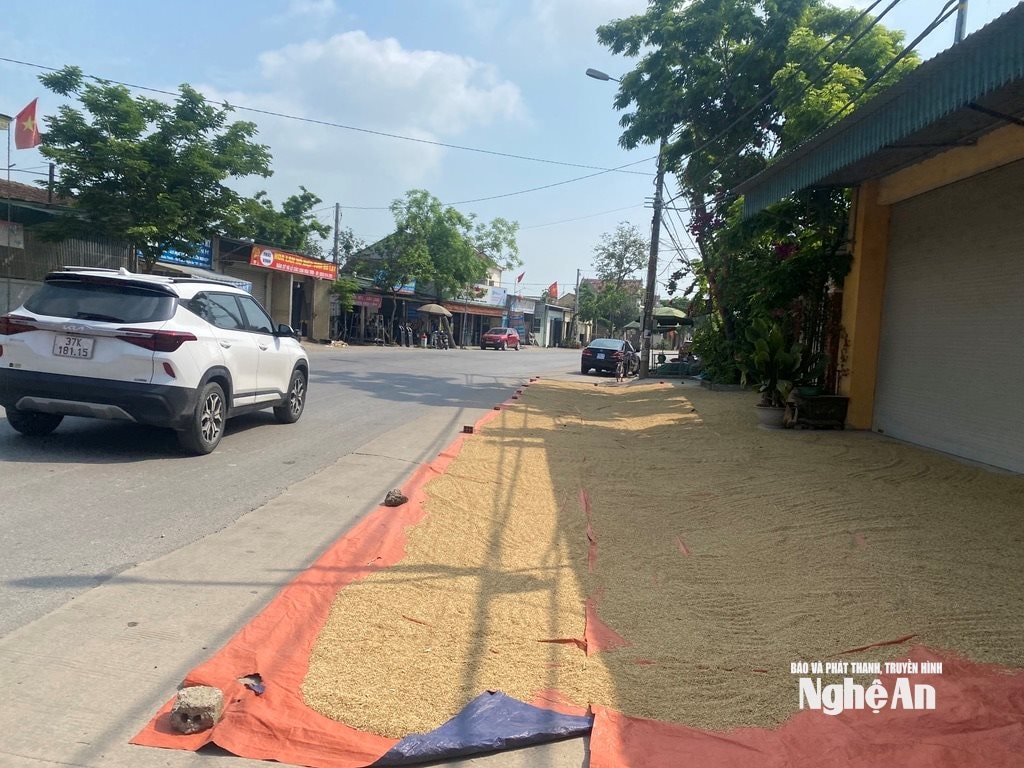
In Quan Thanh commune, despite many roads being paved and vehicles traveling at high speeds, the practice of drying rice in the sun remains widespread. Notably, many households choose locations with obstructed visibility, such as bends and slopes, to dry their rice, further increasing the risk of accidents. It is also worth noting that this locality has many spacious courtyards of cultural centers and sports fields, suitable for drying agricultural products, but these are not being utilized effectively.
Some residents in Quan Thanh commune admit that drying rice on the road is more convenient because it's near their homes and easy to keep an eye on. "If we take it to the communal yard, we have to transport it far, and we worry about theft or damage from livestock," said Mr. Nguyen Van Viet, a resident of Quan Thanh commune.
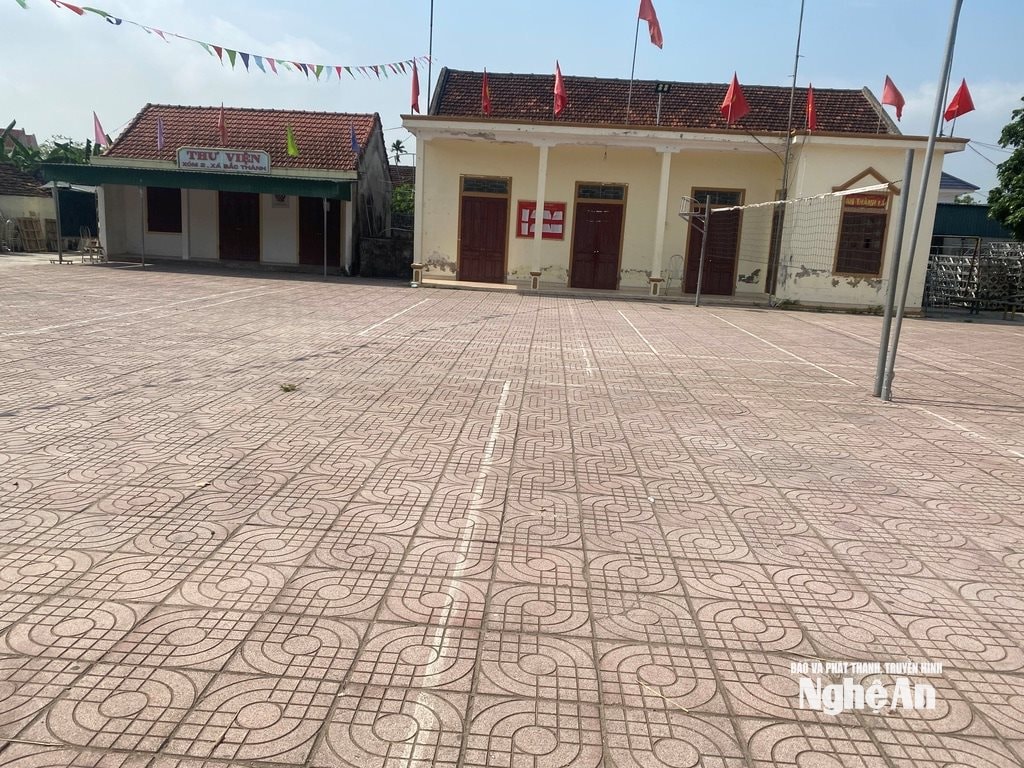
Mr. Thai Dinh Tien, Head of the Economic Department of Quan Thanh Commune People's Committee, said: "Right from the beginning of the season, the commune organized propaganda and mobilized people not to encroach on the road to dry rice. However, due to long-standing habits and practical needs, this situation still recurs. In the coming time, we will coordinate with functional forces to strengthen inspection and handling."
In Quang Chau commune, not only is National Highway 7B littered with rice being dried in the sun, but many inter-commune and inter-village roads are also covered with rice. In some places, people even dry straw right on the road, obstructing traffic and posing a serious accident risk.
.jpeg)
The current issue is that local authorities and commune police forces need to strengthen propaganda efforts to raise public awareness of the risks and consequences of drying agricultural products on roads. At the same time, the authorities should proactively plan and designate designated areas for drying agricultural products, such as stadiums, community centers, and open spaces, which are convenient for residents, safe, and subject to strict management. Furthermore, establishing and maintaining self-governing groups in villages and hamlets to remind and monitor each other is also an effective solution, contributing to raising community awareness.
According to Decree 168/2024/ND-CP (effective from January 1, 2025), specifically Article 12 of Decree 168 stipulates: A fine of 6-8 million VND will be imposed on individuals who illegally place or leave obstacles or other obstructions on roads; pour slippery substances on roads; dump, discharge, or spill chemicals or waste causing road traffic safety hazards...
Individuals who temporarily use roads and sidewalks for purposes other than those permitted without a license or with an expired license will be fined between 10 and 15 million VND; organizations that violate this will be fined double that amount.
In cases where drying rice, paddy, or straw on public roads causes harm to life or serious damage to the health or property of others, the offender may be prosecuted for "Obstructing road traffic" as stipulated in Clause 4, Article 261 of the Penal Code.
Source: https://baonghean.vn/phoi-lua-duoi-long-duong-hiem-hoa-tai-nan-giao-thong-10335293.html

![[Image] Hanoi's urban life under the challenge of a "scorching hot" environment](https://vphoto.vietnam.vn/thumb/1200x675/vietnam/resource/IMAGE/2026/05/25/1779706979265_nang-nong-t5-2026-minh-duy-7-4636-jpg.webp)


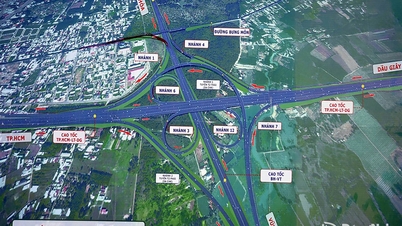
![[Image] Close-up view of the interchange connecting the two expressways and Long Thanh Airport.](https://vphoto.vietnam.vn/thumb/1200x675/vietnam/resource/IMAGE/2026/05/25/1779703378210_ndo_br_z7863716673926-224453a31600126cce10622af6290afd-4549-jpg.webp)



















































































Comment (0)