

Ancient people may have actively mummified bodies as part of a ritual, but this process could also have occurred naturally under special conditions.
Mummies have been found on every continent on Earth, including penguin mummies in Antarctica. The key to natural mummification is disrupting the natural decomposition processes by hindering the microorganisms and enzymes that break down the body after death. This can be achieved in extremely cold, extremely dry, acidic, or oxygen-free environments.
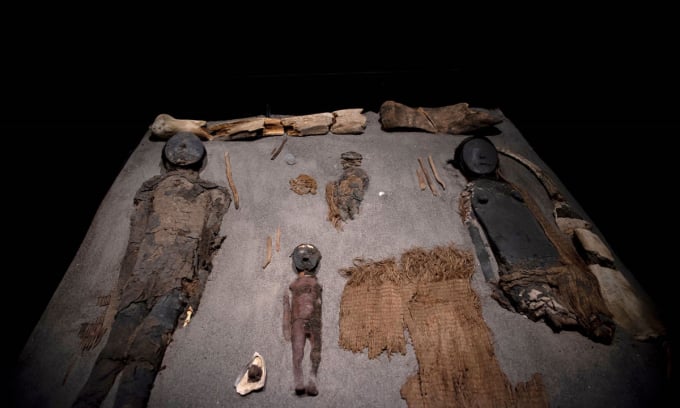
Chinchorro mummies in the San Miguel de Azapa archaeological museum in Camarones, Arica, Chile. Photo: Martin Bernetti/AFP.
Desert Mummy
In drought conditions, the human body can spontaneously mummify due to lack of water. In extremely hot and dry environments, the body is able to lose water quickly enough before microorganisms and enzymes have time to break down most of the tissues, helping to preserve the body in relatively good condition.
Most enzymes function in aqueous environments. Therefore, a lack of water will slow down decomposition, or even stop it altogether. In spontaneous embalming, the body's natural dehydration occurs faster than the development of enzyme activity, according to the book *Taphonomy of Human Remains: Forensic Analysis of the Dead and the Depositional Environment* by Eline MJ Schotsmans, Nicholas Márquez-Grant, and Shari L. Forbes.
However, the body doesn't always dry out evenly. Some parts, like the hands and genitals, will lose water relatively quickly, but internal organs like the heart will take longer.
A famous example of desert mummies is the Chinchorro mummies in the Atacama Desert. Some were likely actively mummified, dating back up to 7,000 years—more than 2,000 years older than the oldest Egyptian mummies. However, even older mummies, believed to have formed naturally due to the desert environment, may be up to 9,000 years old.
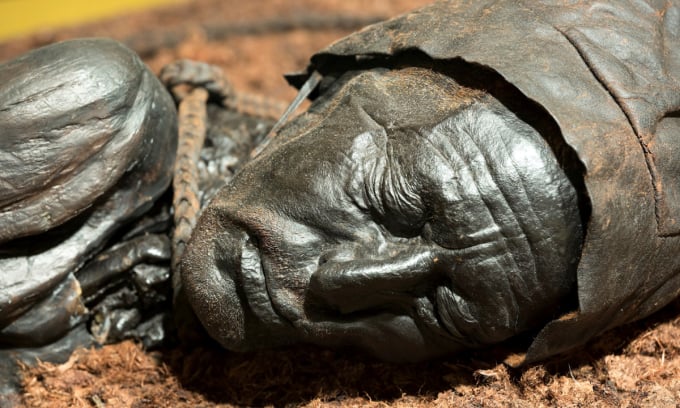
The Tollund Man, a bog mummy dating back approximately 2,400 years. Photo: Tim Graham /Getty
Swamp mummy
Another effective way for natural mummification to occur is by placing the body in peat bogs. Experts have found a large number of such bog mummies in northern Europe, particularly in Denmark, Germany, the Netherlands, Sweden, Poland, Ireland, and England.
If immersed in peat bogs, the body would be exposed to cold, highly acidic water and a lack of oxygen. In addition, certain unique chemical reactions in the environment would accelerate the mummification process.
A key factor is the type of vegetation characteristic of peat bogs. These places often have Sphagnum moss, which grows on the surface of the bog. The lower layers of the bog are filled with decaying Sphagnum moss. When it dies, the moss releases a polysaccharide called sphagnen, which has properties that help remove metal ions from a solution. As a result, some metal ions, such as iron, copper, or zinc, are no longer available to bacteria, depriving them of a crucial nutrient source, according to the book *Taphonomy of Human Remains: Forensic Analysis of the Dead and the Depositional Environment*.
These harsh conditions prevent microorganisms from beginning the decomposition process, although the bones will eventually corrode in the acidic environment. As a result, the body turns brown, retaining its skin, hair, and nails.
The most famous example of a bog mummy is the Tollund Man, discovered by peat miners on the Jutland Peninsula in Denmark around the 1950s. When first seen, the mummy was believed to be a recently missing boy. However, analysis revealed the mummy to be much older, dating back 2,400 years. The mummy was so well preserved that scientists even know what his last meal consisted of.
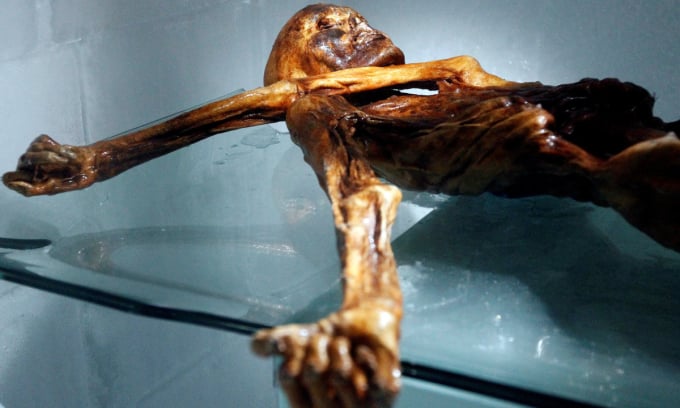
The naturally mummified body, known as "Otzi the Iceman," was discovered in the Alps in 1991. Photo: Andrea Solero/AFP
Ice mummy
Cold and icy environments are also ideal for the natural mummification process. Most enzymes involved in decomposition are inactive at temperatures below zero, so they cannot break down body tissues.
The Otzi Iceman mummy is a prime example of this type of natural mummification. His body was discovered in the Alps, on the Austrian-Italian border, in 1991. Austrian authorities initially believed him to be a modern-day mountaineer due to the remarkably well-preserved body. However, the man actually died approximately 5,300 years ago.
Rising global temperatures are melting more glaciers, ice caps, and permafrost areas, meaning discoveries like Otzi the Iceman could become more common in the future.
Thu Thao (According to IFL Science )
Source link

![[Photo] Prime Minister Pham Minh Chinh presides over a meeting on private sector economic development.](/_next/image?url=https%3A%2F%2Fvphoto.vietnam.vn%2Fthumb%2F1200x675%2Fvietnam%2Fresource%2FIMAGE%2F2025%2F12%2F20%2F1766237501876_thiet-ke-chua-co-ten-40-png.webp&w=3840&q=75)































































































Comment (0)