

Old wound, new blue color.
We returned to Hien Luong - Ben Hai early in the historic month of April. The wooden bridge that once divided the country is now a connecting point between memory and the present. Mrs. Le Thi Hao (78 years old), residing in Hien Luong village, Hien Thanh commune, Vinh Linh district, pointed to the Hien Luong bridge: "Back then, standing on this side and looking across, I missed my loved ones but couldn't cross. Bombs and bullets roared day and night. Now… my children and grandchildren stroll on the bridge every day."
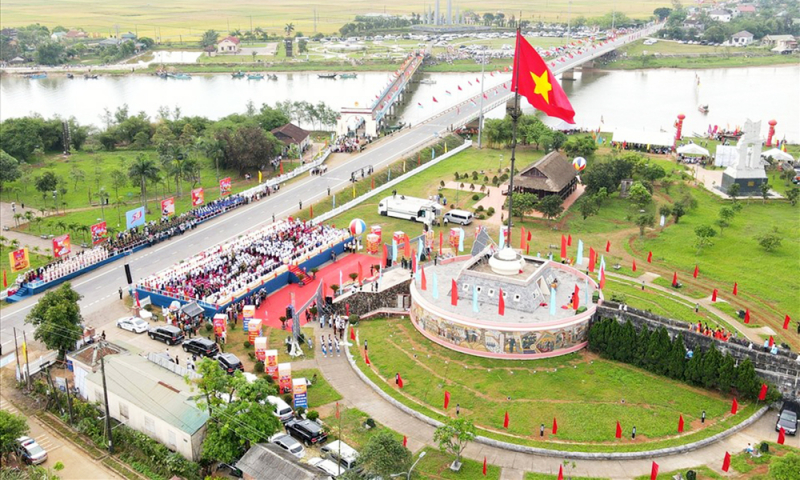
Both banks of the Ben Hai River are now prosperous villages, with rows of high-rise buildings, modern schools, and health centers. The land once carpet-bombed is now a rapidly developing area for aquaculture and ecotourism. Tourists flock to visit, listening to the echoes from both ends of the demarcation line.
At Con Tien - Doc Mieu, once a "guardian eye" protecting the front lines against American and Saigon Army attacks, now a meticulously maintained historical site and memorial, every flower and blade of grass is carefully tended. Mr. Nguyen Tien Luc, Head of the Tourism Management Department of the Quang Tri Provincial Department of Culture, Sports and Tourism, said emotionally: "Every day we welcome dozens of visitors here, many of whom cry when they hear the stories. But what surprises them most is the powerful resurgence of this land."
On the legendary Highway 9 – a route that once bore the weight of millions of tons of bombs, bullets, blood, and sweat of countless young volunteers – the road is now smoothly paved, guiding convoys of trucks back and forth through the Lao Bao border gate. A whole new economic belt has formed in this border region. Commercial and service areas have sprung up and developed continuously, contributing to the new shape of this land that was once a war zone.
In Lang Vay, the site of the famous battle where our soldiers routed the American commando forces, the village of the Van Kieu people is now filled with laughter. Village elder Ho Van Toi told us with a hearty voice: "In the past, bombs fell and bullets flew. Now, our children are educated, we have electricity, roads, and a health clinic. The commune committee even has Van Kieu officials; we are very proud!"
The land of the ancient citadel – where the 81 days and nights of the fiery summer of 1972 became immortal – is now a green park, a solemn memorial. People walk silently amidst the cool green trees, their eyes welling up as they read the inscription: "Every inch of land is an inch of blood."
The stance of a land guardian.
In this journey of revival, the silent yet unwavering contributions of the People's Public Security Force of Quang Tri province cannot be overlooked. From the early days of the province's re-establishment (1989), when the headquarters were still temporarily borrowed, the border was turbulent, and the people's hearts were uneasy, the Public Security Force was a solid support for the government and the people. Colonel Le Phuong Nam, Deputy Director of the Quang Tri Provincial Public Security Department, shared: "We clearly understand: maintaining peace is essential for development. At times we have faced drug trafficking in the border region, at other times we have carried out rescue operations during historic floods, and then there was the fight against the COVID-19 pandemic – it was extremely difficult, but our officers have never retreated."
These silent achievements are recognized through each successful case and each "three-no" residential area: no crime, no social vices, and no law violations. In remote areas, the regular police force deployed to communes not only maintains security but also acts as a bridge to help people develop their economy, eradicate illiteracy, and preserve their cultural identity. Lieutenant Colonel Ho Sy Vinh, Head of the Huong Viet Commune Police Station, Huong Hoa District, who grew up in the Van Kieu village, proudly said: "I am a son of this land, educated and trained to return and serve my homeland. That is my greatest happiness."
In particular, immediately after the implementation of the Government's Project on developing data applications on population, identification and electronic authentication to serve the national digital transformation in the period 2022-2025, with a vision to 2030, as well as in all 63 provinces and cities nationwide, the police force has been the main force in Quang Tri. From urban to rural areas, from the plains to the mountains, the image of dedicated and approachable police officers is not only a symbol of security but also a source of trust for the people…
Quang Tri today is a symbol of resilience rising from the ruins of war. 36 years after its separation from the province, from being one of the poorest in the country, it has achieved stable economic growth, with continuously expanding infrastructure in transportation, education, and healthcare. The hot, dry winds of Laos still blow, but on the wind farms now stand wind turbines, igniting new aspirations. "We will never forget the past, but we are not bound by it. The responsibility of today's generation is to transform Quang Tri into a place worthy of living, investing, and developing," confided Mr. Nguyen Long Hai, Secretary of the Quang Tri Provincial Party Committee. Indeed, that song of rebirth, though written in blood and tears, now resonates with the rhythm of life, faith, and increasingly brilliant achievements!
Source: https://cand.com.vn/Phong-su-tu-lieu/quang-tri-50-mua-xuan-hoi-sinh-tu-khoi-lua-i764629/
![[Photo] Prime Minister Pham Minh Chinh attends the Conference on the Implementation of Tasks for 2026 of the Industry and Trade Sector](/_next/image?url=https%3A%2F%2Fvphoto.vietnam.vn%2Fthumb%2F1200x675%2Fvietnam%2Fresource%2FIMAGE%2F2025%2F12%2F19%2F1766159500458_ndo_br_shared31-jpg.webp&w=3840&q=75)




































































Comment (0)