

The victory of the first General Election on January 6, 1946, marked the birth of the Vietnamese National Assembly , a democratic institution and a cornerstone of the people's rule of law state, by the people and for the people. For the first time in our country's history, all citizens aged 18 and above participated in the General Election to elect the National Assembly of the Democratic Republic of Vietnam, now the National Assembly of the Socialist Republic of Vietnam.
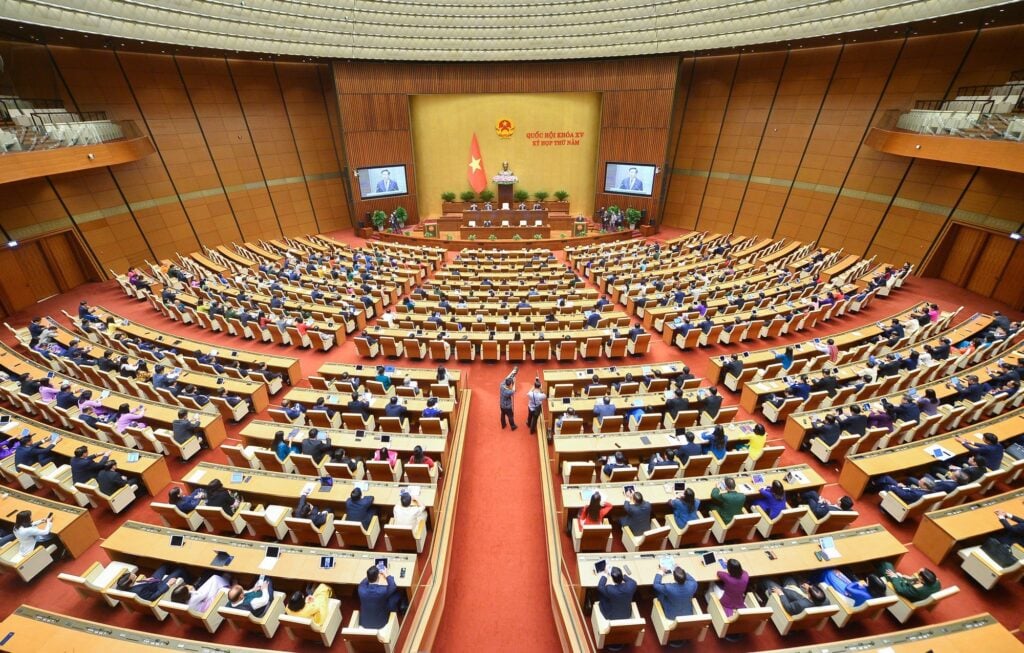
The National Assembly is the highest representative body of the People, the highest state power organ of the Socialist Republic of Vietnam. The National Assembly has three main functions, including: (1) Legislation; (2) Deciding on important issues of the country; (3) Supreme supervision of the activities of the State.
The specific tasks and powers of the Vietnamese National Assembly are stipulated in the Vietnamese Constitution, including: (1) Making and amending the Constitution; making and amending laws; (2) Exercising supreme oversight over compliance with the Constitution, laws and resolutions of the National Assembly; reviewing reports on the work of the President, the Standing Committee of the National Assembly, the Government, the Supreme People's Court, the Supreme People's Procuracy, the National Election Council , the State Audit Office and other agencies established by the National Assembly; (3) Deciding on the goals, targets, policies and basic tasks of socio-economic development of the country; (4) Deciding on basic policies on national finance and currency; stipulating, amending or abolishing taxes; deciding on the distribution of revenues and expenditures between the central and local budgets; deciding on the safe limits of national debt, public debt and government debt; (4) Deciding on the state budget estimates and central budget allocation, approving the state budget final accounts; (5) Deciding on the State's ethnic policy and religious policy; (6) Regulating the organization and operation of the National Assembly, the President, the Government, the People's Courts, the People's Procuracy, the National Election Council, the State Audit Office, local governments and other agencies established by the National Assembly; (7) Electing, dismissing, and removing the President, Vice President, Chairman of the National Assembly, Vice Chairman of the National Assembly, members of the Standing Committee of the National Assembly, Chairman of the National Ethnic Council, Chairmen of the Committees of the National Assembly, Prime Minister, Chief Justice of the Supreme People's Court, Chief Procurator of the Supreme People's Procuracy, Chairman of the National Election Council, General Auditor of the State, and heads of other agencies established by the National Assembly; approving proposals for the appointment, dismissal, and removal of Deputy Prime Ministers, Ministers and other members of the Government, and Judges of the Supreme People's Court; Approve the list of members of the National Defense and Security Council and the National Election Council. After being elected, the President, the Chairman of the National Assembly, the Prime Minister, and the Chief Justice of the Supreme People's Court must take an oath of allegiance to the Fatherland, the People, and the Constitution; (8) Vote of confidence for those holding positions elected or approved by the National Assembly; (9) Decide on the establishment and abolition of ministries and ministerial-level agencies of the Government; establish, dissolve, merge, divide, and adjust the administrative boundaries of provinces, centrally-administered cities, and special administrative-economic units; establish and abolish other agencies as prescribed by the Constitution and laws; (10) Abolish documents of the President, the Standing Committee of the National Assembly, the Government, the Prime Minister, the Supreme People's Court, and the Supreme People's Procuracy that are contrary to the Constitution, laws, and resolutions of the National Assembly; (11) Decide on general amnesty; (12) Regulate ranks and grades in the people's armed forces, diplomatic ranks and grades and other state ranks and grades; regulate state medals, decorations and honorary titles; (13) Decide on war and peace issues; regulate emergency situations, other special measures to ensure national defense and security; (14) Decide on basic foreign policy; approve, decide on accession or termination of international treaties related to war, peace, national sovereignty, membership of the Socialist Republic of Vietnam in important international and regional organizations, international treaties on human rights, fundamental rights and obligations of citizens and other international treaties contrary to laws and resolutions of the National Assembly; (15) Decide on referendums.
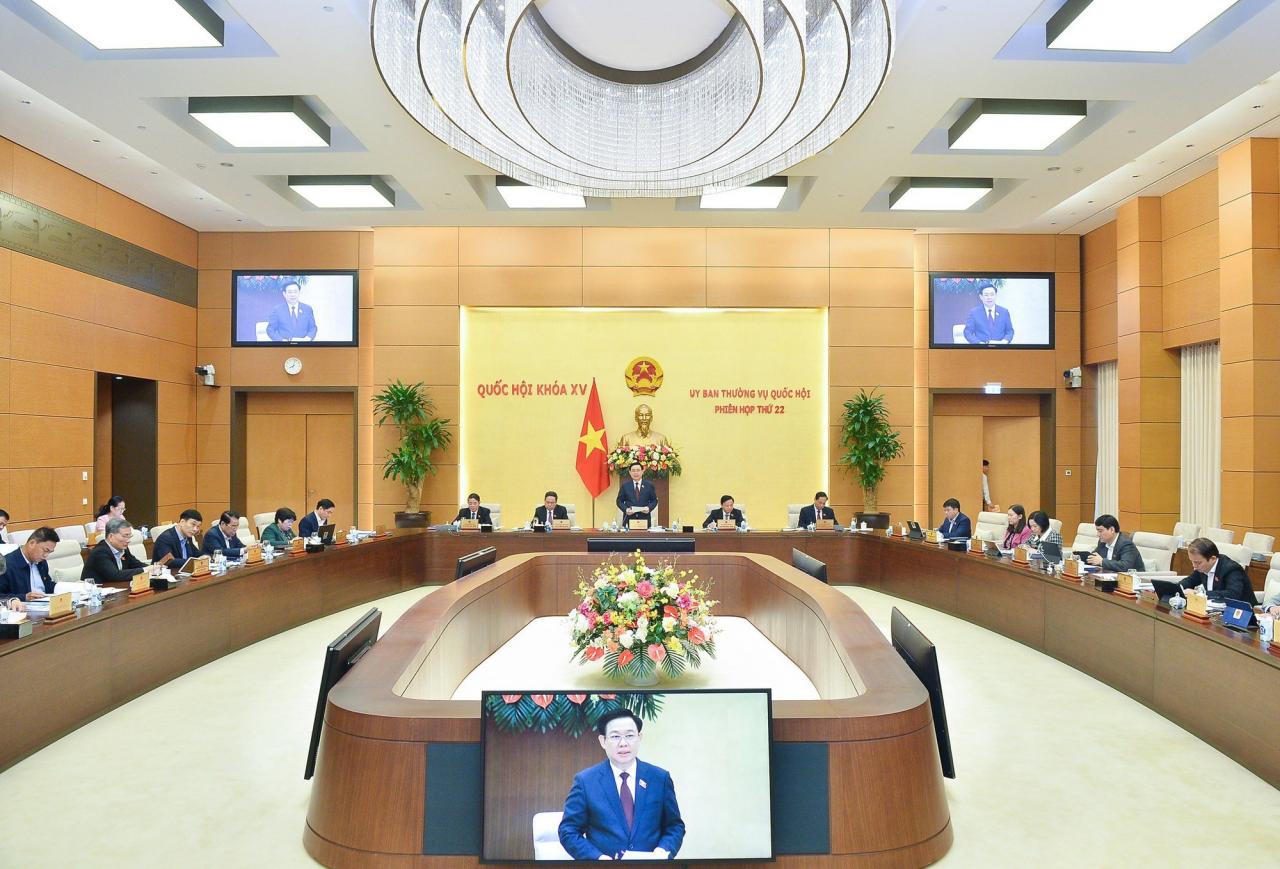
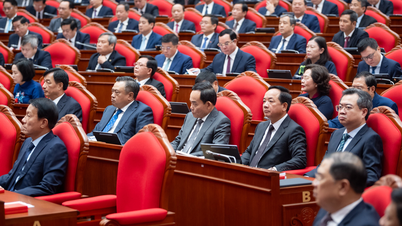
The Vietnamese National Assembly operates on a conference basis and makes decisions by majority vote. The effectiveness of the National Assembly is ensured by the effectiveness of its sessions, the activities of the Standing Committee, the National Council, the National Assembly Committees, the National Assembly delegations, the National Assembly deputies, and the effectiveness of its coordination with the President, the Government, the Supreme People's Court, the Supreme People's Procuracy, the Central Committee of the Vietnam Fatherland Front, and other agencies and organizations. The term of each National Assembly is five years, from the opening of the first session of that National Assembly to the opening of the first session of the next National Assembly. The new National Assembly must be elected sixty days before the end of its term. In exceptional circumstances, if at least two-thirds of the total number of National Assembly deputies vote in favor, the National Assembly may decide to shorten or extend its term at the request of the Standing Committee. The term of a National Assembly cannot be extended beyond 12 months, except in cases of war. Normally, the Vietnamese National Assembly holds two regular sessions annually, convened by the Standing Committee. However, the Standing Committee may convene extraordinary sessions at its own discretion, or at the request of the President, the Prime Minister, or at the request of at least one-third of the total number of National Assembly deputies. National Assembly meetings are public, with some sessions being televised and broadcast live. Representatives of state agencies, social organizations, economic organizations, armed forces units, press agencies, citizens, and international guests may be invited to attend public sessions of the National Assembly. The head of the Vietnamese National Assembly is the Speaker. The Speaker presides over the National Assembly sessions; signs and certifies the Constitution, laws, and resolutions of the National Assembly; leads the work of the Standing Committee; organizes and implements the National Assembly's foreign relations; and maintains relations with National Assembly deputies. The Vice-Chairmen of the National Assembly assist the Chairman of the National Assembly in performing his/her duties as assigned by the Chairman. The total number of National Assembly deputies shall not exceed 500, including full-time and part-time deputies. The number of full-time National Assembly deputies shall be at least 40% of the total number of National Assembly deputies. The Standing Committee of the National Assembly is the permanent body of the National Assembly. The Standing Committee of the National Assembly consists of the Chairman of the National Assembly, the Vice-Chairmen of the National Assembly, and the members of the Standing Committee, with the Chairman of the National Assembly serving as Chairman and the Vice-Chairmen of the National Assembly serving as Vice-Chairmen. The National Assembly establishes specialized bodies including: the Council of Ethnic Minorities; and nine Committees (Law Committee; Judicial Committee; Economic Committee; Finance and Budget Committee; National Defense and Security Committee; Culture and Education Committee; Social Committee; Science, Technology and Environment Committee; and Foreign Affairs Committee). The National Assembly delegation consists of National Assembly deputies elected in a province or centrally-administered city; the National Assembly Office is the advisory and support body for the National Assembly, the Standing Committee of the National Assembly, the Council of Ethnic Minorities, and the Committees of the National Assembly, as well as the Departments of the Standing Committee of the National Assembly. In addition, the Standing Committee of the National Assembly establishes agencies under its authority to advise and assist the Standing Committee on specific areas of work, including: the Committee on Delegate Affairs, the Committee on Citizen Petitions, and the Institute for Legislative Research. The current Vietnamese National Assembly is a member of the Inter-Parliamentary Union (IPU), the ASEAN Inter-Parliamentary Assembly (AIPA), the Francophone Parliamentary Assembly (APF), and is a founding member of the Asia-Pacific Parliamentary Forum (APPF) and the Asian Parliamentary Assembly for Peace (AAPP). Inheriting and building upon the fine traditions of previous National Assemblies, the 15th National Assembly (2021-2026), headed by National Assembly Chairman Vuong Dinh Hue, has continued to innovate its methods, improve the quality and effectiveness of its operations, with the ultimate goal of serving the interests of the nation and people, and the happiness of the people; promoting democracy, unity, the rule of law, integrity, openness, transparency, increasing professionalism, and continuously improving the quality and effectiveness of the National Assembly's work in both legislative work, supreme oversight, and decision-making on important national issues. Based on a thorough understanding and timely institutionalization of the Resolution of the 13th National Party Congress, in the early years of the 15th National Assembly's term, the National Assembly has continuously improved the quality of legislative work and discipline, the legislative process, and built a synchronous, unified, stable, and feasible legal system, ensuring the constitutionality and legality of the legal system and conforming to international treaties to which Vietnam is a signatory, in order to create a complete legal framework for sustainable national development, with the people and businesses at the center. It has continued to innovate and strengthen supervision, considering this a key and crucial step to enhance the effectiveness and efficiency of the National Assembly's operations. It has also continued to innovate the methods and approaches of organizing questioning and answering sessions, strengthening questioning activities in the Standing Committee of the National Assembly, and accountability activities in the Ethnic Council and the Committees of the National Assembly; The supervisory activities of National Assembly deputies and delegations should focus on monitoring the implementation of laws and the execution of recommendations following supervision, linked to the accountability of relevant organizations and individuals, especially the responsibility of the heads of organizations… Continuously innovate working methods and improve the quality of decisions on important national issues regarding the organization of the state apparatus and high-level personnel; regarding the goals, targets, policies, and basic tasks of socio-economic development, investment policies for national target programs, and important national projects. Improve the quality, effectiveness, and efficiency of basic policy decisions on national finance and currency, ensuring discipline, order, transparency, and accountability in the financial and budgetary fields. Improve the quality of basic policy decisions on foreign affairs; Continue to strengthen the National Assembly's foreign relations in conjunction with the Party's foreign relations, State diplomacy , and people-to-people diplomacy, contributing to enhancing the National Assembly's prestige and the country's position in the international arena; Promote digital transformation in the organization and operation of the National Assembly. Continue to innovate and improve the quality and effectiveness of advisory, support, and service work for the National Assembly's activities; the work of directing, guiding, and supervising the activities of the People's Councils; innovate and strengthen activities of contacting voters, consulting, listening to opinions, and closely engaging with voters. To achieve the goals of the term, according to initial statistics, in the first nearly three years of the 15th National Assembly's term, approximately 136 official normative documents have been issued (of which, the National Assembly issued 101 normative documents, and the Standing Committee of the National Assembly issued 35 normative documents); 793 directives from the National Assembly leaders at conferences, forums, meetings, etc. Throughout its nearly 80-year history of formation and development, the Vietnamese National Assembly, under the leadership of the Party, has always affirmed itself as the focal point of the intellect, courage, and strength of national unity, reflecting the will and aspirations of the voters. In every stage of the revolution, it has always stood alongside the nation, always fulfilling its assigned mission and responsibilities.
According to nghisitre.quochoi.vn
Source


![[Photo] Young people of the Dong Thap Border Guard actively participate in "March Border Month" activities.](https://vphoto.vietnam.vn/thumb/1200x675/vietnam/resource/IMAGE/2026/03/23/1774248483508_ndo_tl_dt3-jpg.webp)
























































Comment (0)