


Recognizing the historical mission entrusted by the Party, the State, and the people, the Hanoi city government is urgently concretizing regulations, not waiting until the Law takes effect (July 1, 2026), but proactively preparing the necessary conditions and determined to quickly put the new policies into practice. This proactive approach aims to create substantive changes in socio -economic development and build a modern, flexible, and superior urban governance model.
Comprehensive decentralization and delegation of power - A lever for creating development.
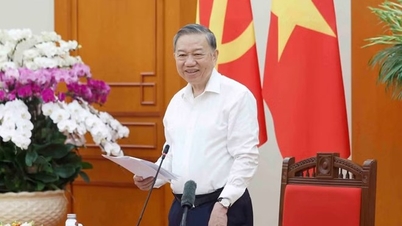
The 2026 Law on the Capital City (amended) was developed based on a thorough understanding of the Party's major policies, especially Resolution No. 02-NQ/TW dated March 17, 2026, of the Politburo on building and developing Hanoi in the new era. During group discussions, General Secretary and President To Lam (National Assembly Delegation from Hanoi) emphasized that this amendment to the Law on the Capital City is not simply about perfecting a specific law. It is a genuine opportunity, a strategically significant step towards creating a new institutional development model for Hanoi, a capital city with a very special position as the national political and administrative center, and also a driving force for the country's development. This is the difference, a very significant requirement for Hanoi.
General Secretary and President To Lam particularly emphasized the requirement to put the people at the center, stating that all policies for the development of the capital city must be based on openness, transparency, and a harmonious balance of interests between the State and the people. The ultimate goal is to improve the quality of life and ensure the rights and safety of the people of the capital city.
The most striking feature of the amended Capital City Law is the fundamental shift in the thinking behind lawmaking, moving strongly from a model of detailed regulations and rigid mechanisms to a "framework law" model, granting more autonomy to the city government. The management mindset has shifted significantly towards "development governance." The law has granted Hanoi 199 unique and exceptional powers – an unprecedented number.
This decentralization is clearly demonstrated in many key areas. According to Vu Dai Thang, Member of the Central Committee of the Communist Party of Vietnam, Deputy Secretary of the Hanoi City Party Committee, and Chairman of the Hanoi People's Committee, the city has autonomy in managing its organizational structure and staffing. The City People's Council is empowered to decide on the staffing levels of agencies within the city's political system; and allows those directly employing civil servants to carry out recruitment, appointment, and evaluation. Regarding planning and construction, the city has the autonomy to develop mechanisms, policies, and solutions for green and smart urban development, transportation-oriented development (TOD), and urban renovation, upgrading, and reconstruction. In terms of finance and investment, Hanoi has the autonomy to structure its budget revenue and expenditure; decide on credit allocations, and establish financial funds to serve development investment. In particular, the amended Capital City Law also includes a mechanism to protect officials who "dare to think and dare to act" by excluding or exempting from legal responsibility those involved in drafting, enacting, and implementing the Capital City Law in cases where there is no self-serving motive.
With 199 delegated powers, the role of the Hanoi City People's Council has also undergone a significant transformation. Deputy Secretary of the City Party Committee and Chairwoman of the City People's Council, Phung Thi Hong Ha, emphasized that the City People's Council is no longer confined to the role of a traditional local power body, but is strongly transforming into a "policy-making institution." The amended Capital City Law grants the City People's Council 128 tasks and powers, spanning many fields. The City People's Council has the power to decide on core issues concerning living space and infrastructure, such as: approving the Capital City Planning and the General Planning of the Capital City before submitting them to the Prime Minister for approval; deciding on the investment policy for urban railway projects under the TOD model. Regarding finance, the People's Council can decide on specific fees and charges; and provide budget support to localities within the Capital Region. It can be affirmed that the role of the City People's Council has strongly shifted from "waiting for guidance" to "actively creating" policies suitable to the unique characteristics of the Capital City.
Notably, the amended Capital City Law allows Hanoi to pilot new mechanisms and policies, even those different from current laws or concerning issues not yet regulated by law. This represents a significant expansion of institutional space, creating conditions for the capital to experiment with new governance and development models. However, this "openness" must always be accompanied by strict control mechanisms. Designing specific mechanisms coupled with power control is a prerequisite to ensure that policies are effective, avoid risks, and uphold the rule of law. All mechanisms must ensure transparency, openness, fair competition, and have mechanisms for monitoring and evaluation.

Decisive action, early and proactive implementation of policies.
Recognizing that the effectiveness of the amended Capital City Law largely depends on the speed and quality of its implementation by the city government, Hanoi proactively prepared all necessary conditions for its deployment both before and after the law was passed. The city adopted a proactive approach: developing guiding documents during the law drafting process.
According to Nguyen Xuan Luu, member of the Standing Committee of the Hanoi City Party Committee and Vice Chairman of the Hanoi City People's Committee, immediately after the Law was passed, the City People's Committee issued a document on organizing the implementation of the Law.
According to Vice Chairman of the Hanoi People's Committee Nguyen Xuan Luu, during the drafting process of the amended Capital City Law, Hanoi proactively implemented a comprehensive set of solutions to ensure the law was put into practice as soon as it was passed by the National Assembly. Specifically, the city reviewed and identified policies to be continued based on the amended Capital City Law; inheriting provisions from the 2024 Capital City Law and incorporating new policies into the law.
Authorities at all levels, from the city to the grassroots, have begun drafting implementing documents for the amended Capital City Law, while proactively preparing financial and human resources to ensure the effective implementation of new policies assigned to the city by the central government. Regarding implementation principles, the city has clearly defined: Content that is clear and can be implemented immediately will be implemented immediately; content requiring further research will be implemented according to a suitable roadmap…
To ensure the correct, effective, and transparent implementation of the Law, the Chairman of the Hanoi People's Committee, Vu Dai Thang, outlined five comprehensive solutions. Accordingly, the city clearly defines the responsibilities of each agency; regularly inspects and supervises, promptly resolving difficulties; strengthens inspection, supervision, and handling of violations; strictly implements regulations on openness, transparency, and accountability; and seriously complies with the supervision and inspection of central agencies.
Besides improving institutions, Hanoi is accelerating the process of streamlining its organizational structure to meet new requirements. Departments, agencies, and localities have proactively reviewed their functions and tasks, reorganized their organizational structure, and clearly defined responsibilities. The city is particularly focused on preparing its staff of officials, civil servants, and public employees, because in the context of strong decentralization, this workforce not only needs to comply with regulations but also must have the capacity to analyze, design, and implement policies.
In fact, the foundation for Hanoi's current confidence and decisiveness stems from the positive results achieved in implementing Resolution No. 258/2025/QH15 of the National Assembly on piloting some specific mechanisms and policies for implementing large and important projects in the capital city. Through this Resolution, the city has proactively implemented large and important projects such as the Olympic Sports Urban Area project and the Red River Landscape Boulevard project. Resolution No. 258/2025/QH15 required shortening the time for completing project procedures, creating an impetus for management agencies to innovate their working methods, thereby changing the way the management apparatus operates, towards proactiveness and flexibility. These effective pilot mechanisms do not exist as "temporary exceptions" but have become an important practical basis for integration and "legalization" in the amended Law on the Capital City.
However, putting the Law into practice also requires strategic focus. Deputy Director of the Department of Legal Document Drafting (Ministry of Justice) Le Tuan Phong particularly emphasized that establishing a mechanism for checking and supervising power must be implemented from the outset and carried out in parallel with the implementation process to ensure that special powers are used for their intended purpose.
From a grassroots perspective, the impact of the amended Capital City Law also brings great expectations. Nguyen Sy Doan, Deputy Secretary of the Party Committee and Chairman of the People's Committee of Khuong Dinh Ward, shared that the biggest expectation is that the Law will create additional legal tools to address long-standing "bottlenecks" such as traffic infrastructure, urban order, environmental pollution, and the renovation of old apartment buildings. For the ward level, the effectiveness of the Law will be measured by the concrete changes in each residential area.
With a proactive mindset, acting immediately upon the law's passage, Hanoi is demonstrating immense political determination in transforming legal regulations into practical values. The Capital City Law (amended) of 2026 is not merely a technical law, but a strategic step in the process of institutional reform, a mission for Hanoi to rise and create a "Cultural - Civilized - Modern - Happy" city, playing a leading role in socio-economic development and spreading development throughout the Capital Region and the entire country.
Source: https://baotintuc.vn/thoi-su/quyet-liet-dua-luat-thu-do-sua-doi-di-vao-cuoc-song-20260503103557754.htm
![[Image] Hanoi's urban life under the challenge of a "scorching hot" environment](https://vphoto.vietnam.vn/thumb/1200x675/vietnam/resource/IMAGE/2026/05/25/1779706979265_nang-nong-t5-2026-minh-duy-7-4636-jpg.webp)



![[Image] Close-up view of the interchange connecting the two expressways and Long Thanh Airport.](https://vphoto.vietnam.vn/thumb/1200x675/vietnam/resource/IMAGE/2026/05/25/1779703378210_ndo_br_z7863716673926-224453a31600126cce10622af6290afd-4549-jpg.webp)



























































































Comment (0)