

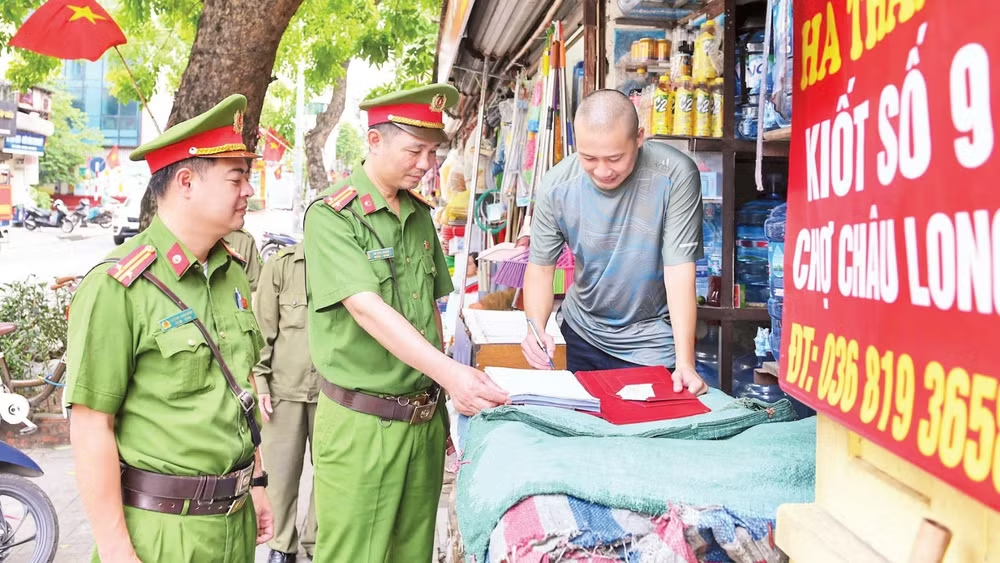
After more than six months of implementing Hanoi 's Plan 332/KH-UBND on resolving "urban order" bottlenecks and building communes and wards that ensure urban order, discipline, and civility, the appearance of many streets and residential areas in Hanoi has improved positively, and many urban order hotspots have been addressed. However, to maintain these results in the long term, the city needs to continue to address shortcomings in commercial infrastructure planning, parking, and improve public awareness of compliance.
Significant change
According to statistics from the Hanoi City Police, as of May 10, 2026, the city had cleared 184 out of a total of 231 illegal street markets and unauthorized businesses, and 310 locations violating urban order. Following the clearance, these locations were listed, assigned officers were in charge, and surprise inspections were maintained to prevent re-encroachment. Authorities handled over 43,000 cases of urban order violations, imposing fines totaling over 30.1 billion VND.
Many areas that were once "hot spots" for urban order violations have now seen significant improvements. At the HH Linh Dam apartment complex (Hoang Liet ward), the temporary market with over 110 stalls that once encroached on almost the entire road and sidewalk has now been cleared. Ms. Tran Mai Hoa, a resident of HH3 Linh Dam building, said that previously the market was held right at the foot of the apartment complex, causing constant chaos. Now the area is much cleaner and more spacious. Although residents have to travel further to buy food, they feel much safer.
At the intersection at the beginning of alley 537, Bat Khoi Street (Long Bien Ward), an impromptu market has existed for many years, despite being only about 600 meters from Thach Ban Market. After the local authorities resolutely dealt with the violations and restored urban order, the vendors switched to renting kiosks or premises from residents to conduct their business. Mr. Nguyen Van Tuan, who sells pork there, shared that although he has to pay extra for renting the location, in return, business is more convenient and stable thanks to electricity, water, and better conditions for preserving goods compared to before.
In suburban areas, the encroachment on roads and sidewalks for business purposes occurred at the entrance to Ba Vi General Hospital, Nhong Market, and the Dong Pheo area (Vat Lai commune), causing traffic congestion and detracting from urban aesthetics. After being informed, guided, and reminded, the businesses seriously complied with the regulations; 100% of violators voluntarily dismantled the encroaching structures and did not re-offend.
To achieve these results, Hanoi implemented a comprehensive set of solutions, with the police force playing a core role. The city's police force established a direct communication channel with the chairmen of the People's Committees of communes and wards to daily update images of violations and reports from the press and citizens. Through this, local authorities are required to promptly inspect, handle, and report the results.
In Hai Ba Trung ward, an area with many bustling commercial streets and large hospitals leading to traffic congestion, the ward police, in coordination with Traffic Police Team No. 4 (Traffic Police Department of Hanoi City Police), conduct patrols and resolutely fine vehicles parked illegally.
Lieutenant Colonel Duong Dai Viet, Head of the Public Order Police Team, stated: "The unit maintains six local teams, each led by a public order police officer. In collaboration with forces from the Department of Economy , Urban Infrastructure, the Project Management Board, and the heads and deputy heads of neighborhood groups, we patrol each street and area from 6 AM to 10 PM, resolutely addressing violations. Thanks to the regular and decisive inspections by the authorities, the public's compliance awareness has gradually improved; to date, the streets are clear and orderly."
In Ba Dinh ward, the local authorities are utilizing some temporarily suspended project land plots to set up parking areas, reducing parking pressure on central streets.
Captain Nguyen Tien Quang, Deputy Head of Ba Dinh Ward Police, said that the unit has instructed its officers and soldiers to clearly understand that this is a political task, not to be carried out as a campaign, but to be implemented regularly and continuously with the spirit of strict and resolute handling, without any forbidden areas or exceptions.
Besides imposing fines, police officers and soldiers directly meet with business owners to encourage and guide them to arrange goods neatly, propose that the People's Committee of the ward grant permits for motorbike parking areas, and regularly inspect and strictly handle points that collect fees illegally.
Fundamental solutions are needed to sustain these results.
Despite many positive developments, addressing urban order "hot spots" still faces numerous challenges. In reality, many violations stem from long-standing inadequacies in urban planning and infrastructure.
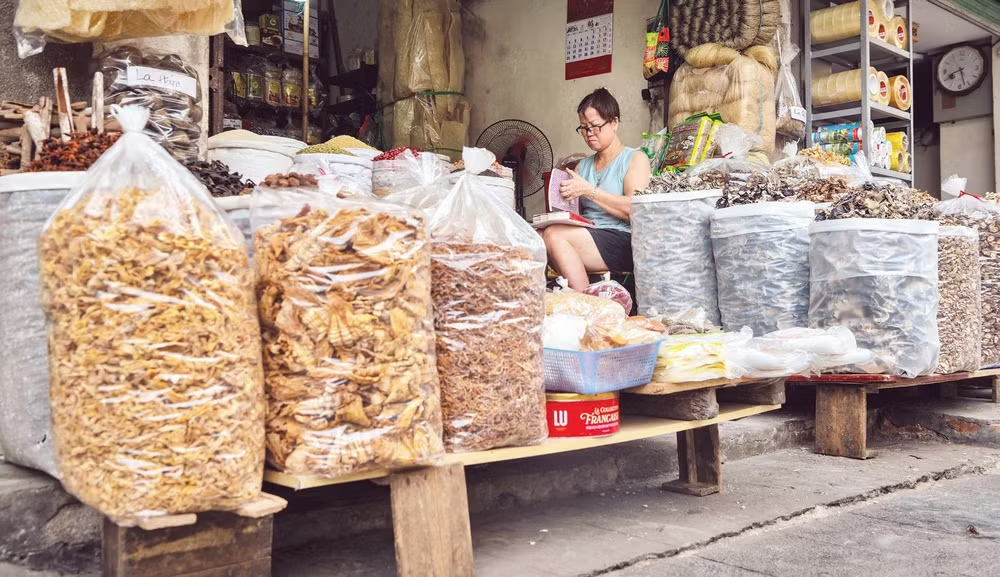
The city currently has 457 markets, meeting approximately 40% of shopping needs in the inner city and about 70% in the suburbs. Many densely populated urban areas lack local markets, while numerous traditional markets are dilapidated and no longer meet business and shopping needs.
For example, the HH Linh Dam area, with approximately 40,000 residents, lacks a local market or supermarket large enough to serve daily shopping needs. In Da Phuc commune, there used to be seven temporary markets, but no official market. The lack of stable business locations forces many small traders to utilize roads and sidewalks to make a living.
According to Nguyen Anh Tuan, Vice Chairman of the People's Committee of Hoang Liet Ward, the local government's stance is to both ensure urban order and consider suitable business locations for small traders. Simply clearing the area without providing alternative solutions would significantly increase the risk of re-encroachment.
According to Nguyen The Hiep, Deputy Director of the Hanoi Department of Industry and Trade, communes and wards need to continue persistently dismantling illegal markets according to the planned schedule; at the same time, they should review and arrange for traders to move into markets or organize temporary, managed business points in areas lacking commercial infrastructure.
Between 2026 and 2030, Hanoi plans to build and rebuild 108 markets, while renovating and upgrading 118 existing markets. This aims to gradually replace informal business locations, creating a more civilized, stable, and sustainable business environment. Many urban experts believe that Hanoi also needs to continue reviewing parking plans, public spaces, and urban traffic organization, as reality shows that in many areas, the demand for parking, business, and daily life has exceeded the capacity of existing infrastructure.
At the progress review meeting for Plan 332, Lieutenant General Nguyen Thanh Tung, Director of the Hanoi City Police, emphasized that the handling of urban order violations must be maintained regularly and continuously; areas that show no improvement must change their approach, and the responsibility of the head of the area must be clearly defined. The ultimate goal is to gradually build a civilized urban lifestyle, raise people's awareness of law compliance, and form a more effective and sustainable urban management mechanism in the capital city.
Source: https://nhandan.vn/quyet-liet-duy-tri-trat-tu-ky-cuong-van-minh-do-thi-post963914.html
![[Image] Close-up view of the interchange connecting the two expressways and Long Thanh Airport.](https://vphoto.vietnam.vn/thumb/1200x675/vietnam/resource/IMAGE/2026/05/25/1779703378210_ndo_br_z7863716673926-224453a31600126cce10622af6290afd-4549-jpg.webp)


![[Image] Hanoi's urban life under the challenge of a "scorching hot" environment](https://vphoto.vietnam.vn/thumb/1200x675/vietnam/resource/IMAGE/2026/05/25/1779706979265_nang-nong-t5-2026-minh-duy-7-4636-jpg.webp)























































































Comment (0)