

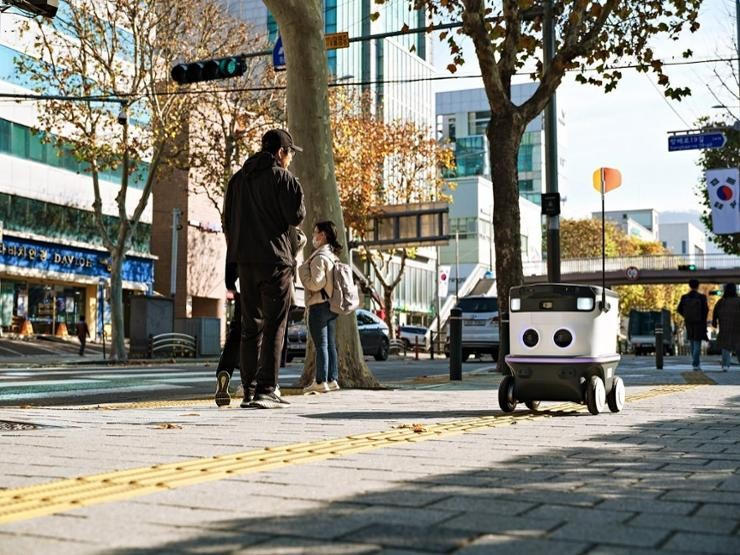
The automated robot startup Neubility announced that it has partnered with the city government to operate 10 delivery robots near Pangyo Station and Seohyeon-dong, following the relaxation of regulations on the use of outdoor delivery robots. The project aims to help small retailers reduce delivery costs. The company received 300 million won in government funding and an additional $130 million from other investors.
From November 2023, South Korea licensed outdoor robot delivery services when the amended Intelligent Robot Development and Supply Act came into effect, while the amended Road Traffic Act classified delivery robots as pedestrians, allowing them to travel on pedestrian walkways.
The relaxed regulations have prompted many robotics companies here to take their robots outdoors to assess their capabilities in new environments. In collaboration with telecommunications company KT and the Gangnam District Office, Neubility began testing its Neubie robot late last year, delivering drinks to customers who ordered near Seolleung Station via a mobile app.
Woowa Brothers, the operator of the Baedal Minjok delivery app, is also testing the Dilly robot for outdoor deliveries near COEX. According to company officials, thanks to its advanced cameras and sensors, the robot can accurately detect and avoid obstacles while operating in crowded areas. It also uses high-quality autonomous algorithms, helping it avoid pedestrians and find new routes instantly when encountering unexpected situations.
Robotics, which previously operated Gaemi delivery robots in environments such as apartment complexes, campuses, resorts, and golf courses, is now gradually shifting to delivering drinks on the streets, partnering with the Vanada Coffee franchise chain.
According to market research firm Quad Intel, the outdoor delivery robot market is projected to grow to $105 million by 2027 from $4 million in 2020, reflecting an average annual growth rate of 17.3%. In a report, Quad Intel wrote that the use of outdoor delivery robots will reduce overall labor costs, supplementing delivery personnel and carrying loads exceeding 100kg per trip.
However, the company also warned that robots could cause traffic accidents and injure pedestrians. Robots are also criticized for encroaching on space reserved for pedestrians and wheelchair users.
(According to Korea Times)
Source: https://vietnamnet.vn/robot-giao-hang-sap-nhan-nhan-tren-duong-pho-han-quoc-2282890.html

![[Photo] Prime Minister Pham Minh Chinh presides over a meeting on private sector economic development.](/_next/image?url=https%3A%2F%2Fvphoto.vietnam.vn%2Fthumb%2F1200x675%2Fvietnam%2Fresource%2FIMAGE%2F2025%2F12%2F20%2F1766237501876_thiet-ke-chua-co-ten-40-png.webp&w=3840&q=75)


![[Photo] Prime Minister Pham Minh Chinh presides over the conference announcing the establishment of the International Finance Centre in Vietnam.](/_next/image?url=https%3A%2F%2Fvphoto.vietnam.vn%2Fthumb%2F1200x675%2Fvietnam%2Fresource%2FIMAGE%2F2025%2F12%2F21%2F1766309817714_ndo_br_dsc-3400-jpg.webp&w=3840&q=75)





















































































Comment (0)