

Last June, VinMotion Multi-Purpose Robot Research, Development and Application Joint Stock Company introduced a generation of "made in Vietnam" humanoid robots that attracted public attention.
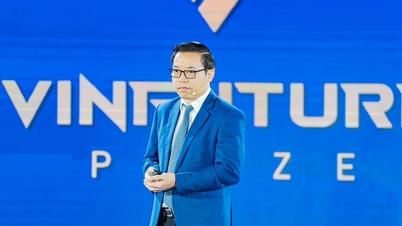
On the sidelines of VinFuture 2025 Science and Technology Week, Dr. Nguyen Trung Quan - Chief Science Officer of VinMotion, shared about the next development journey of humanoid robots in Vietnam.
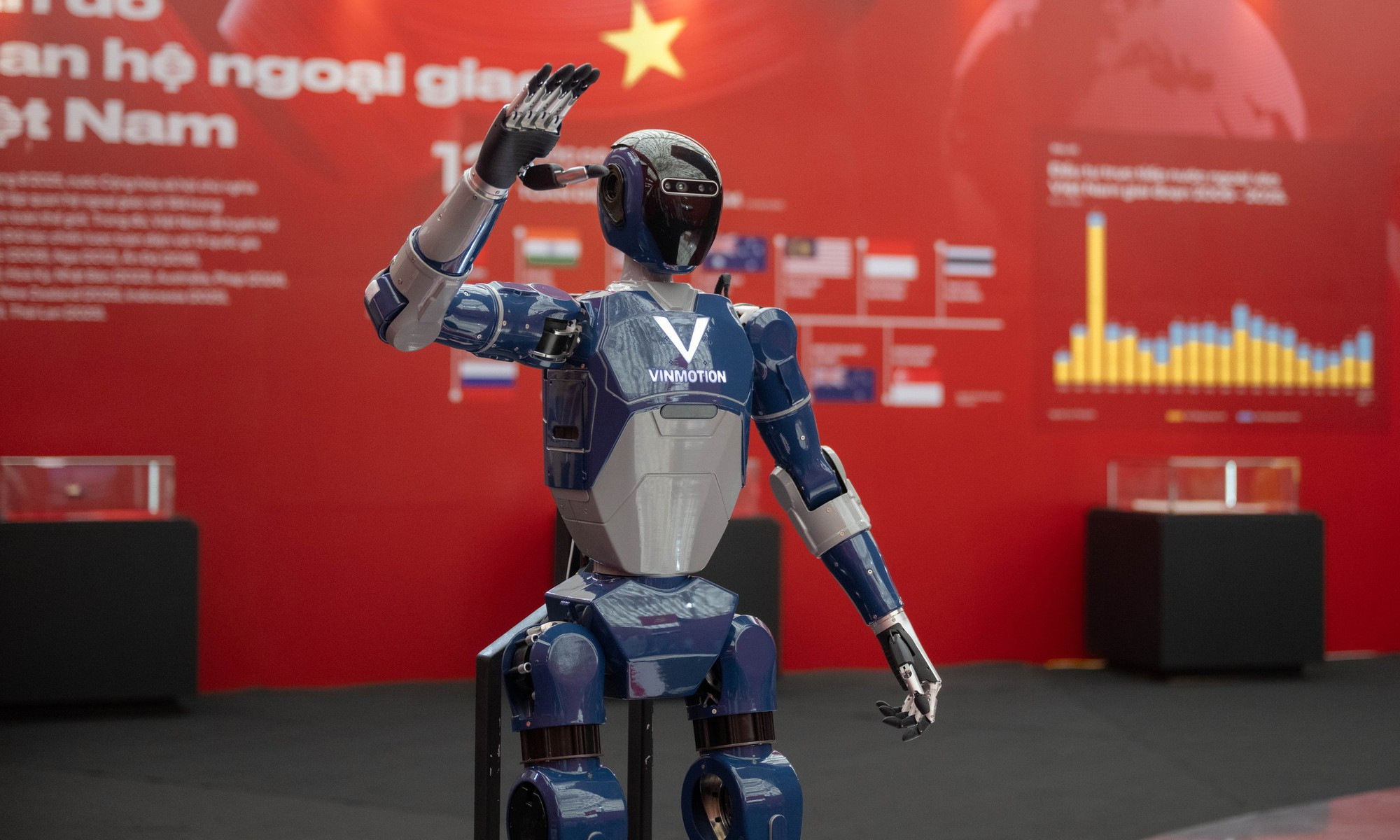
VinMotion's Motion 1 robot model at the National Achievement Exhibition "80 years of journey of Independence - Freedom - Happiness".
Robot Motion is coming to version 2
- In less than 7 months since its establishment, VinMotion has introduced 5 versions of humanoid robots. Up to now, what new technological breakthroughs has the company achieved, sir?
VinMotion team has been and is continuing to strongly improve its technology and products in both hardware and software.
Our robot is now moving more flexibly and much faster than 3 months ago. The AI part is also integrated with flexible multilingual communication, especially Vietnamese and English. We will soon announce these achievements as soon as possible.
- In addition to the current robot model, does VinMotion have any plans to develop technology or products that are different from current robot models in the world ?
Currently, we have been developing the Motion 2 robot model. This is considered a much more breakthrough robot model than the Motion 1 that we launched and demonstrated to the public recently.
I think the biggest difference between our robot and other robot models is that we focus on solving practical requirements to be able to deploy robots on a large scale in the future instead of just demoing in the lab.
Specifically, the Motion 2 robot model we have been aiming for superior movement capabilities that surpass even normal humans. During the design process, I also set three very important criteria, which I temporarily call the 3S standard, to ensure that the robot can operate continuously.
One is self-standing up, meaning that if the robot falls, it must stand up by itself. Two is that the robot can change its own battery or charge itself when necessary. Three is that the hardware as well as the entire system must be guaranteed to be in a state of continuous, stable operation without stopping for many hours.
In my opinion, a robot can only be useful if it can operate continuously 24/7 without direct human intervention. And that is also a very big criterion that we set for this robot model.
- What is VinMotion's vision in the humanoid robot industry in Vietnam as well as the world, sir?
Since the company was founded, we have always shaped ourselves to compete with the humanoid robot industry in the world. The VinMotion team and I have always aspired to contribute to bringing Vietnam to the same level as the world's leading countries on the world technology map.
Our goal is to develop humanoid robots that are increasingly flexible, intelligent and versatile so that they can gradually enter life in many different fields, from services, industry, to household help.
I know this is a very big goal, but I believe that this is the "golden time" for us to dream of it. With the inner strength and desire to prove ourselves of the VinMotion engineering team, I believe that this goal is not too far away. However, to achieve that, we need to try very hard, focus, and always maintain faith in the mission and path we have chosen.
Vietnam can become a major competitor in developing robotics.
- In the context of the world's shortage of robot engineers, rising labor costs and the trend of shifting supply chains, what position does VinMotion expect Vietnam to occupy in the global robot value chain? And what strategy is there to turn Vietnam into a regional robot production and R&D "hub"?
If we focus on investing in the robotics or physical AI industry, I believe that Vietnam has many advantages. The robotics industry requires three very important things: High-tech human resources for software and AI development; Flexible manufacturing for prototyping and hardware production; Trust and security in application deployment.
While the US is dominant in the first area and China is dominant in the second, if positioned correctly, Vietnam can emerge as a counterweight that can do well in all three areas.
With good direction and support from the Government , I believe that Vietnam can become a major competitor, even a leader in the world's robotics development.
This is a big field with a lot of potential, but everything is just beginning. Our starting point is not too far from the world. We can completely believe that we can do well if we have enough faith and focus to invest in this field.
In my opinion, this is a "golden opportunity" for Vietnam to rise up and put its name on the world technology map.
- What advantages does VinMotion have to compete in the global market, sir?
VinMotion has several competitive advantages that it can leverage.
Firstly, Vietnam has a very flexible manufacturing base, which is very suitable for the production and improvement of fast, quality-assured but reasonably priced robots. This helps us a lot in continuously improving our robots.
Second, with the support of Vingroup, we can cooperate with many different subsidiaries to deploy and improve our technology early. Currently, we are testing in many different companies, from VinFast, Vinpearl to Vinmec.
We aim for a complete product that can operate for a long time, stably and at a reasonable cost, not just a demo technology in the lab. So these are huge competitive advantages for us to continuously improve our products and technology faster than any other partner.
And finally, with the Party and State's policies to encourage the development of Science and Technology, plus the support of the people, this is also a great motivation for the VinMotion team to fight day and night with the hope of affirming the position of Vietnamese technology in the international arena.
- Does VinMotion have plans to cooperate with international corporations or research centers to bring robots to the global market? If so, which units are they?
We are currently working on a strategic partnership with a leading global AI chip company. We will announce this strategic partnership at the CES Consumer Electronics Show in January 2026.
This is an important strategic cooperation, laying a solid foundation for VinMotion to enhance its position in the international arena.
It's all still very new and in its early stages, but we're very confident in this partnership and hope to be able to share more soon after the official announcement next year.
One more point and I think this is also a strength of VinMotion, is that we are implementing research cooperation with many leading humanoid robot research labs in the US.
This not only helps to position VinMotion's brand and international influence, but is also a valuable opportunity for the Vietnamese engineering team at VinMotion to learn the most advanced technologies, in order to build a foundation of knowledge and technology ready for the sustainable development of VinMotion in particular and the Vietnamese robotics industry in general.

Dr. Nguyen Trung Quan - Scientific Director of VinMotion.
- Humanoid robots can replace workers in socially sensitive fields. How do you assess the impact of VinMotion robots on the Vietnamese and international labor markets?
With the aging population and the young generation no longer interested in manual or boring jobs, the shortage of human resources in many different professions is not only happening in developed countries but is also gradually happening in developing countries like Vietnam.
Therefore, it is almost inevitable that humanoid robots will emerge as a craze to be ready to supplement this labor shortage. In addition, in the future, if humanoid robots become more advanced and affordable, many new industries can also be created, or develop stronger than ever.
Source: https://vtcnews.vn/robot-hinh-nguoi-made-in-viet-nam-se-linh-hoat-hon-ca-nguoi-ar991140.html


![[Photo] Cat Ba - Green island paradise](/_next/image?url=https%3A%2F%2Fvphoto.vietnam.vn%2Fthumb%2F1200x675%2Fvietnam%2Fresource%2FIMAGE%2F2025%2F12%2F04%2F1764821844074_ndo_br_1-dcbthienduongxanh638-jpg.webp&w=3840&q=75)



























































































Comment (0)