

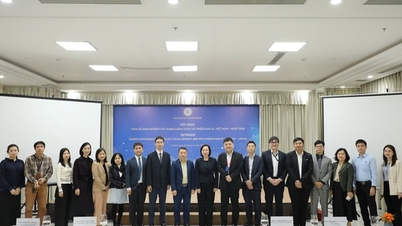
Professor Sir Richard Henry Friend, Chairman of the VinFuture Prize Council, had an academic exchange with students of Hanoi University of Science and Technology within the framework of the scientific workshop "Innovation and Organic Semiconductors".
Here, he shares his journey of more than three decades of organic electronics research and why this field opens up a new direction for materials science.

Professor Sir Richard Henry Friend shares with students of Hanoi University of Science and Technology (Photo: Media Center).
The journey of discovery of organic semiconductors
At the beginning of his talk, Professor Friend recounted his decades-long research journey with organic semiconductors. He emphasized that science is always a field full of surprises and never ends with a few pages of a textbook.
“The world of science is always full of surprises. Sometimes when you read textbooks, you think everything has been solved, but in reality it is just fiction. When you step into the lab, you will see that there are still countless things to learn,” the professor shared.
According to Professor Friend, one of the important milestones was the paper published 35 years ago in the journal Nature, which laid the foundation for the field of organic light-emitting diodes.
From that foundation, research groups around the world have gradually turned the idea of using organic molecules as light sources into OLED screen technology that is appearing in countless smartphones and TVs today.
“When you turn on your smartphone, the light you see is coming from little diodes, not made of silicon or gallium, but from organic molecules. That was a big surprise, because we don’t normally think of organic molecules as semiconductors,” he explains.
From his observations of life, Professor Friend related to nature. Leaves are green because they absorb sunlight and convert it into chemical energy. In photosynthesis, when a photon is absorbed, an electron is removed from its original position and a hole is left.
According to him, it is the prototype of an electronic device, the smallest solar cell in nature.
In the technical discussion, Professor Friend introduced students to the structure of organic transistors and the concept of light-emitting transistors. This device allows simultaneous injection of positive and negative charges into the channel, where they meet to create an excited state and emit light.
Experimental results demonstrate that electrons and holes can move over certain distances in organic semiconductors, sufficient for building real electronic components.
Learning from plants to develop organic solar cells
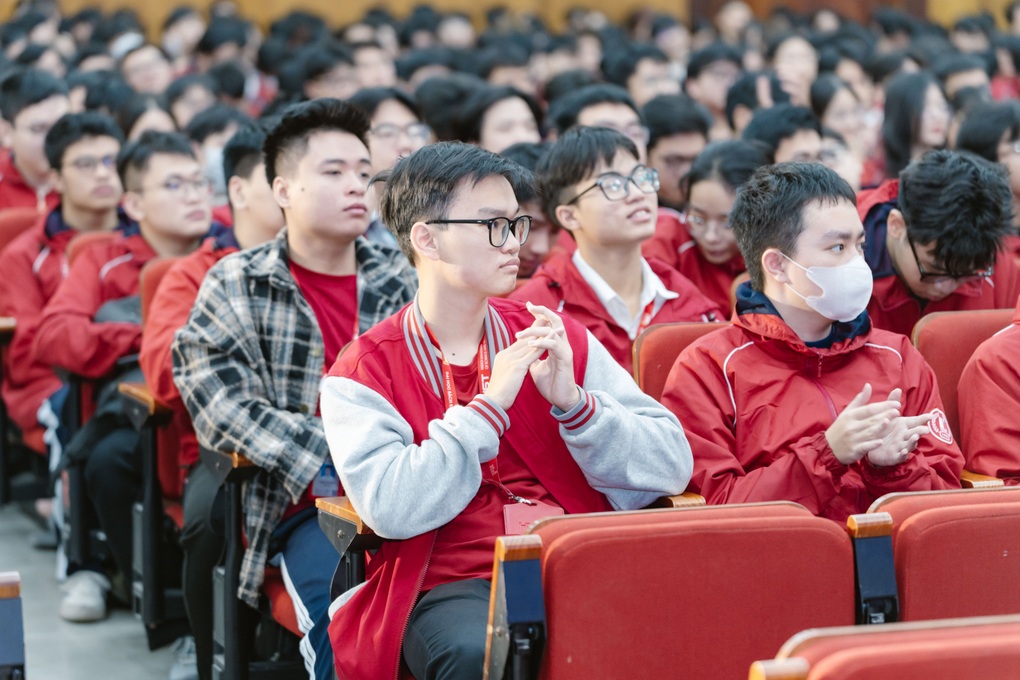
Many students of Hanoi University of Science and Technology listen to the sharing of a world-class scholar (Photo: Media Center).
From natural photosynthesis, Professor Friend led students to another application area: organic solar cells. He described how green plants capture light through molecular antenna systems, transmit energy to the reaction center, and then separate the charges.
Scientists simulate this principle with a bulk heterojunction structure. In it, two types of materials are mixed together, one that likes to accept electrons and one that likes to accept holes. The interweaving creates numerous boundaries, making it easier to separate the charges.
Thanks to this material strategy, the efficiency of organic solar cells has increased rapidly in the past 10 years. According to Professor Friend, organic battery systems have now reached over 20%, approaching the efficiency of commercial silicon cells.
The advantages of this technology are low material costs, the ability to print over large areas, and the potential to fabricate flexible panels that can be mounted on a variety of surfaces.
New directions from free radical materials and quantum sensors
In recent years, Professor Friend's group has focused on a new approach to reducing the energy loss caused by the triplet state.
They worked with free radicals, which are molecules with an odd spin. Instead of letting free radicals become reactive and destabilized, the team found a way to stabilize them in a crystal lattice.
Another interesting finding came from molecular systems with two spins, called biradicals. The team demonstrated that even a very small magnetic field can significantly change the color or intensity of the emitted light.
Professor Friend sees this as a rare quantum effect that can be exploited with simple experimental conditions.
According to him, this phenomenon opens up prospects for new biosensors. With just a type of fluorescent dye that is sensitive to magnetic fields at a very small scale, scientists can monitor processes in biological samples with higher precision, thereby supporting medical diagnosis.
Opportunities for innovation ecosystem in Vietnam
In addition to Professor Friend, the workshop also had the participation of Dr. Jayshree Seth, a scientist from 3M Corporation and a member of the VinFuture Prize Preliminary Committee. The fact that world-renowned scientists directly interact with students is considered a valuable opportunity for the young research community.

Dr. Jayshree Seth believes that scientists need to help the public see that science is present in every aspect of life (Photo: Media Center).
Associate Professor Huynh Dang Chinh, Vice President of Hanoi University of Science and Technology, emphasized the significance of the event as it contributes to promoting the research and innovation ecosystem of the school and of Vietnam.
“The school hopes that such academic exchanges will inspire new scientific ambitions in students, and at the same time open up directions for cooperation between Polytechnic research groups and domestic and foreign partners,” Mr. Chinh emphasized.

Associate Professor Huynh Dang Chinh, Vice President of Hanoi University of Science and Technology, delivered the opening speech (Photo: Media Center).
These first-hand accounts from a world-class scientist about his journey from the lab to the everyday tech show that materials science is not a distant field. Science still has a lot to discover, and each generation of young researchers has the opportunity to create new blazes for the future.
VinFuture 2025 Science and Technology Week, taking place from December 2 to December 6 in Hanoi.
With the theme “Together we grow - Together we prosper”, this year’s series of annual international events continues to affirm VinFuture’s mission in connecting knowledge, arousing the desire to serve and elevating Vietnam’s position as a center for promoting science and innovation in the world.
The week includes 7 main activities: Inspirational speeches, Science for Life discussion; VinFuture future exploration dialogue series; "The Touch of Science" exhibition, VinFuture award ceremony; exchange with VinFuture 2025 award winners; VinUni - Leadership Forum: Higher Education Innovation Conference.
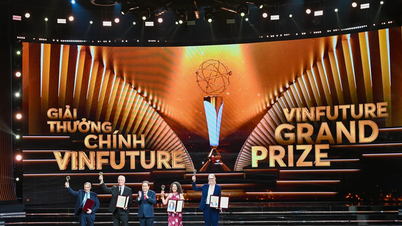
The highlight of the event was the VinFuture 2025 Awards Ceremony, which took place on the evening of December 5 at the Hoan Kiem Theater (Hanoi). This is an event to honor outstanding scientific works that have had a positive and sustainable impact on millions, even billions of people around the world.
This year, the award will be given to works that bring the value of "Together we grow - Together we prosper" to humanity, as the theme has set out, affirming VinFuture's mission of honoring intelligence, spreading humanity and serving life.
Source: https://dantri.com.vn/cong-nghe/hoc-gia-hon-140-bang-sang-che-tiet-lo-nguyen-ly-tu-nhien-giup-tao-ra-oled-20251205120221454.htm


![[Photo] National Assembly Chairman Tran Thanh Man attends the VinFuture 2025 Award Ceremony](/_next/image?url=https%3A%2F%2Fvphoto.vietnam.vn%2Fthumb%2F1200x675%2Fvietnam%2Fresource%2FIMAGE%2F2025%2F12%2F05%2F1764951162416_2628509768338816493-6995-jpg.webp&w=3840&q=75)
![[Photo] 60th Anniversary of the Founding of the Vietnam Association of Photographic Artists](/_next/image?url=https%3A%2F%2Fvphoto.vietnam.vn%2Fthumb%2F1200x675%2Fvietnam%2Fresource%2FIMAGE%2F2025%2F12%2F05%2F1764935864512_a1-bnd-0841-9740-jpg.webp&w=3840&q=75)




































































Comment (0)