

According to IT Home, a new type of robot is expected to explore Mars at unprecedented speed, scanning rocks and searching for signs of life without needing human guidance.
According to IT Home, exploring the surfaces of other planets is a difficult and time-consuming task. During missions to Mars, communication delays between Earth and the rover can range from 4 to 22 minutes. Limited data transmission capacity also restricts the volume of two-way information exchange.
Bound by these challenges, scientists had to plan the Mars rover mission very early on. The rover's design prioritized energy efficiency and risk avoidance, resulting in very slow movement across the rugged terrain. In most cases, it could only move a few hundred meters per day, which not only limited the scope of its survey of the surrounding landscape but also hindered the collection of a wide variety of geological samples.
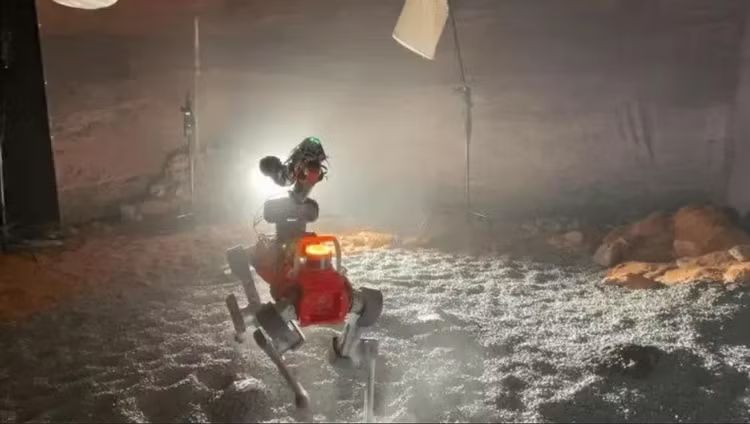
To overcome these limitations, researchers experimented with a new approach. They developed a semi-autonomous exploration robot capable of independently moving to and from various target points and collecting data, without constant human control or guidance.
This robot can automatically move to multiple locations and complete detection and analysis independently at each location without the need for close human supervision to focus on a single rock.
Research results show that robots equipped with compact, sophisticated devices can significantly improve detection efficiency. This technology could accelerate the exploration of resources on the Martian surface, helping to search for signs of life (i.e., evidence of life). Robots can analyze multiple targets sequentially, collecting massive amounts of data in a shorter time.
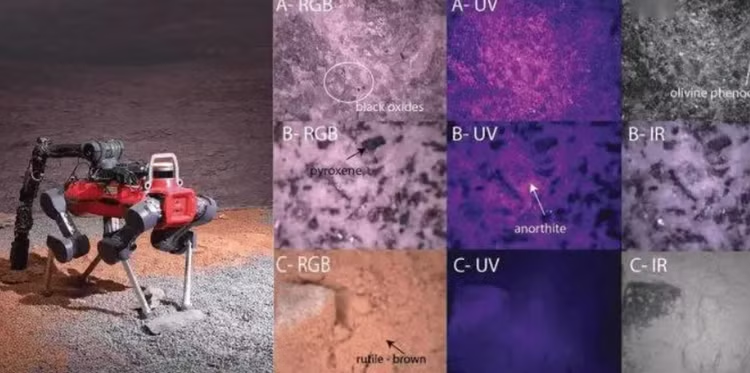
The research team aimed to verify whether a semi-autonomous robot equipped with a relatively simple scientific kit could still produce scientifically valuable results while operating at high speeds. The study confirmed that even with compact, simple instruments, the robot was capable of performing core scientific tasks, including identifying rock types of importance to astrobiology and exploring resources.
To verify this detection method, researchers conducted an experiment using the quadrupedal robot ANYmal. This robot is equipped with a robotic arm and carries two detection devices: a MICRO microscope camera and a portable Raman spectrometer developed for the European Space Agency's Space Resource Challenge – European Space Resource Innovation Centre.
The experiment was conducted at the Mars Lab facility of the University of Basel. This facility used simulated rocks, soil (planetary dust), and simulated lighting conditions to replicate Martian surface conditions as closely as possible. During the experiment, the robot automatically moved to the selected target, precisely positioned the probe with its robotic arm, and transmitted images and spectroscopic data for scientific analysis.
This detection system has successfully identified several key rock types crucial for Mars exploration, including gypsum, carbonates, basalt, peridotite, and anorthosite. Many of these materials are of great significance to future deep space exploration missions.
This study confirms that simple, compact devices combined with autonomous robotic systems can still produce highly valuable scientific research results. Future deep space exploration missions will not need to rely entirely on large and complex equipment. Flexible and agile robots can be utilized to quickly survey the surrounding environment and identify key targets for in-depth analysis.
Source: https://khoahocdoisong.vn/robot-tu-hanh-co-the-thay-doi-cuoc-dua-chinh-phuc-sao-hoa-post2149099522.html

![[Image] Close-up view of the interchange connecting the two expressways and Long Thanh Airport.](https://vphoto.vietnam.vn/thumb/1200x675/vietnam/resource/IMAGE/2026/05/25/1779703378210_ndo_br_z7863716673926-224453a31600126cce10622af6290afd-4549-jpg.webp)


![[Image] Hanoi's urban life under the challenge of a "scorching hot" environment](https://vphoto.vietnam.vn/thumb/1200x675/vietnam/resource/IMAGE/2026/05/25/1779706979265_nang-nong-t5-2026-minh-duy-7-4636-jpg.webp)















![[GALLERY] A completely different iPhone for the 20th anniversary edition](https://vphoto.vietnam.vn/thumb/402x226/vietnam/resource/IMAGE/2026/05/25/1779686871893_212-jpg.webp)
































































Comment (0)