

Japan's biologic hybrid robot, measuring just 3 cm in height, can move and even change direction underwater thanks to muscle contractions.
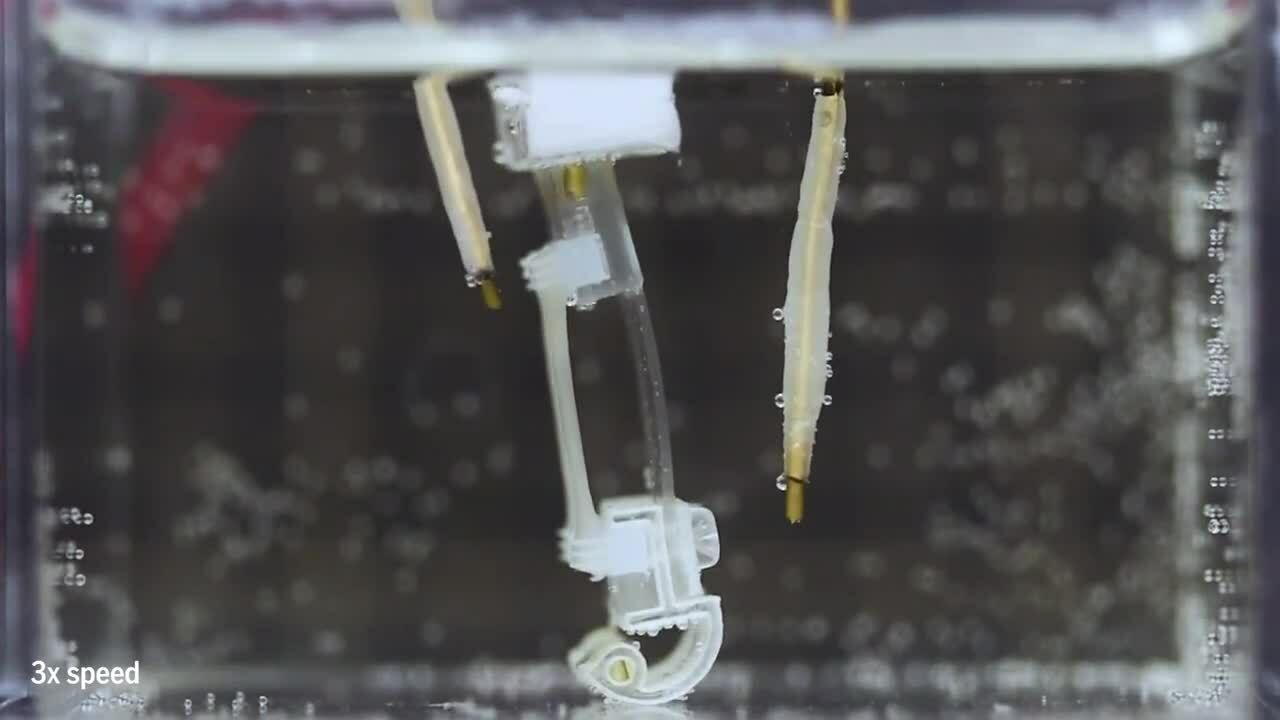
Bipedal robot walks in water. Video : Science.org
Japanese scientists have created a small, bipedal robot incorporating both muscle tissue and artificial materials, capable of walking and changing direction by contracting its muscles, New Scientist reported on January 26. The new research was published in the journal Matter.
Previously, some bio-hybrid robots capable of crawling and swimming were built with muscles developed in the lab. However, this new robot is the first bipedal robot capable of turning and making sharp turns. It accomplishes this by transmitting electricity to one leg to cause the muscle to contract, while the other leg remains stationary. The muscle acts as a bio-actuator – a device that converts electrical energy into mechanical force.
The robot is only 3 cm tall, currently unable to stand on its own in the air, and has a foam float to help it stay upright in a tank of water. Its muscles were developed from mouse cells in a laboratory.
"This is just basic research. We haven't reached the stage where we can use this robot anywhere. To make it work in the air, we need to solve many related problems, but we believe it's possible by increasing its muscle strength," said Shoji Takeuchi, a member of the research team and an expert at the University of Tokyo.
The robot is still very slow by human standards, moving only 5.4 mm per minute. It also takes over a minute to rotate 90 degrees, provided it receives electrical stimulation every 5 seconds. To be able to move in the air instead of in water, the robot also needs a nutrient supply system to sustain its muscle tissue.
Takeuchi hopes the research team can make the robot move faster by optimizing the electrical stimulation model and improving the design. "The next step with this bio-hybrid robot is to develop a version with additional joints and muscle tissue so it can walk in a more sophisticated way. Additionally, we need to develop thicker muscles to increase strength," he said.
"Biological hybrid robots are useful tools for studying modified muscle tissue, and also help in researching how to control biomechanical actuators. As force and control are improved through this type of research, the potential applications of such actuators for more complex robots will increase," commented expert Victoria Webster-Wood at Carnegie Mellon University.
Thu Thao (According to New Scientist )
Source link


































































































Comment (0)