

Banks are aggressively raising capital through certificates of deposit with interest rates higher than regular savings accounts. The market is concerned that this could trigger a wave of interest rate increases, leading to higher input costs for banks and forcing them to adjust lending rates.
The Certificate of Deposit Race
Sacombank (Saigon Thuong Tin Commercial Joint Stock Bank) recently issued 5,000 billion VND worth of certificates of deposit with a 7-year term and a fixed interest rate of 7.1% for the first year. Interest rates in subsequent years will be adjusted flexibly according to market conditions.
Accordingly, Sacombank's certificate of deposit has a face value of 1 million VND. The principal is paid in a lump sum upon maturity, and interest is paid periodically each year. Notably, buyers of Sacombank certificates of deposit can withdraw part or all of the principal before maturity, transfer ownership, or pledge the certificate to borrow capital at preferential interest rates…
Similarly, Vietnam Public Commercial Bank (PVcomBank) has also recently issued certificates of deposit for individual customers, offering a fixed interest rate of 8% per year and a term of up to 85 months. Notably, PVcomBank's certificates of deposit have a minimum face value of 10 million VND, and customers receive interest monthly instead of annually as is typical. This means that after receiving monthly interest, certificate holders can continue to deposit savings to increase their interest earnings. In fact, buyers of PVcomBank certificates of deposit receive a higher actual interest rate than the 8% per year rate set by the bank.
Alongside the issuance of certificates of deposit, many banks are also preparing to increase deposit interest rates after a period of competing to lower them. Incomplete statistics show that since the beginning of September, at least six commercial banks have increased deposit interest rates for short-term maturities.
Most recently, the Agricultural and Rural Development Bank ( Agribank ) increased interest rates on 1-2 month term savings by 0.2 percentage points, to 2%/year; online savings interest rates for 3-5 month term increased by 0.3 percentage points, to 2.5%/year; and interest rates for 6-9 month term were slightly adjusted upwards by 0.1 percentage points, to 3.3%/year.
A recent analysis report by MB Securities Joint Stock Company (MBS) indicates that the reason banks are increasing deposit interest rates and attracting capital through other channels such as high-interest certificates of deposit is to enhance the competitiveness of the savings channel compared to other investment channels. The MBS analysis team believes that the rise in deposit interest rates is also due to continued credit growth, as capital demand typically accelerates sharply in the final months of the year.

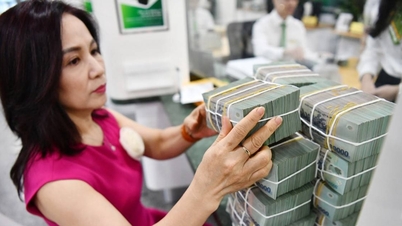
The increased demand for capital at the end of the year is believed to be the reason why banks are preparing to raise deposit interest rates. Photo: Lam Giang
Customers are worried about rising loan interest rates.
Following news of rising deposit interest rates, some people who have borrowed or are preparing to borrow money from banks to buy houses, cover expenses, or start businesses are concerned that lending interest rates may rise again in the near future.
Regarding this issue, Mr. Tran Tan Loc, Vice Chairman of the Board of Directors of Vietnam Export Import Commercial Bank (Eximbank), said that depending on the capital structure of each bank, the bank will decide whether or not to adjust interest rates. This is because if credit demand increases sharply, banks are forced to raise interest rates on long-term deposits to attract depositors, or banks may anticipate rising deposit interest rates in the future and decide to increase them in advance to anticipate market trends.
"Whether lending interest rates increase or not depends on the bank's input costs. For example, if a bank increases long-term deposit interest rates but simultaneously attracts a large amount of low-cost demand deposits, then the bank's input costs will not increase, and lending interest rates will remain stable."
Conversely, banks need long-term capital, so they have to raise funds at high interest rates. However, without other channels to attract deposits at lower rates, input costs will increase, and lending interest rates will certainly rise as well," Mr. Loc analyzed and commented.
Mr. Tran Minh Hoang, Director of Research and Analysis at Vietcombank Securities Company (VCSB), believes that deposit interest rates may continue to rise to ensure the attractiveness of the Vietnamese Dong, but this has not yet created an interest rate race due to the slow absorption of credit by the economy . Accordingly, VCBS expects lending interest rates to remain relatively stable in the second half of 2024. However, lending interest rates will still vary depending on the industry and the risk level of each bank.
From another perspective, financial expert Nguyen Tri Hieu expressed concern that, despite weak credit growth, banks are still raising deposit interest rates or issuing high-interest certificates of deposit, which he considers a matter of concern.
According to him, this could be due to rising bad debts, some banks being unable to recover capital, and a decrease in liquidity, forcing them to increase deposit interest rates to attract capital and stabilize cash flow. This could lead to increased business costs for banks, consequently driving up lending interest rates.
At a recent regular government press conference, Deputy Governor of the State Bank of Vietnam, Dao Minh Tu, assessed that while deposit interest rates have increased, lending interest rates have decreased. This means that commercial banks have shared a great deal of the burden with businesses. Although deposits must increase to pay higher interest rates to depositors, lending rates have decreased, thus narrowing the gap between input and output.
Real estate credit is increasing.
From a state management perspective, Mr. Nguyen Duc Lenh, Deputy Director of the State Bank of Vietnam's Ho Chi Minh City branch, stated that in the first seven months of 2024, overall credit in the city increased by 3.9%, but the growth rate of real estate credit reached 5.5%; of which, housing loans (including social housing, commercial housing, and other housing) accounted for the highest proportion, approximately 57% of the total outstanding real estate credit in the city.
Outstanding loans for social housing increased by 78% compared to the end of 2023 as banks intensified loan disbursements for social housing projects in the area. Real estate credit serving production and business activities such as: developing industrial park and export processing zone infrastructure, lending for the construction of offices, high-rise buildings, restaurants, hotels, tourist areas… all achieved a fairly high growth rate.
"The results of real estate lending activities in the area are linked to the market's growth trend. Therefore, some banks are increasing their efforts to attract deposits to implement upcoming lending plans, creating momentum for increased loan balances in all sectors," Mr. Leinh said.
Source: https://nld.com.vn/ruc-rich-tang-lai-suat-huy-dong-196240910221837352.htm


![[Photo] Prime Minister Pham Minh Chinh attends the Conference on the Implementation of Tasks for 2026 of the Industry and Trade Sector](/_next/image?url=https%3A%2F%2Fvphoto.vietnam.vn%2Fthumb%2F1200x675%2Fvietnam%2Fresource%2FIMAGE%2F2025%2F12%2F19%2F1766159500458_ndo_br_shared31-jpg.webp&w=3840&q=75)









































































































Comment (0)