Heartbreaking incidents involving stray dogs.
In Ho Chi Minh City, the situation of dogs and cats roaming freely without leashes or muzzles, defecating indiscriminately, and chasing pedestrians poses a serious risk of traffic accidents. Furthermore, numerous cases of dogs attacking children and adults have increased the risk of rabies transmission.

The problem of stray dogs and cats is still common in Ho Chi Minh City, posing many health and traffic safety risks to pedestrians. Photo: Le Binh .
For example, on the evening of December 7th, in Hai Phuc neighborhood (Phuoc Hai commune), a 4-year-old girl named L.D. was playing in the commune's central square when she was suddenly attacked and bitten by a dog. As a result, her face and left eye were severely injured, requiring many stitches, and she suffered severe trauma.
Mr. Ta Van Lua, the child's father, expressed his grief, saying that this was a familiar play area for many children in his neighborhood, but he couldn't believe it happened to his child. "The incident happened quickly and was dangerous. If the residents hadn't intervened in time, the consequences for my child would have been unimaginable. I hope that dog owners will be more responsible towards the community," Mr. Lua said.
Earlier, at around 6:00 AM on May 22nd, Mr. TVH (born in 1985, residing in Phuoc Tinh commune, now Long Hai commune) was riding his motorbike on Provincial Road 44A when he collided with a stray gray and white dog. The collision caused Mr. H to fall onto the road and be struck by a car traveling behind him. As a result, Mr. H died on the spot. The dog also died later. This tragic accident has left a lasting trauma for the people in the area.
At approximately 12:30 PM on November 5th, Ms. VA, residing in Rach Dua ward, was hit by a dog being carried on a motorbike without a muzzle or leash by a man traveling in the opposite direction. The dog suddenly jumped out onto the road right in front of her vehicle. Although she braked sharply and was fortunately unharmed, she and her child were quite frightened. The owner offered no apology, quickly picked up the dog, and left.

The incident involved a stray dog causing an accident, resulting in the deaths of both the driver and the pet in Long Hai commune. Photo : LB.
In many residential areas and streets throughout Ho Chi Minh City, it's common to see groups of 4-5 dogs running freely on the roads without a handler. Some dogs even run in front of vehicles moving at high speeds. On sidewalks, dogs defecate, tear up discarded garbage bags, and drag them haphazardly across the road, creating unsanitary conditions. This familiar situation poses a daily risk and is a particularly dangerous source of rabies transmission.
Many people still let their dogs roam freely in the streets, without muzzles, leashes, or even full vaccinations. When incidents occur, some owners try to evade responsibility, causing public outrage.
In the Gia Phat Sake residential area (46B Street, Tam Long Ward), the problem of stray dogs is a frequent occurrence. Along just a short stretch of road, more than a dozen dogs roam freely every day. When strangers enter the neighborhood, the pack of dogs rushes out, barking loudly and surrounding them, frightening many residents. Furthermore, the dogs defecate everywhere, creating unsanitary conditions and seriously affecting the daily lives of the residents.
Ms. Le Thi Kim, a resident of Gia Phat Sake area, expressed her frustration: “Every day I see dogs running around on the streets, without leashes or muzzles. I've been chased by dogs many times while exercising. We hope the authorities will take strict action and demand that dog owners be responsible to the community.”
There are still many difficulties in management.
Given the alarming rate of stray dogs biting people, the People's Committees of many communes and wards have intensified propaganda and campaigns to encourage people not to let their dogs roam freely and to ensure they receive all necessary vaccinations. However, enforcing these regulations in practice still faces many difficulties.
Mr. Nguyen Hong Phuc, Vice Chairman of the People's Committee of Phuoc Hai commune, said that in the past, the locality regularly launched campaigns to deal with the situation of letting dogs roam freely, but the force is thin, while the awareness of some people is still limited, leading to the situation of "catching them and then having them reappear". Tracing the owners when incidents occur is also not easy.

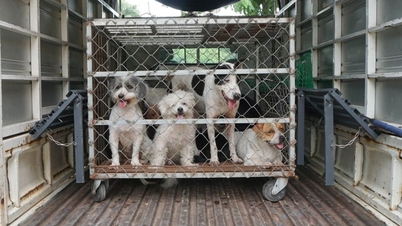
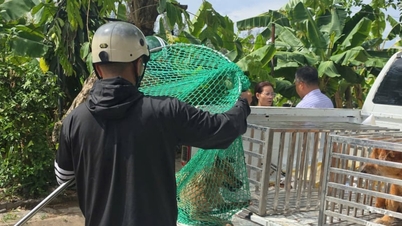
People's Committees of communes and wards in Ho Chi Minh City are strengthening teams to catch stray dogs in order to control rabies, improve urban aesthetics, and ensure traffic safety in the area. Photo: Le Binh .
In Tam Long ward, a representative from the Department of Economy , Infrastructure and Urban Development stated that after the administrative unit merger, organizing campaigns to catch stray dogs has encountered many difficulties, especially in the process of handling the dogs after they are captured.
According to statistics from the Ho Chi Minh City Department of Animal Husbandry and Veterinary Medicine, after the expansion of administrative boundaries, the total number of dogs and cats exceeded 310,000. This poses a significant challenge to animal management and rabies prevention and control. To strengthen the management of dogs and cats, the Ho Chi Minh City People's Committee has issued a decision on the Rabies Prevention and Control Program in Ho Chi Minh City for the period 2026-2030.
Accordingly, during the period 2026-2030, Ho Chi Minh City aims to annually manage over 90% of households raising dogs and cats, and vaccinate over 90% of the total dog and cat population against rabies. Simultaneously, the city strives for 100% of commune, ward, and special zone People's Committees to monitor dogs and cats infected or suspected of being infected with rabies. 100% of communes, wards, and special zones will have at least one rabies vaccination and antiserum injection point for humans. Ho Chi Minh City also aims to have no human deaths from rabies in the city by 2030.

Managing dogs, cats, and rabies in Ho Chi Minh City depends primarily on the awareness of pet owners. Photo: Le Binh .
According to Mr. Tran Phu Cuong, Head of the Department of Animal Husbandry and Veterinary Medicine of Ho Chi Minh City, the city is providing 100% of the funding for vaccines and vaccination services for dogs and cats in 54 communes and wards. The veterinary sector is also implementing software to manage the dog and cat population and will collect approximately 3,500 serum samples annually to assess the effectiveness of immunity after vaccination.
"However, managing dogs and cats remains a major challenge due to the dispersed nature of the animal population, the transportation of animals without quarantine declarations, low vaccination awareness in some areas, and inconsistent communication efforts... In reality, solving the problem of stray dogs cannot rely solely on short-term campaigns," Mr. Cuong said.
The key remains the self-awareness of the people. If each household raising animals simply follows regulations such as not letting them roam freely, muzzling them when going out, ensuring full vaccination, and registering their pets as required, the risk of accidents and rabies will be significantly reduced.
According to the Ho Chi Minh City Center for Disease Control, the city records tens of thousands of dog bite cases each year, mostly involving pets that are not properly managed. Between 2022 and 2025, the number of rabies exposures from bites by stray dogs and cats increased rapidly, especially in the former Ba Ria - Vung Tau area. This area has recorded 6 deaths due to rabies. Currently, there is no specific treatment for rabies, so once the disease develops, the mortality rate is almost 100%.
Source: https://nongnghiepmoitruong.vn/rui-ro-benh-dai-tai-nan-rinh-rap-tu-cho-tha-rong-d789360.html







![[Photo] General Secretary and President To Lam presides over a meeting on preparations for the review of one year of operation of the three-tiered government system.](https://vphoto.vietnam.vn/thumb/1200x675/vietnam/resource/IMAGE/2026/06/02/1780391821195_a1-bnd-4595-9717-jpg.webp)







![Transforming from Resolution 57: [Part 2] Businesses Lead the Way](https://vphoto.vietnam.vn/thumb/402x226/vietnam/resource/IMAGE/2026/06/02/1780399668663_5332-dsc09931-2-235637_295-235639.jpeg)





![The Essence of Viet Bac Villages: [Part 3] The Precious Fragrance of Nghinh Tuong](https://vphoto.vietnam.vn/thumb/402x226/vietnam/resource/IMAGE/2026/05/29/1780020600366_5237-tinh-tuy-ban-lang-viet-bac-bai-3-chuyen-o-nghinh-tuong-050626_700.jpeg)
![The Quintessence of Northern Vietnam's Villages: [Part 2] The Famous Cassava Noodles of Kunming](https://vphoto.vietnam.vn/thumb/402x226/vietnam/resource/IMAGE/2026/05/28/1779937455892_3929-3144-mien-dong-15-nongnghiep-023138.jpeg)
![The Essence of the Village: [Part 1] Wine on the mountain, tea in the clouds - Bang Phuc](https://vphoto.vietnam.vn/thumb/402x226/vietnam/resource/IMAGE/2026/05/27/1779841729178_3821-1jpg-nongnghiep-103814.jpeg)

































































Comment (0)