

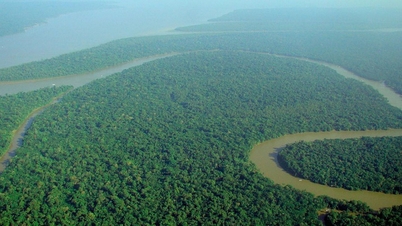
Intense storms and drier air are accelerating the natural biomass conversion process in the Amazon rainforest, raising concerns about the long-term carbon sequestration capacity of this "green lung" of the Earth.
This is the result of research conducted by the South China Botanical Garden (SCBG) of the Chinese Academy of Sciences in collaboration with Cornell University (USA) and other international partners, and published in the journal Nature Climate Change.
Tropical rainforests like the Amazon contain more than 60% of the world 's plant biomass and play a crucial role in regulating the global climate.
However, their role in carbon storage depends on how long the carbon is retained within trees and vegetation before being released back into the atmosphere. Scientists call this the carbon retention time.
Research shows that carbon retention time is decreasing across the Amazon. This is due to climate change, with increasingly extreme weather, drier air, and more intense storms causing ancient trees to die more quickly.
Even though new trees grow to replace them, the faster "die-regrowth" cycle means that carbon is released back into the atmosphere sooner, significantly reducing the forest's long-term carbon sequestration capacity.
Previous studies on carbon sinks in tropical regions have focused primarily on plant growth and productivity, paying less attention to biomass transformation.
Most of these studies also rely on data from small forests, so they cannot fully simulate large-scale models of biomass transformation.
To address this problem, the research team combined satellite imagery with long-term data from forests across the Amazon. This allowed them to map the tree "die-and-regrow" process and biomass transformation across the entire region.
Then, using machine learning, the scientists assessed how different environmental factors affect the carbon conversion time of forests.
The results show that carbon transition times vary across the Amazon and are influenced by environmental change in strongly nonlinear ways. Severe storms have an even more pronounced impact than droughts.
Researchers predict that by the end of this century, the carbon conversion time in Amazonian forests will decrease by an average of about 3% if global emissions remain low.
In a scenario of high global emissions, carbon sequestration time could decrease by up to 15%. These findings could help scientists better understand what helps maintain the stability of carbon sinks in rainforests.
They also provide an important basis for improving Earth system models, which are used to determine future climate change trends.
Source: https://www.vietnamplus.vn/rung-amazon-doi-mat-nguy-co-suy-giam-thoi-gian-luu-giu-carbon-post1112497.vnp





![[Image] Hanoi's urban life under the challenge of a "scorching hot" environment](https://vphoto.vietnam.vn/thumb/1200x675/vietnam/resource/IMAGE/2026/05/25/1779706979265_nang-nong-t5-2026-minh-duy-7-4636-jpg.webp)






























































































Comment (0)